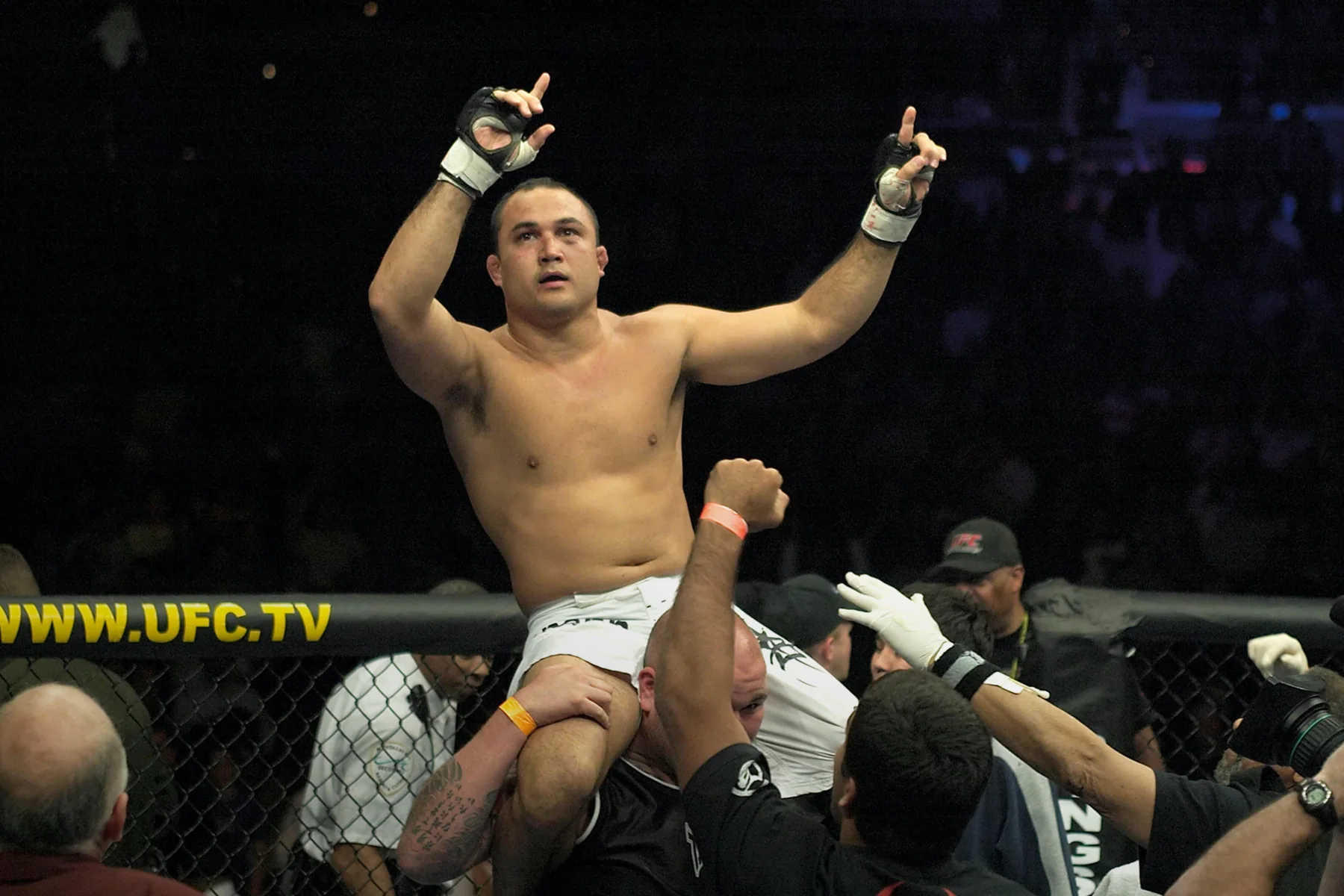
Georges St-Pierre is No. 1 in our editorial ranking of the 30 greatest UFC fighters of all time. His two-division championship résumé, 13 UFC title-fight wins, avenged defeats and sustained control of an elite welterweight era give him the most complete case under the method below.
This is not an official UFC list or a live pound-for-pound ranking. It evaluates UFC careers through August 19, 2026, using championship achievement, opponent quality, longevity, era-adjusted skill and historical influence. Results outside UFC provide context but do not receive equal credit. The order includes tournament pioneers, every men's weight-class tradition, and champions from all three UFC women's divisions. Short, brilliant peaks can make the list, but they do not automatically outrank years of title-level work. Officially overturned results and title disruptions also remain part of the résumé record. Reasonable fight fans will move names; the value of this list is that its rules and tradeoffs are visible before the countdown begins.
How did we rank the 30 greatest UFC fighters?
This is a weighted editorial rubric, not a claim that greatness can be solved by one statistic. UFC's own 2016 greatest-fighter project named championship reigns, record, opponent caliber, era, innovation and historical relevance as useful factors. We adapted that vocabulary, published the weights before writing the countdown and limited scored achievement to UFC competition.
UFC title-fight success and peak divisional dominance.
Quality of champions, contenders and stylistic tests defeated.
Longevity, repeat elite work and consistency through change.
Technical standard and achievement adjusted for the fighter's era.
Historical influence on UFC competition, divisions or participation.
Four guardrails matter. First, this is a UFC-career list. A PRIDE, WEC, Strikeforce or ONE accomplishment can explain who a fighter was, but it does not silently become a UFC title defense. Second, era adjustment is contextual, not a fantasy matchup. Royce Gracie is judged against the demands and knowledge of tournament-era UFC; a modern champion is judged in a deeper, specialized weight class. We do not pretend either could be teleported unchanged into the other's rule set.
Third, peak and duration both count. A short two-division surge can outrank a long non-title career, but repeated wins in title fights usually beat a burst built on two or three landmark nights. An unbeaten record is not a separate bonus; the level and stakes of the bouts decide its value. Popularity matters only when it materially changed UFC's competitive history, never as a substitute for wins.
Finally, the official record stays visible. If a result was overturned, a title was stripped or a reign was interrupted by an anti-doping finding, the affected achievement carries less résumé certainty. That is not a character score, and unrelated wins remain. Ties go first to the stronger UFC title-and-opponent résumé, then elite longevity, then era-adjusted influence. These rules explain why a defensible list can put GSP first, keep Jon Jones near the top and still reserve meaningful places for pioneers and women's champions.
Nos. 30-25: pioneers and explosive peaks
The opening band combines two routes into history: fighters who changed what UFC competition could be, and modern champions whose peaks reached two divisions before they built long reigns. Influence gets them through the door; limited UFC volume keeps them below the sustained champions ahead.
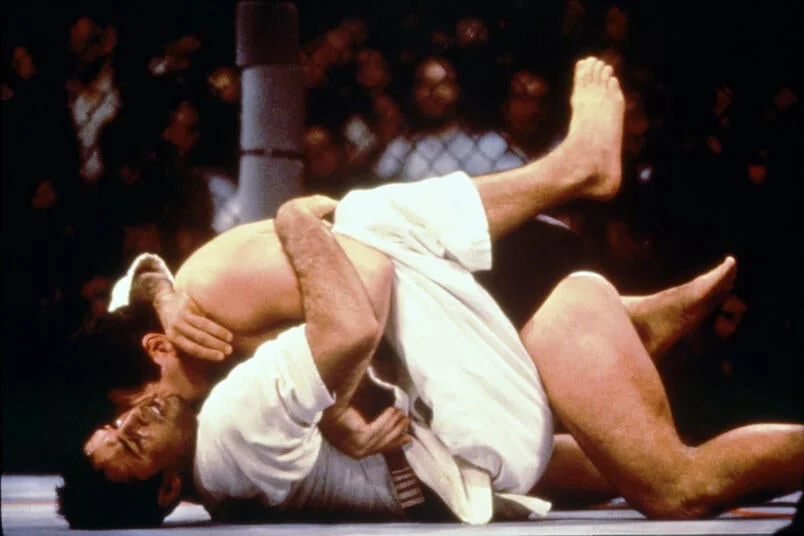
30. Frank Shamrock — an early complete champion
Shamrock won the first title in today's light heavyweight lineage, when it was called the middleweight belt, then defended it four times. His 1999 stoppage of Tito Ortiz displayed conditioning and an integrated game that looked ahead of its era. A perfect five-fight UFC title run is powerful evidence; only five UFC appearances keep it from carrying more longevity weight.
29. Henry Cejudo — champion at flyweight and bantamweight
Cejudo edged Demetrious Johnson for flyweight gold, defended against T.J. Dillashaw, stopped Marlon Moraes for the vacant bantamweight title and defended it against Dominick Cruz. That is a rare two-class championship sequence. Retirement interrupted the run, and four losses after his return weakened the consistency side of his case without undoing the peak.
28. Conor McGregor — the first simultaneous two-division UFC champion
McGregor knocked out José Aldo for featherweight gold and stopped Eddie Alvarez at UFC 205 to become UFC's first simultaneous two-division champion. Those are two of the promotion's defining title performances. His competitive influence is enormous, but fame is not a defense: he recorded no successful UFC title defense, so the scored championship sample remains brief.
27. Ilia Topuria — a two-division peak still being written
Topuria stopped Alexander Volkanovski, Max Holloway and Charles Oliveira in successive championship landmarks, winning featherweight and lightweight belts. The cutoff also includes his first professional loss: Justin Gaethje took the lightweight title by fourth-round corner stoppage on June 14, 2026. The peak is already historic, but one completed defense and a short UFC title sample make future credit off-limits.
26. Royce Gracie — the tournament pioneer
Gracie won UFC 1, UFC 2 and UFC 4, submitting specialists of very different sizes and showing a new audience why leverage and ground skill mattered. No fighter on this list has a stronger origin-story claim. The lower placement separates foundational influence from a long divisional championship résumé in the deeper, regulated sport that his success helped create.
25. Frankie Edgar — elite longevity across lighter divisions
Edgar took the lightweight title from B.J. Penn, beat him again and remained a serious contender through featherweight and bantamweight chapters. His Hall of Fame résumé includes victories over Penn, Urijah Faber, Cub Swanson, Sean Sherk and Charles Oliveira. Championship time, adaptability and opponent depth earn the place; unsuccessful later title bids limit the ceiling.
Nos. 24-19: division builders and crossover champions
This group turned new or unstable divisions into recognizable championship ladders. Their claims rest on repeat title stakes, not nostalgia: successful defenses are kept separate from winning a belt multiple times.
24. Tito Ortiz — the light heavyweight standard of his era
Ortiz beat Wanderlei Silva for the vacant 2000 title and defended it five times, setting the early 205-pound pace through his wrestling and ground-and-pound. Yuki Kondo, Evan Tanner, Elvis Sinosic, Vladimir Matyushenko and Ken Shamrock formed the defense run. Later losses to Randy Couture and Chuck Liddell keep him behind the champions who superseded him.
23. Joanna Jedrzejczyk — strawweight's first dominant ruler
Jędrzejczyk stopped Carla Esparza for the strawweight belt and made five successful defenses, including sharp five-round wins over Cláudia Gadelha, Karolina Kowalkiewicz and Jéssica Andrade. Her range control, volume and takedown defense set the division's first durable technical standard. Two losses to Rose Namajunas ended the reign, but not its depth.
22. Ronda Rousey — the champion who opened UFC's women's era
Rousey entered UFC as its first women's champion and finished all six successful defenses, most with her signature armbar. The competitive case therefore precedes the cultural one: she repeatedly delivered under title stakes, then made women's divisions impossible to treat as an experiment. Knockout losses to Holly Holm and Amanda Nunes exposed the limits of that concentrated prime.
21. B.J. Penn — two-division champion with a lightweight peak
Penn submitted Matt Hughes for the welterweight title, later ruled lightweight and made three defenses at 155 pounds. His prime combined elite jiu-jitsu, balance and boxing against opponents from Jens Pulver and Sean Sherk to Kenny Florian and Diego Sanchez. A severe late-career losing run lowers consistency, but it cannot erase a rare two-division championship peak.
20. Chuck Liddell — the knockout champion of UFC's breakout years
Liddell won the light heavyweight belt from Couture and defended it four times against Jeremy Horn, Couture, Renato Sobral and Ortiz. His takedown defense created space for a seven-fight UFC knockout streak, giving “sprawl and brawl” its defining champion. Crossover fame adds context, but the defense run and decisive rematch wins do the scoring work.
19. Randy Couture — reinvention across heavyweight and light heavyweight
Couture became the first fighter to win UFC titles in two weight classes and occupied five separate championship stints, beginning with the UFC 13 tournament and heavyweight gold in his fourth pro fight. His clinch wrestling and planning traveled across size and age. Repeatedly regaining belts demonstrates adaptation, although it is not the same as a long uninterrupted defense streak.
Nos. 18-13: long reigns and divisional standards
The next six established a repeatable standard in a mature division. Their cases combine championship volume with skills that survived changing opposition. We keep WEC belts, the BMF title and UFC divisional championships in their proper lanes, because a clean count is more useful than a larger one.
18. Matt Hughes — the welterweight benchmark before GSP
Hughes won the UFC welterweight title twice and made seven successful defenses across those reigns. He paired explosive takedowns with punishing top control, beating champions such as Georges St-Pierre and B.J. Penn while also defeating Carlos Newton, Frank Trigg and Sean Sherk. The landmark Royce Gracie win was non-title. Later losses showed the sport moving forward, but his championship volume set the 170-pound baseline.
17. Dominick Cruz — bantamweight's movement innovator
Cruz's shifting footwork, angles and reactive wrestling redefined bantamweight. He defended UFC gold against Urijah Faber and Demetrious Johnson, lost years to injuries, then took the belt from T.J. Dillashaw in a remarkable 2016 return and beat Faber again. His record also contains two WEC defenses; we do not relabel those as UFC defenses. Lost prime time lowers his longevity score, not his technical importance.
16. Valentina Shevchenko — sustained flyweight control
Shevchenko won the vacant flyweight title from Joanna Jędrzejczyk in 2018 and defended it seven times through precise counter striking, clinch control and timely takedowns. Alexa Grasso submitted her, fought her to a draw and forced a genuine adjustment cycle; Shevchenko then regained the belt in 2024 and added 2025 defenses over Manon Fiorot and Zhang Weili. That second act strengthens an already deep reign.
15. Charles Oliveira — lightweight finishing excellence
Oliveira's current UFC ledger contains a promotion-record 21 finishes and 17 submissions, proof of dangerous longevity rather than one hot streak. He won lightweight gold against Michael Chandler and officially defended it against Dustin Poirier. Because he missed championship weight before beating Justin Gaethje, that victory is not counted as a title defense. One official divisional defense limits the reign score; elite finishes across generations lift everything else.
14. Max Holloway — volume, durability and featherweight depth
Holloway stopped José Aldo twice and defended the undisputed featherweight title against Aldo, Brian Ortega and Frankie Edgar. His volume boxing then remained relevant against later contenders, and his 2025 win over Dustin Poirier made him the first fighter to defend the separate BMF title. Charles Oliveira took that belt in March 2026 before Holloway stopped Conor McGregor in July. Three losses to Alexander Volkanovski cap an otherwise exceptional divisional case.
13. Kamaru Usman — a concentrated welterweight title run
Usman took the welterweight belt from Tyron Woodley and defended it five times: twice each against Colby Covington and Jorge Masvidal, plus Gilbert Burns. His pressure wrestling evolved into damaging title-fight striking, especially in the Burns and Masvidal rematches. Repeat opponents slightly narrow the résumé, while Leon Edwards ended the reign dramatically. A July 2026 middleweight decision loss to Dricus Du Plessis is current context, not a rewrite of that 170-pound dominance.
Nos. 12-7: modern pound-for-pound pillars
Every fighter here built a serious top-six argument. The separation comes from championship duration, the breadth of elite wins and how a résumé held up against its closest rival. For the completed fights that shape today's divisional debates, use the live UFC results hub; this countdown is a historical editorial judgment through August 19, 2026.
12. Israel Adesanya — a defining middleweight champion
Adesanya unified the middleweight belt against Robert Whittaker and made five official defenses, using feints, distance traps and sharp counters to pull challengers into losing exchanges. His knockout of Alex Pereira to regain the belt answered a defining rival, even though Sean Strickland ended the second reign immediately. Stoppage losses to Nassourdine Imavov and Joe Pyfer by March 2026 deepen the late decline, but five defenses still anchor the placement.
11. Alexander Volkanovski — featherweight excellence against elite rivals
Volkanovski made five defenses during his first featherweight reign, beating Holloway twice as champion and solving the different threats of Brian Ortega, Chan Sung Jung and Yair Rodriguez. Ilia Topuria ended that reign, but Volkanovski returned to win vacant gold from Diego Lopes in 2025 and beat Lopes again in January 2026. That tactical adaptability is elite; two failed lightweight title bids stop ambition from becoming two-division credit.
10. Khabib Nurmagomedov — unmatched control in a shorter title reign
Nurmagomedov retired 29-0 overall and 13-0 in UFC after defending lightweight gold against Conor McGregor, Dustin Poirier and Justin Gaethje. His cage pressure, mat returns and wrist control denied elite finishers the time and space to establish offense. Few champions looked more inevitable. Three defenses, however, remain three defenses; an unbeaten retirement does not supply the additional title volume accumulated by the fighters above him.
9. Daniel Cormier — championship success in two weight classes
Cormier defended the light heavyweight belt three times, knocked out Stipe Miocic for heavyweight gold and submitted Derrick Lewis in a heavyweight defense. That made him the first UFC fighter to successfully defend championships in two weight classes. His chain wrestling and clinch boxing worked against larger men as well as 205-pound contenders. The UFC 214 Jones result was overturned to a no contest, but Jones's earlier win and Cormier's two later Miocic losses remain important limits.
8. Stipe Miocic — the strongest UFC heavyweight title résumé
Miocic's four total heavyweight defenses include the division-record run of three consecutive defenses, and UFC credits him with six heavyweight title-fight wins. He won gold from Fabricio Werdum, defended against Alistair Overeem, Junior Dos Santos and Francis Ngannou, then regained the belt from Cormier and won their trilogy. Compact boxing, footwork and wrestling created unusual heavyweight repeatability. The overall title volume is lower than the lighter champions ahead.
7. Jose Aldo — featherweight greatness across the WEC-UFC transition
Aldo defended the WEC belt twice, entered UFC as its inaugural featherweight champion and then made seven UFC defenses. The counts stay separate, but the continuity matters: his takedown defense, low kicks, body work and counters ruled 145 pounds across a merger and several challenger styles. An 18-fight winning streak ended in 13 seconds against McGregor, and Holloway later beat him twice. Neither ending deletes one of MMA's longest elite divisional runs.
Nos. 6-1: the UFC GOAT tier
The final six own the strongest combinations of title stakes, elite opposition and repeatable dominance in UFC history. Their positions are close enough that one different weighting could change the order. Under our frozen method, however, No. 1 must combine longevity and championship depth with adaptation—not simply an unbeaten record, a highlight reel or a second belt.
6. Amanda Nunes — the greatest women's UFC résumé
Nunes became the first woman to hold UFC titles in two divisions and the first simultaneous double champion to defend both belts. Her 11 women's title-fight wins include Miesha Tate, Ronda Rousey, Valentina Shevchenko, Cris Cyborg, Holly Holm, Germaine de Randamie and Julianna Peña. That is an extraordinary sweep of champions and styles. The five above narrowly offer longer defense records or more total championship volume across the full UFC field.
5. Islam Makhachev — record-setting modern consistency across divisions
Makhachev surpassed Khabib with four lightweight defenses, including two wins over Alexander Volkanovski, then vacated and beat Jack Della Maddalena for the welterweight title. Four days before this cutoff, he reportedly retained against Ian Machado Garry by unanimous decision at UFC 330, extending his UFC streak to a record 17. UFC's own event and athlete pages were still stale when checked, so that result uses post-event reporting rather than a silently updated official ledger. No future defense receives credit.
4. Demetrious Johnson — eleven straight flyweight title defenses
Johnson became UFC's first flyweight champion and made 11 consecutive defenses, blending striking, level changes, clinch work and submissions without giving challengers a single preferred phase. His suplex-to-armbar finish of Ray Borg captured that fluency in one sequence. Henry Cejudo ended the reign by split decision. Johnson's later ONE Championship accomplishments enrich the career story, but they are not scored here; the UFC defense record alone places him in this tier.
3. Anderson Silva — the middleweight reign that changed expectations
Silva held the middleweight belt for 2,457 days, defended it 10 times and won 16 consecutive UFC bouts. He could counter at long range, finish from the clinch and survive a near-complete loss to submit Chael Sonnen late. Non-title light heavyweight wins add stylistic context, not extra defenses. Chris Weidman ended the reign, and Silva's late run included many losses plus the Nick Diaz no contest. The prime nevertheless remains one of UFC's longest and most destructive.
2. Jon Jones — unmatched light heavyweight wins with résumé complications
Jones became UFC's youngest champion and owns 15 title-fight wins, with victories over a remarkable line of former champions. His reach, wrestling, clinch offense and opponent-specific adjustments later carried him to heavyweight gold and a defense over Stipe Miocic. The record cannot be cleaned for convenience: the UFC 214 Cormier result is a no contest after a failed drug test, and strips or vacancies interrupted his reigns. Those official disruptions break the continuity tie with GSP.
1. Georges St-Pierre — the most complete UFC career case
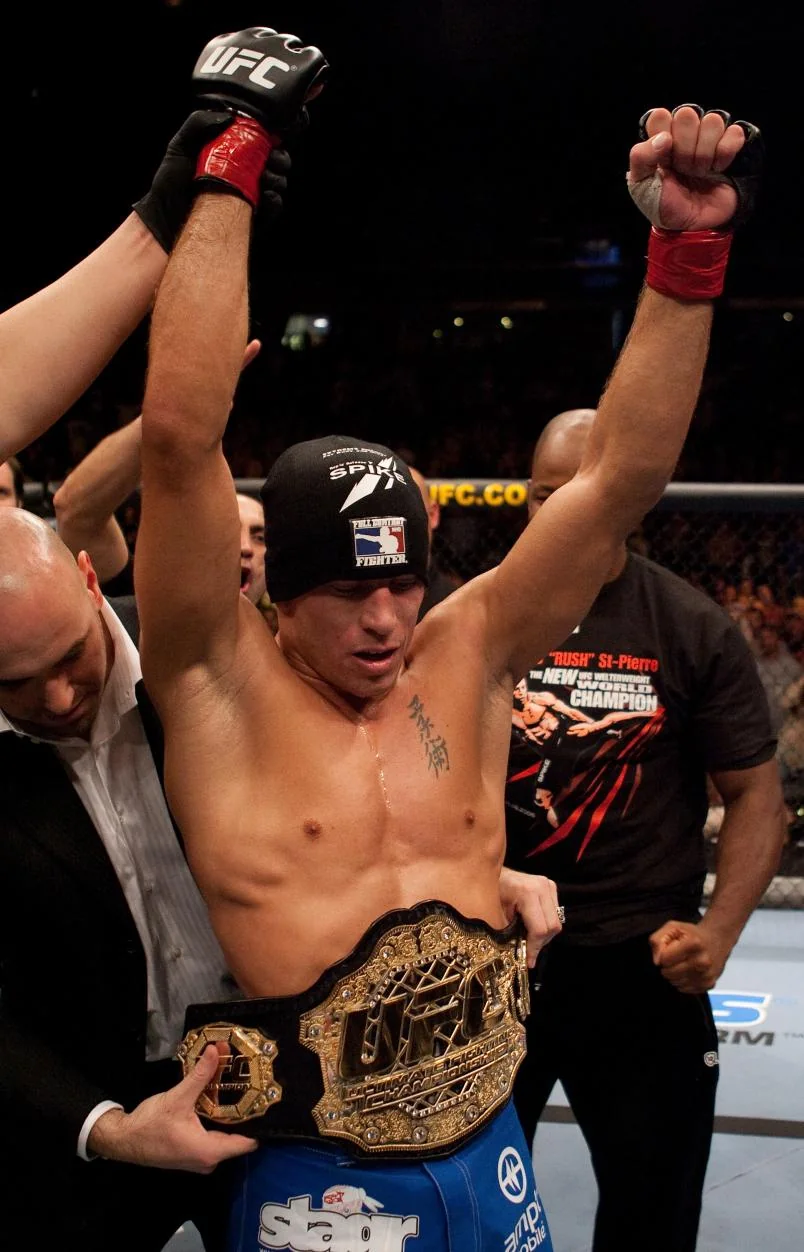
St-Pierre made nine consecutive welterweight defenses, avenged both career losses and beat champions across distinct generations. His jab and reactive takedowns made opponents defend two phases at once; his game plans changed when rematches demanded it. After nearly four years away, he submitted Michael Bisping for the middleweight title. He did not defend that second belt, so we do not inflate the achievement. The balance—title volume, opponent quality, clean avenged defeats, adaptability and a verified second-division win—puts GSP first.
For forward-looking event information rather than historical judgment, compare the upcoming UFC events with the site's latest UFC results. The countdown freezes every résumé at August 19, 2026.
Which great UFC fighters just missed the top 30?
Alex Pereira was the hardest omission. He won UFC titles at middleweight and light heavyweight, defended the 205-pound belt three times, regained it after a loss and then failed in a 2026 bid for interim heavyweight gold. If peak achievement and rapid two-division success carried more than our combined 50% for championship résumé and opponent quality, he would enter the list. The frozen longevity weight kept his comparatively short UFC sample outside.
Aljamain Sterling also has a strong numerical argument. UFC credits him with a bantamweight-record three consecutive defenses, including the Petr Yan rematch that answered questions created by the disqualification title win. Benson Henderson likewise defended lightweight gold three times. Both were squeezed by a field in which longer reigns were paired with broader historical or technical influence, but either belongs in a serious top-35 conversation.
Robbie Lawler and Cain Velasquez represent the peak-versus-duration problem from different directions. Lawler defended the welterweight belt against Rory MacDonald and Carlos Condit in two defining five-round fights, yet his full UFC win-loss consistency trails the selected champions. Velasquez's pace, wrestling and heavyweight pressure looked nearly unsolvable at his best; injuries restricted his second reign to two successful defenses. A peak-heavy method would move him up quickly.
Other fair objections include Rose Namajunas, Zhang Weili, Petr Yan, Dustin Poirier, Tony Ferguson, Junior Dos Santos, Fabricio Werdum and Dan Henderson. Henderson illustrates the scope rule especially well: an outstanding total-MMA career built partly in PRIDE and Strikeforce cannot import those belts into a UFC-only score. The same limit applies to great careers completed substantially in ONE, WEC or other promotions.
To build your own list honestly, change the weights before moving the names. Raise peak dominance and Pereira or Velasquez climbs. Raise pure defense volume and Sterling or Henderson gains ground. Expand the scope from UFC careers to all MMA and several omissions become top-30 candidates. Then apply that revised rule to every fighter, not only a favorite.
Current careers can change quickly. Check the upcoming UFC schedule before awarding an active fighter a future opportunity, and use official completed results before adding any win. This list awards only what had happened by the cutoff.
Fight talk
Comments