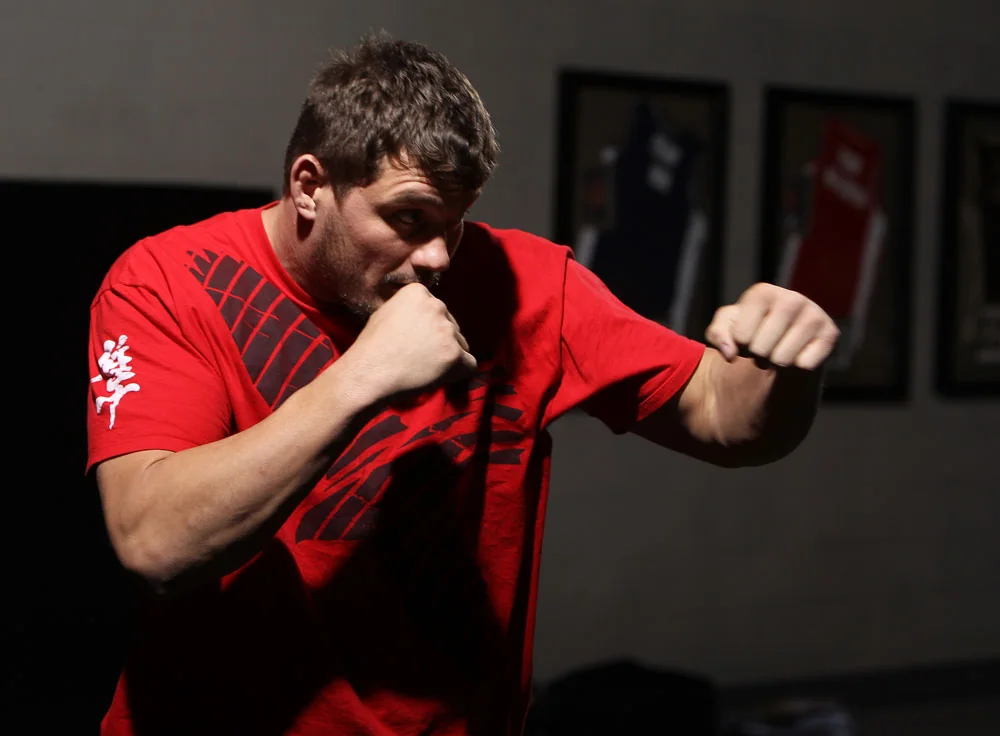
Matt Mitrione’s Purdue background was a substantial football career before it became a line in a fight introduction. The former defensive lineman played under Joe Tiller, shared a team with Drew Brees and later built a 9–5 UFC record. For fight fans, the interesting question is what carried over: explosive movement, experience with contact and comfort under pressure helped him start. They did not remove the need to learn striking defense, submission awareness and the demands of competing alone.
Purdue gave Mitrione a demanding athletic foundation
Mitrione played defensive line for Purdue from 1998 through 2001. UFC’s retrospective on its former football players credits him with 35 consecutive starts. That is a different background from briefly trying another sport: he had already spent years preparing for opponents, repeating technical movements and performing while tired before he entered professional MMA. The relevance is sustained high-level training, not the assumption that a large football player must be a natural fighter.
The team connection is concrete. Purdue’s 2021 reunion announcement names Mitrione among the defensive linemen on the 2000 team that earned the 2001 Rose Bowl berth. Joe Tiller’s team shared the Big Ten championship, with Brees at quarterback. Reaching that game is the claim here; it should not be casually rewritten as winning the Rose Bowl. Brees identifies the era and the quality of that program, rather than serving as evidence of Mitrione’s later fighting ability.
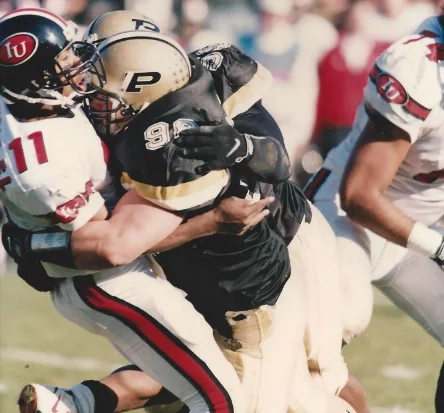
His position also makes the comparison more useful than a general claim about toughness. A defensive lineman must coordinate his first movement with his hands and feet while another athlete tries to disrupt him. Balance matters because force is useful only when the athlete can direct it. Those are reasons to investigate a possible transfer of skills. They are not a technical breakdown of a specific football play or proof that one sport teaches the complete mechanics of the other.
There was a psychological connection, too. In a 2010 UFC interview, Mitrione described experience with hostile college crowds as useful preparation, while emphasizing the difference between arriving with a football team and being the individual focus in the cage. That distinction deserves to survive the highlight reel. Familiarity with noise can help; teammates cannot take the next exchange for you.
Read the Purdue years as a foundation with clear limits. They help explain why a relatively inexperienced mixed martial artist could bring physical confidence and competitive habits into the gym. They do not tell us how he would respond to a submission threat, manage distance against a veteran striker or recover after making a tactical error. Those questions had to be answered in MMA, against actual opponents.
The Ultimate Fighter was a new apprenticeship
Mitrione’s route into UFC ran through The Ultimate Fighter: Heavyweights in 2009. He competed on Rashad Evans’ team and was eliminated by James McSweeney in the quarterfinals. Appearing on the show and winning its season are different achievements. For a former football player, the opportunity was an unusually public apprenticeship: he was learning a new competitive environment while television viewers were already forming opinions about him.
His professional MMA debut came at the live finale on December 5, 2009, against Marcus Jones, another former NFL player. Mitrione won by knockout 10 seconds into the second round. The round is essential. Calling it a ten-second debut erases the first five minutes, which contained much of the evidence that he could deal with difficulties rather than simply hit hard.
The contemporary UFC report describes Jones taking him down early, applying pressure against the fence and threatening a guillotine. Mitrione escaped trouble and began finding punching range late in the first round. At the next round’s opening, his right hands ended the fight. This was a recovery within a bout, followed by a sudden finish, not an uninterrupted demonstration of dominance.
The matchup is revealing because both men arrived with a football background but wanted different kinds of exchanges. Jones sought grappling positions; Mitrione was more dangerous when he could strike standing. Their shared previous profession did not give them the same game. A fight fan assessing a crossover athlete should ask how that fighter creates his preferred exchanges and what happens when an opponent refuses them.
Keep the competition’s record categories separate as well. Mitrione’s televised tournament appearances belong to the show’s history; the finale victory began his professional record at 1–0. Mixing the exhibition bracket with his professional UFC results produces a misleading total. The distinction also explains how a fighter can lose on a season of the show and still make a successful debut on its concluding event.
The useful lesson is narrower than a claim that football made him ready for everything. He had enough power and composure to capitalize on a standing opening, and enough resilience to get through a difficult opening round. That established a starting point. It did not settle how he would fare against more experienced heavyweights, stronger defensive wrestling or opponents who could punish the gaps between his attacks. Those tests came later.
Hand fighting and footwork transferred, but the rules changed
Mitrione identified the useful carryover himself. In his 2016 USA Football interview, he pointed to footwork, hand fighting and the ability to reset mentally after a good or bad play. Treat that as an athlete’s account of his experience. It explains what he felt he brought into MMA; it does not establish that every defensive lineman will develop the same strengths.
Footwork is the most visible connection, but it is also easy to oversimplify. Staying balanced while changing direction can help a heavyweight reach an opening or leave an exchange. In the cage, however, that movement must account for punches, kicks and takedown attempts. Moving forcefully toward an opponent is not enough if it leaves the fighter exposed as he enters or unable to recover his stance afterward.
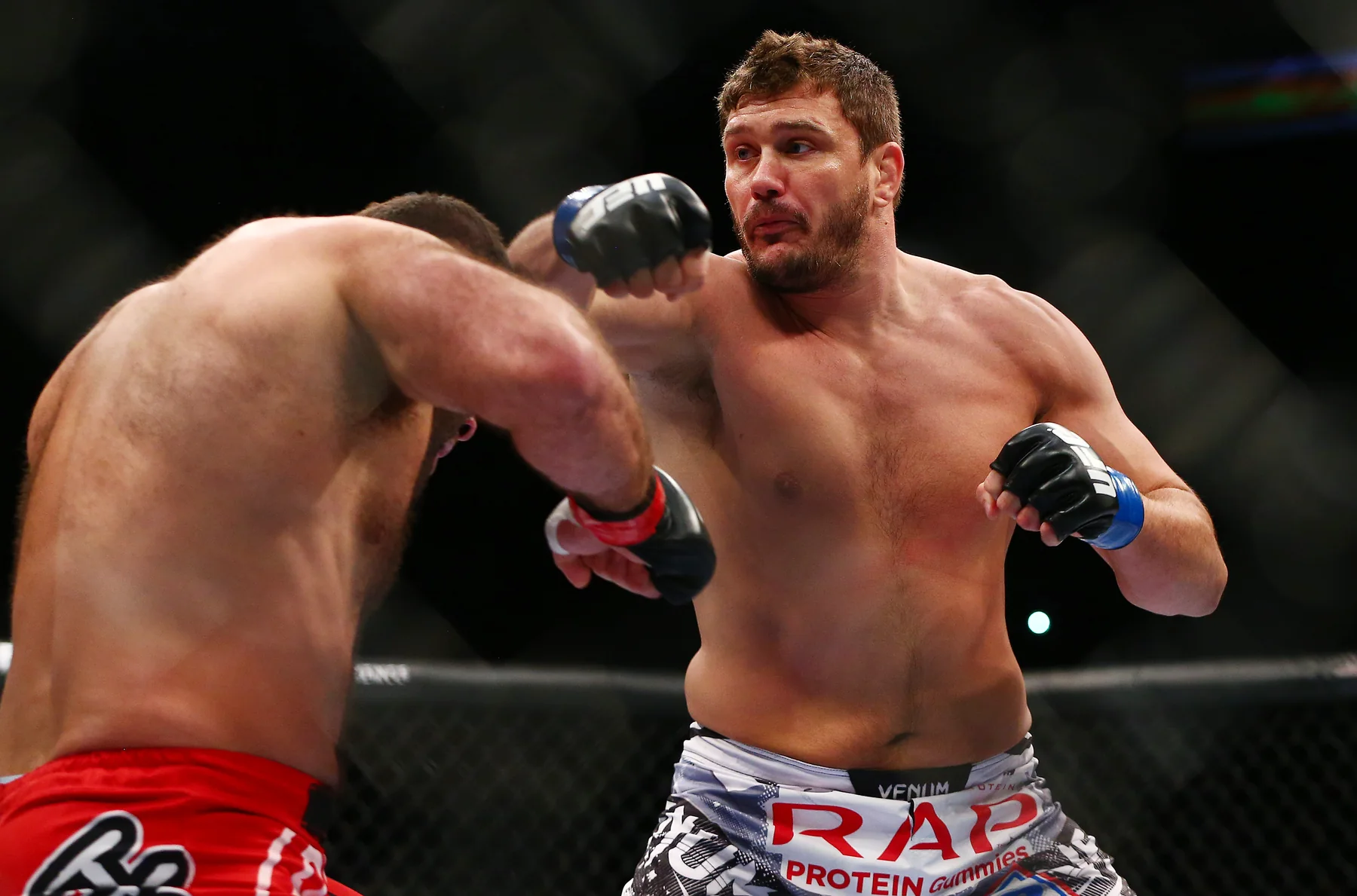
The same distinction applies to using the hands. Familiarity with fighting for position can be valuable, yet a football collision and an MMA clinch have different consequences. A fighter must protect his neck, manage hip position and anticipate what happens if the exchange reaches the ground. The action does not end merely because someone has been brought down. A powerful entry can create danger for the athlete attempting it as well as for his opponent.
Mitrione’s later training choices show why the second half of that comparison matters. In a June 2015 UFC interview, he described building a group of large wrestling and grappling partners after his loss to Brendan Schaub. The group became known as Team Two Ton. He credited work against the fence, on the ground and in takedown defense with making him more comfortable committing to his striking.
That is a plausible connection between defense and offense: if a fighter is less concerned about being held down, he may move and attack more freely. The evidence here is Mitrione’s explanation of his own development, not a controlled measurement of why he won. A winning streak cannot isolate the contribution of one training change from opponent style, preparation and decisions made during each bout.
For viewers, the practical question is whether the athlete can connect his strengths. Watch the position after a punch, not just the punch itself. Does he remain balanced? Can he defend the next phase? Can he recover when the opponent forces a different kind of fight? Those questions give football experience its proper place: a useful starting resource that becomes meaningful through MMA-specific work.
The wins and losses explain more than the football label
The strongest evidence for Mitrione’s development is his actual opposition. In 2014 he stopped Shawn Jordan, Derrick Lewis and Gabriel Gonzaga in the first round. Those were UFC heavyweight wins, not demonstrations arranged to showcase a former football player. They establish that he could turn his tools into results while leaving room to examine how each matchup unfolded.
Against Gonzaga in Phoenix on December 13, 2014, Mitrione finished the fight by TKO at 1:59 of round one. The contemporaneous report describes Gonzaga advancing into punches, followed by Mitrione landing further strikes on the ground. The important transition is from a standing opening to a completed finish. Power mattered, but it had to arrive in a useful position against an opponent who had his own striking and grappling threats.
Do not read that result as evidence that grappling was no longer a problem. On June 6, 2015, Ben Rothwell submitted Mitrione at 1:54 of the first round in New Orleans. UFC’s event report describes Mitrione attempting a takedown, Rothwell defending it and then securing the choke. The exchange changed phases quickly, and the attempt to bring the fight down created the opening for the opponent.
That loss is especially useful beside Mitrione’s earlier explanation of his training. Feeling more comfortable defending wrestling can improve a fighter’s choices without making him immune to a veteran’s submission. Progress is not a permanent exemption from technical mistakes. Nor does one defeat prove that every improvement was imaginary. The more useful assessment is specific: which position did the fighter enter, what counter was available and could he recognize it in time?
Keep the record’s boundaries equally precise. UFC’s historical overview lists nine wins and five losses across 14 UFC bouts from 2009 to 2016. That is his record in the promotion, not a total for every professional MMA appearance. His later Bellator career belongs to the broader story but should not be silently added to a UFC-only figure. Likewise, a record quoted in an interview before a fight is a snapshot from that date, not necessarily the result after it.
When following today’s heavyweights, our UFC results pages help separate the winner, method, round and stoppage time for recent cards. Use those details before building an explanation around a fighter’s former sport. Mitrione’s career is interesting because the Purdue athlete became a recognizable heavyweight with both dangerous offense and opponents capable of exposing limitations. Reducing that career to either “football translates” or “football does not translate” loses the fights that make the answer worth reading.
Follow Purdue without confusing kickoff and fight-card time
If Mitrione’s story makes you curious about the Boilermakers, start with the team he actually represented. Watching Purdue gives the college connection a present-day context without pretending that today’s roster has a direct role in his fighting career. It also lets you understand the setting behind references to Ross-Ade Stadium, Big Ten opponents and the college crowds he remembered.
CollegeFootballSchedule.net is a related schedule tool from the same project as UFC Schedule. Its Purdue football schedule offers a focused starting point for dates, opponents, venues and available television information. Use the official Purdue schedule to confirm the latest kickoff and location before making a firm viewing or travel plan. This is a practical way into the football side of the story, not an independent ranking of competing products.
Keep three distinctions visible when comparing it with a fight night. First, the football tool labels its times Eastern; use the same time zone when you open our UFC schedule. Second, a football kickoff and a UFC Main Card start describe different things. The Main Card time starts a sequence of bouts; it is not a guaranteed walkout time for one particular fighter. Third, an unannounced time remains unannounced. A date on the calendar does not fill in a missing television window.
If both sports overlap, decide what you are willing to miss. A football game can run beyond an expected viewing window, while early finishes can change the pace of a fight card. Do not assume halftime will coincide with a particular bout or that the heavyweight you want will appear at a minute calculated from the listed start. Check the current card order and choose the sport you want to prioritize when the windows collide.
Finally, keep the history separate from the schedule. This article follows Mitrione’s Purdue background and his completed UFC run; it is not an announcement of a new Mitrione booking. His story gives fight fans a specific college program to explore and a better way to assess crossover athletes. The evidence remains the same in either sport: watch how preparation holds up against an opponent, and let the actual contest tell you more than the introduction.
Fight talk
Comments