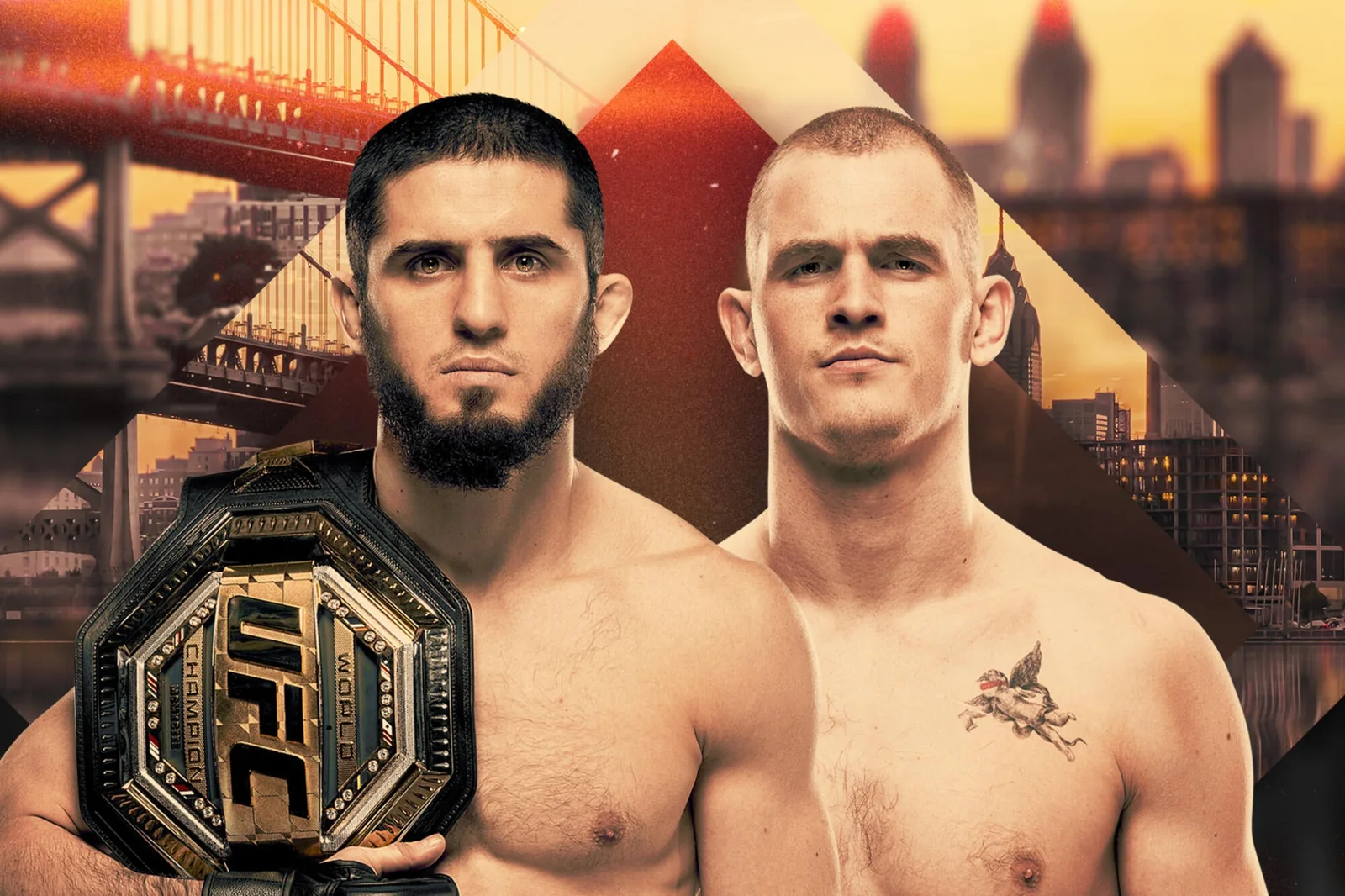
Islam Makhachev defeated Ian Machado Garry by unanimous decision at UFC 330, retaining the UFC welterweight title after five demanding rounds in Philadelphia. Judges Sal D'Amato and Mike Bell scored the main event 49-46, while Eric Colon returned a 48-47 card. The result was clear across all three scorecards, but the fight was not a routine shutout: Garry landed more significant strikes, Makhachev scored the only knockdown, and the champion repeatedly used takedowns to break the challenger's rhythm. That contrast is the key to understanding both the result and the argument it created among fight fans.
This UFC 330 recap starts with the verified results, then works through the main event round by round, explains what the judges were actually asked to score, and identifies the performances worth revisiting from the rest of the card. For the bout-by-bout listing, start with the complete UFC 330 event page.
UFC 330 results at a glance
- Main-event winner
- Islam Makhachev
- Official result
- Unanimous decision, 5 rounds
- Scorecards
- 49-46, 49-46, 48-47
- Title status
- Makhachev retained at welterweight
- Event
- August 15, 2026 · Xfinity Mobile Arena · Philadelphia, Pennsylvania
Neither championship changed hands. Mackenzie Dern retained the women's strawweight belt by unanimous decision over Gillian Robertson in the co-main event, with the same set of totals: 49-46, 49-46 and 48-47. Those two five-round decisions occupied the top of the card, but they do not tell the story of the full night. Eight of the 12 bouts ended inside the distance—four by KO or TKO and four by submission or technical submission—while only four reached the judges.
The main-event numbers explain why a simple winner-and-loser line feels incomplete. According to the official UFCStats fight record, Garry led 29-22 in significant strikes. Makhachev, however, produced the fight's lone knockdown, completed seven of 15 takedown attempts and accumulated 12:30 of control time. Those figures do not score the bout automatically, but they show where the champion created his clearest advantages and why the next step has to be a round-by-round reading rather than a comparison of final totals.
Fans looking for every recent winner, method, round and time can also use the site's continuously updated UFC results page. Here, the focus is narrower: how Makhachev secured the decision, where Garry made the champion uncomfortable, and which moments changed the meaning of the night.
How Makhachev built the lead in the first two rounds
Makhachev's early advantage came from making Garry defend in layers. The challenger first had to read the southpaw's kicks and level changes, then stop the entry, then separate from the clinch if the shot reached his hips. In Round 1, Makhachev needed five recorded attempts to complete one takedown, but the apparent inefficiency hides the real shape of the round. He held 3:38 of control, kept Garry working along the fence and led total strikes 23-10. Garry officially landed none of his two significant-strike attempts. It was not a damaging round; it was a round in which the challenger spent most of his meaningful time solving Makhachev's grips rather than building his own offense.
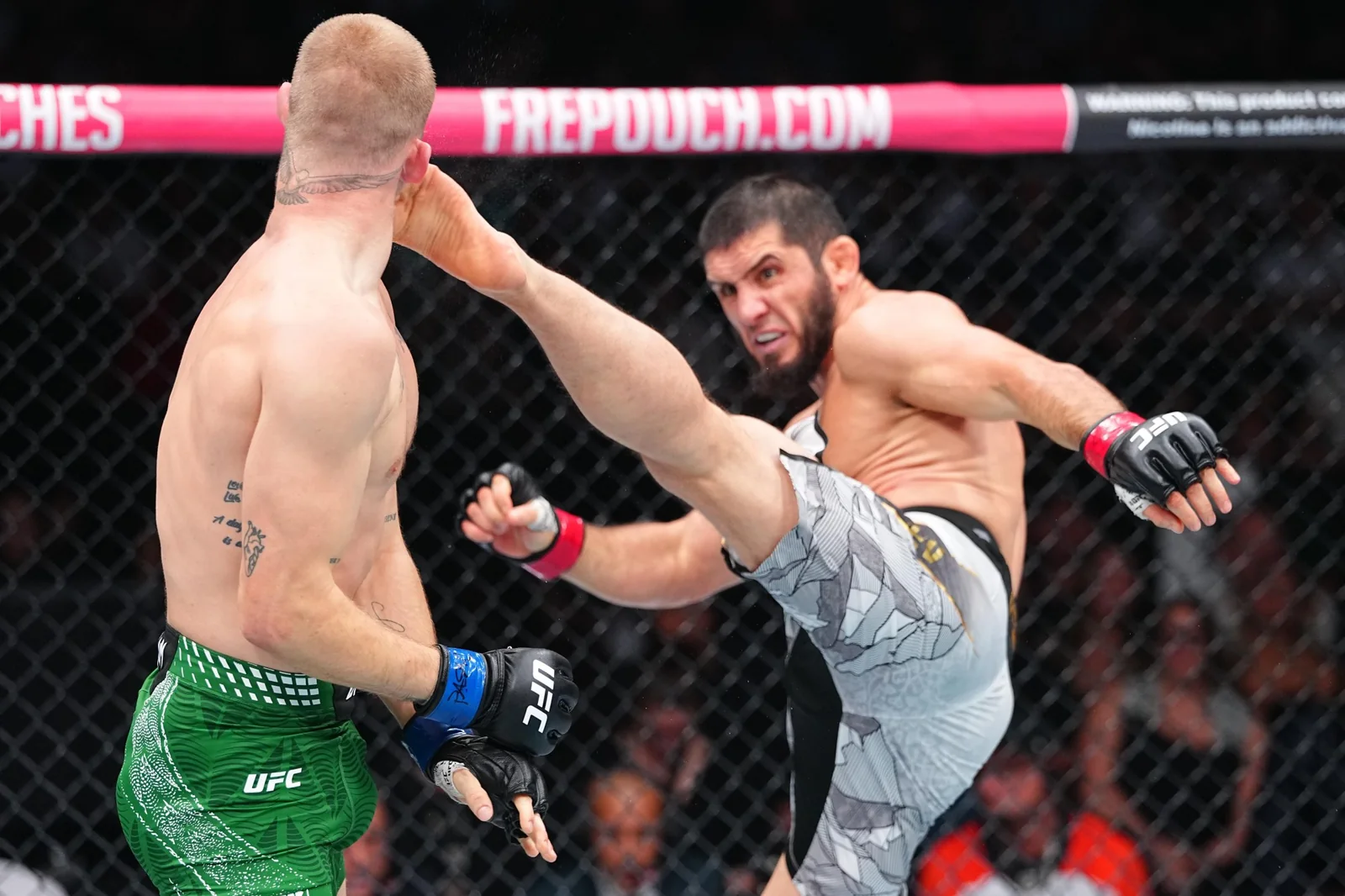
Round 2 supplied the damage that Round 1 lacked. Garry opened his kicking game and tried to occupy the long range, but after a clinch exchange and separation Makhachev connected with a punch and then drove a high kick into the challenger's head. UFCStats recorded the sequence as the only knockdown of the fight. Garry recovered quickly enough to stand, yet Makhachev closed the distance, threw him back to the canvas and took control again. The champion finished the round ahead 11-6 in significant strikes, 24-7 in total strikes, 1-for-1 on takedowns and 2:19 to 0:17 in control time.
The tactical point is more important than treating those numbers as a checklist. Garry could not react only to the shot because Makhachev had shown he could kick high from the same broad posture that supported his level changes and forward pressure. Once the kick landed, the follow-up grappling denied Garry the clean reset he needed to prove the knockdown was an isolated moment. MMA Fighting's live scorer had the champion up 20-18 after two, a sensible media reading rather than a disclosure of the judges' cards at that stage.
Just as important, Makhachev had not broken the challenger. Garry survived the most dangerous strike of the bout, repeatedly worked back toward his feet and began to see where space might open once the champion's initial attacks stalled. That resilience is why the first two rounds established a lead rather than ending the contest—and why the later rounds revealed more about both men than a routine title defense would have. The champion's wider career context is available on the Islam Makhachev fighter profile.
How Garry made the championship rounds competitive
Garry changed the fight by making the space after Makhachev's entries more valuable. From Round 3 onward, he landed more significant strikes in every round, returned to his feet more efficiently and stopped waiting for a completely safe moment to attack. The adjustment did not remove Makhachev's wrestling; it forced the champion to connect more phases together before he could settle the position.
Round 3 was the cleanest example. Makhachev completed one takedown, but Garry reversed the position, stood and denied him sustained control. UFCStats credited Makhachev with only 16 seconds of control in the round. At range, Garry landed a head kick, continued to use the oblique kick and led significant strikes 9-5. That was the first round in which the challenger consistently finished exchanges in places where he could score without immediately being attached to the fence.
Round 4 became the hinge of the official decision. Garry landed seven significant strikes to Makhachev's three and 41 total strikes to seven, much of his work coming through body attacks and short shots during the grappling exchanges. Makhachev answered with two takedowns and 3:05 of control, repeatedly forcing the challenger to stand, balance and separate before he could resume striking. A fan who prioritizes Garry's cleaner offense can see that round for the challenger; a judge who found Makhachev's effective grappling more consequential can reach the other result. The numbers expose the disagreement, but they do not resolve it without considering the scoring criteria.
The fifth followed a similar pattern before ending in a stronger position for the champion. Garry landed seven significant strikes while Makhachev officially landed none, including clean right hands early. Makhachev nevertheless completed both of his takedown attempts, worked to the back and controlled for 3:12. Total strikes finished 19-19 in the round as the champion added short offense while Garry hand-fought and protected his neck. Garry had moments at range; Makhachev owned the longest settled sequence and closed the fight there.
Late-round split
Across Rounds 3–5, Garry led significant strikes 23-8. Makhachev completed five takedowns and accumulated 6:33 of control. That is why “Garry made it close” and “Makhachev found a way to retain” can both be accurate readings of the performance.
Garry attempted no takedowns of his own, so his improvement was expressed through defense, reversals, balance and faster offense after the break. It was a credible showing against the champion, not a hidden victory created by adding the final strike totals together. His career path and previous five-round experience are summarized on the Ian Machado Garry fighter profile.
Why the judges still scored the fight for Makhachev
Makhachev could win unanimously despite losing the final significant-strike count because MMA is scored one round at a time, and effectiveness matters more than accumulating a larger event total. A 29-22 edge across 25 minutes does not tell us when Garry's strikes landed, how consequential they were, or what effective grappling occurred in the same rounds. It is entirely possible to land more over the full fight and still lose three or four individual frames.
The scoring order that matters
- 1.Effective striking: legal offense judged by what it actually accomplishes, not raw activity alone.
- 2.Effective grappling: successful takedowns, reversals and threatening positional or submission work.
- 3.Fighting-area control: who dictates the location and pace when the higher-priority offense does not separate the fighters.
- 4.Effective aggressiveness and defense: lower-priority considerations under Pennsylvania's published scoring order.
That hierarchy comes from Pennsylvania's MMA regulations, while the Association of Boxing Commissions' current officials handbook adds an important practical clarification: control without an effective result or impact should not decide the assessment by itself. In other words, “he was on top longer” is not a complete scoring argument. The judge still has to evaluate what the fighter achieved through the takedown, position or offense.
Round 2 gives the easiest application. Makhachev did not merely hold Garry; he scored the bout's only knockdown with a head kick, followed it with a takedown, advanced position and landed offense. Round 5 also contained more than an entry: Makhachev completed two takedowns, reached the back, used a body triangle and added short strikes while Garry defended his neck. Those are observable grappling results even though Makhachev's official significant-strike line for the round was 0-for-3.
Round 4 is where reasonable cards can separate. Garry's 7-3 significant-strike and 41-7 total-strike advantages support a 48-47 reading that gives him the middle two rounds. Makhachev's two takedowns and 3:05 of control create the alternative argument if a judge believed the grappling had the more meaningful effect. Sal D'Amato and Mike Bell ultimately returned 49-46 totals; Eric Colon scored it 48-47. Until an official round-by-round card is available, assigning a particular disputed round to each judge would be guesswork.
The careful conclusion is not that control automatically beat damage, nor that Garry's aggregate strike lead proves he won. It is that Makhachev banked the clearest high-impact moment, repeatedly converted entries into effective grappling, and secured at least three defensible rounds on every card. Fans can revisit the fight data and future scorecard module on the UFC 330 event detail page.
What the win means for Makhachev's welterweight reign
UFC 330 gave Makhachev two separate career markers: his first successful defense of the welterweight championship and his 17th consecutive UFC victory. The second number moved him past Anderson Silva's long-standing run of 16 straight wins. The first mattered just as much for the present division, because it turned Makhachev from a two-weight title winner into a champion who had defended belts in two weight classes.
The sequence began at UFC 322 on November 15, 2025, when Makhachev beat Jack Della Maddalena by unanimous decision to claim the 170-pound title. That victory tied Silva's streak. Beating Garry made the record his alone and moved his professional mark to 29-1. It also came after Makhachev had vacated the lightweight championship following four successful defenses, so this was not a short detour while keeping a lower-weight belt inactive; it was the first test of a new reign.
17
consecutive UFC victories after UFC 330
1st
successful welterweight title defense
29-1
professional record following the decision
The difficulty of the fight does not reduce those achievements; it explains the next problem Makhachev must solve. Garry was bigger than many of the lightweights the champion had controlled, remained composed after the head-kick knockdown and made repeated returns to his feet. Makhachev acknowledged afterward that welterweights carry more strength and are harder to submit. Yet his wrestling still produced seven takedowns, and his fifth-round back control gave him a reliable route to close a competitive defense.
A 17-fight streak does not, by itself, settle every all-time argument. Silva built his run in a different era and title context, and greatness cannot be reduced to one leaderboard. What UFC 330 adds is evidence of durability across situations: Makhachev won after his challenger survived the biggest strike, adjusted to the wrestling and created a genuine middle-round problem. The complete career line belongs on the Makhachev profile; any next defense should be treated as real only when it appears among the confirmed upcoming UFC events.
Dern vs Robertson was a control battle, not a submission race
Mackenzie Dern retained the strawweight title because she connected the phases of MMA more consistently than Gillian Robertson. The unanimous scores—49-46, 49-46 and 48-47—came from early striking advantages, well-timed takedowns and repeated advances toward the back. This was not simply a contest to see which decorated grappler could attack the first submission.
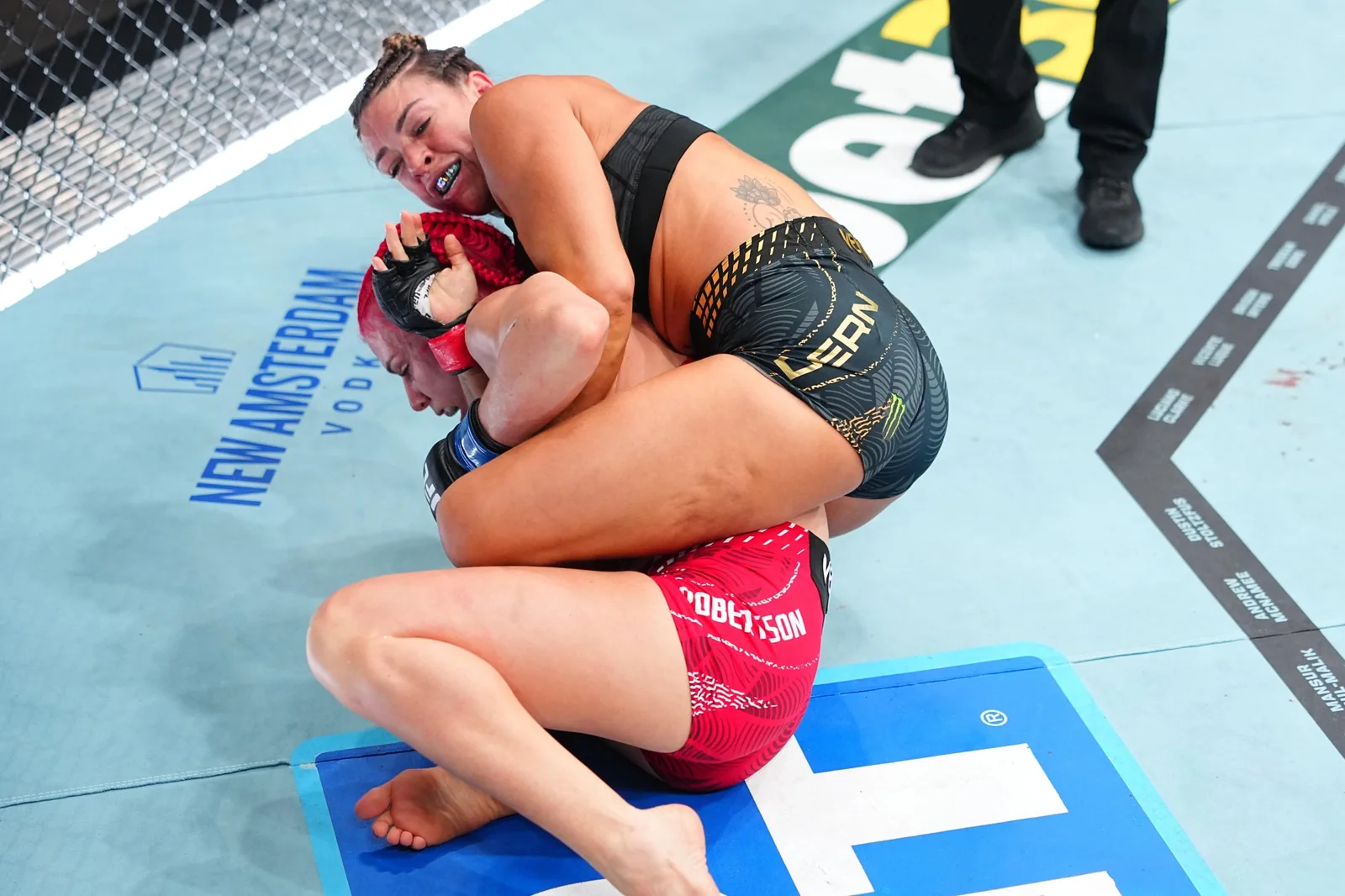
Round 1 created the separation. Dern denied Robertson's early entries, landed 19 significant strikes to three, completed her first takedown and worked from half guard toward the back. Her rear-naked choke threat came close enough to force focused defense before the horn. UFCStats recorded one official submission attempt in the fight, but that count should not erase the other setups and positional threats that never reached the statistical threshold.
Across five rounds, Dern led significant strikes 65-49, completed four of six takedowns and held 10:48 of control. Robertson did not simply accept bottom position: she produced two reversals, defended the finishing sequences and eventually completed her own takedown. The difference was timing. Dern's successes arrived early enough to build a lead and were usually attached to advancement or offense, while Robertson's longest settled spell came after she already needed more than a routine round win.
Robertson controlled 4:28 of Round 5 and led significant strikes 14-8 in that frame. It was her clearest round, but Dern remained active enough from guard to avoid a serious submission or damaging sequence. A 10-9 fifth could not undo four rounds that MMA Fighting's live scorer had already awarded to the champion. The official 48-47 total shows one judge found an additional round for Robertson, but without the round-by-round card it would be wrong to guess which one.
For Dern, the performance showed improved control over where exchanges began: her jab and combinations helped create better wrestling moments instead of forcing desperate scrambles. For Robertson, the defense and final round proved she could survive elite positions, but a challenger cannot wait until the fifth to impose her best phase. More career context is available on the Mackenzie Dern profile and Gillian Robertson profile.
The finishes that shaped the rest of the UFC 330 card
Eight of UFC 330's 12 fights ended inside the distance: four by knockout or TKO and four by submission. That finish rate matters because the two title fights went all 25 minutes. Fans catching up on the card should not mistake two tactical championship decisions for a slow night from top to bottom.
Jalin Turner delivered the fastest ending, stopping Kauê Fernandes with punches just 39 seconds into Round 1. Donte Johnson also needed less than two minutes to put away Eric McConico, while Lucas Fernando's third-round knee and follow-up strikes ended a much longer battle with Rafael Tobias. Esteban Ribovics stopped Edson Barboza at 1:32 of Round 2; MMA Fighting reported that Barboza then laid down his gloves and announced his retirement, bringing a respectful, emotional close to the veteran's night.
The submission slate offered more variety than the raw total suggests. Dustin Stoltzfus found a rear-naked choke late in Round 2. Charles Johnson twisted Eduardo Chapolin into a rare twister in the third round of their 130-pound catchweight bout. Jeremiah Wells closed the event's opening fight with the clinch submission commonly described as a ninja choke; UFCStats records it within the guillotine family. Those are the replays to find if unusual grappling finishes are your priority.
| Winner | Opponent | Method | Round / time |
|---|---|---|---|
| Islam Makhachev | Ian Machado Garry | Unanimous decision (49-46, 49-46, 48-47) | 5 rounds |
| Mackenzie Dern | Gillian Robertson | Unanimous decision (49-46, 49-46, 48-47) | 5 rounds |
| Jalin Turner | Kauê Fernandes | KO/TKO, punches | R1, 0:39 |
| Dustin Stoltzfus | Mansur Abdul-Malik | Submission, rear-naked choke | R2, 4:25 |
| Esteban Ribovics | Edson Barboza | KO/TKO, punches | R2, 1:32 |
| Chidi Njokuani | Joel Alvarez | Unanimous decision | 3 rounds |
| Charles Johnson | Eduardo Chapolin | Submission, twister | R3, 1:36 |
| Donte Johnson | Eric McConico | KO/TKO, punch | R1, 1:38 |
| Tresean Gore | Vicente Luque | Unanimous decision | 3 rounds |
| Lucas Fernando | Rafael Tobias | KO/TKO, knee and strikes | R3, 1:10 |
| Neil Magny | Ramiz Brahimaj | KO/TKO, punches | R2, 3:20 |
| Jeremiah Wells | Myktybek Orolbai | Submission, ninja choke | R3, 1:24 |
The table follows the completed result record rather than an early version of the lineup, so replaced or canceled matchups are not mixed into the final card. For video modules and bout-level updates, open the UFC 330 event page. The latest UFC results page is the faster route when you only need winners, methods, rounds and times from recent cards.
What comes next after UFC 330
The honest post-fight answer is that none of the four title-fight athletes had an officially announced next opponent as of August 16, 2026. UFC 330 changed their records and supplied evidence for the matchmakers, but a backup fighter, an in-cage wish or a tempting name is not a booked bout. Here is what is confirmed and what the performances suggest.
Islam Makhachev: champion, 29-1
Confirmed: He completed his first welterweight title defense. No second challenger is official.
Editor's read: The next contender needs more than anti-wrestling defense. Garry survived transitions and won striking exchanges late, yet Makhachev still found the Round 5 takedowns needed to close the fight. A challenger must punish the entries without giving up the reset.
Track Makhachev's next fight →Ian Machado Garry: contender, 17-2
Confirmed: His first UFC title challenge ended by unanimous decision. There is no immediate rematch on the schedule.
Editor's read: Garry proved he can remain functional under elite wrestling pressure and still create offense in championship rounds. His route back is a contender win that turns those late reads into earlier damage, not a moral-victory argument about the scorecards.
Track Garry's next fight →Mackenzie Dern: champion, 17-5
Confirmed: Dern recorded the first defense of her strawweight title. Her next challenger has not been announced.
Editor's read: UFC 330 strengthened her claim as a complete champion. She used striking and takedown timing to reach dominant grappling positions rather than depending on one submission scramble. Zhang Weili is an interesting discussion, but discussion is not a contract.
Track Dern's next fight →Gillian Robertson: contender, 17-9
Confirmed: Robertson lost her first UFC championship bout by unanimous decision. No return date is official.
Editor's read: Her fifth-round control showed she can make adjustments against an elite grappler, but the slow start left too much ground to recover. A matchup with another ranked strawweight would show whether she can impose that urgency before a fight reaches its final frame.
Track Robertson's next fight →Treat the status panel as a snapshot, not a prediction sheet. The upcoming UFC events page is where a matchup becomes useful to fans: once the promotion announces it, the date, venue, local start time and fight-card position can all be checked together.
Fight talk
Comments