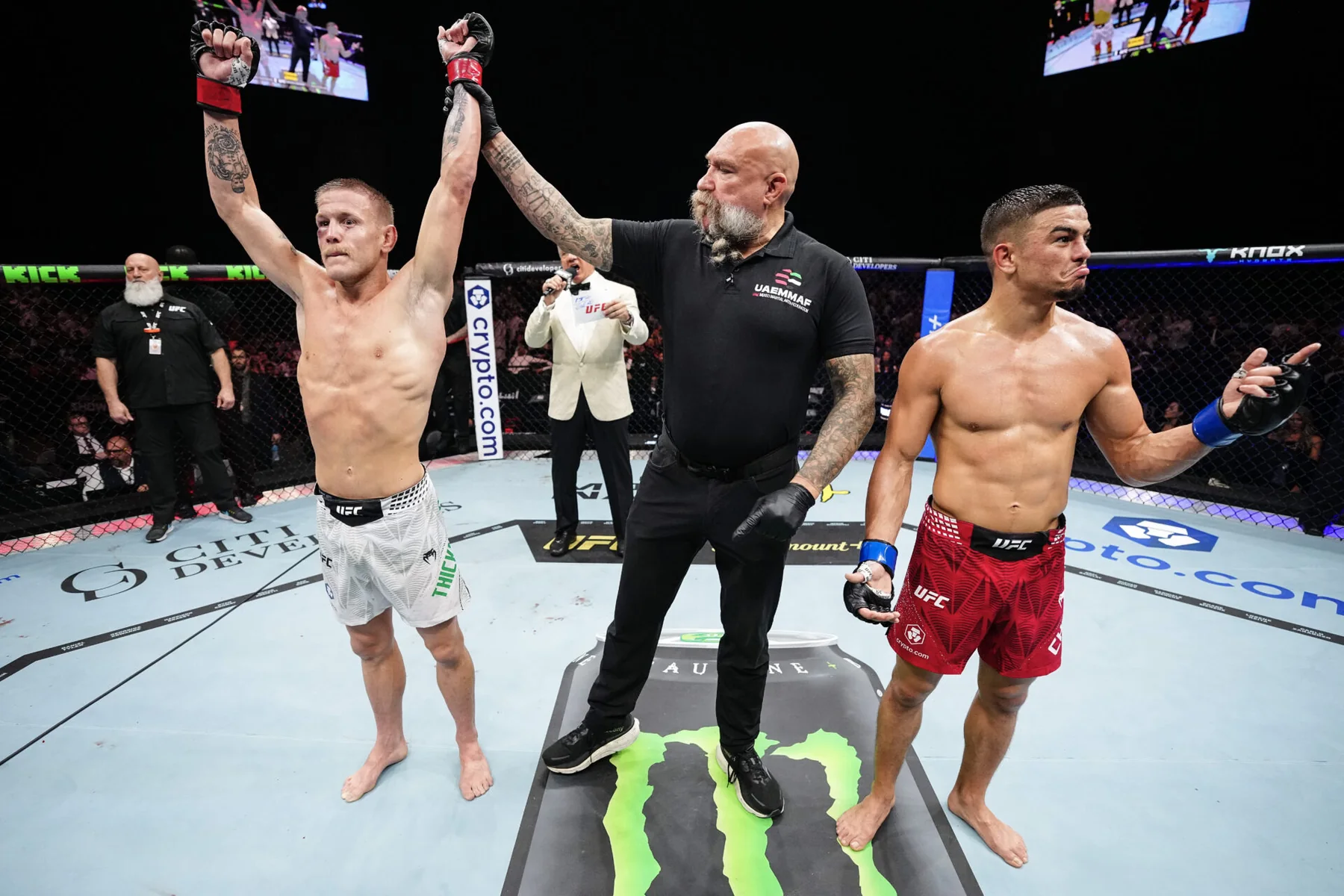
Colby Thicknesse beat Asaf Chopurov by split decision at UFC 333, but the two judges who selected him did not agree on his winning rounds. Ben Cartlidge gave him rounds 2 and 3. David Lethaby gave him rounds 1 and 2. Darryl Ransom preferred Chopurov in rounds 1 and 3. That pattern explains why the controversy needs a closer look than the final 29–28 totals.
What the original Thicknesse–Chopurov scorecards show
The bantamweight bout took place at Etihad Arena in Abu Dhabi on October 24, 2026, with Mike Beltran refereeing. The original UFC scorecard records two complete cards for Thicknesse and one for Chopurov. It also shows disagreement in two separate rounds, rather than one disputed final-round vote.
The nine round scores
| Round | Cartlidge: Thicknesse–Chopurov | Lethaby: Thicknesse–Chopurov | Ransom: Thicknesse–Chopurov |
|---|---|---|---|
| 1 | 9–10 | 10–9 | 9–10 |
| 2 | 10–9 | 10–9 | 10–9 |
| 3 | 10–9 | 9–10 | 9–10 |
| Total | 29–28 | 29–28 | 28–29 |
The MMA Decisions transcription agrees with those entries. Cartlidge and Lethaby both reached 29 for Thicknesse through different combinations. Ransom's card matched neither of those overall routes, even though he agreed with one or both colleagues in every individual round.
The scores contain no penalty or 10–8 round
Every round on the three sheets was 10–9, and no deduction is shown. There is no unusual penalty arithmetic to resolve and no official 10–8 changing the value of a round. Each judge selected the fighter he considered better in two of the three rounds, then added those scores.
That makes the disagreement unusually easy to locate on paper. Lethaby differed from both colleagues in Round 1; Cartlidge differed from both in Round 3. Round 2 was the only unanimous round. The final result is confirmed, while an argument about the quality of the decision must explain one or both of those contested periods.
This article explains those original sheets and the contemporaneous reporting around them. The scorecard can identify where judges disagreed; deciding that a particular official was wrong requires a complete comparison of the action in the relevant round. A selected highlight or a fighter's reaction cannot perform that comparison alone.
How Thicknesse won despite two judges favoring Chopurov in two rounds
If you look across the judges instead of down each individual card, a striking pattern appears. Two judges preferred Chopurov in Round 1. All three preferred Thicknesse in Round 2. Two preferred Chopurov in Round 3. A round-by-round majority would therefore produce a different winner from the announced split decision.
The official result uses each judge's complete scorecard. Cartlidge's total selected Thicknesse; Lethaby's total selected Thicknesse; Ransom's total selected Chopurov. That is the two-to-one decision recorded by the official UFC News result. It is not calculated by combining the judges' votes into one new shared card after every round.
Consider Cartlidge first. His Round 1 score put Chopurov ahead, but his next two scores gave Thicknesse 20 points to 18. Lethaby reached the same total in reverse order: Thicknesse took the first two rounds on his sheet, while Chopurov won the last. Ransom agreed with Cartlidge about Round 1 and Lethaby about Round 3, which produced his 29–28 for Chopurov.
Nothing in that arithmetic requires a tied round, a hidden deduction or a scoring correction. The difference comes from how the individual judgments were distributed across the three cards. An observer can find the outcome frustrating and still understand that the announced winner follows the recorded totals.
The quality of those underlying round judgments remains a separate question. Explaining the voting method does not establish that Lethaby correctly assessed the first round or that Cartlidge correctly assessed the third. It simply identifies what a challenge to the decision must address. Changing an isolated round on one card could alter that judge's total, and potentially the overall vote.
For readers comparing other controversial bouts, start with that distinction before arguing about a final number. Our Perez–Dumont analysis examines another set of judges' sheets. In this case, the original Thicknesse–Chopurov card makes the important point visible: the two winning votes agreed on the result while disagreeing about the route to it.
Why Lethaby's first round is central to the dispute
Lethaby's opening-round score deserves separate attention because he was the only judge to give that round to Thicknesse. Cartlidge and Ransom both preferred Chopurov. Anyone describing the entire controversy as a disagreement about Round 3 misses a second decision that helped produce the official winner.
The UFC's preliminary recap describes Chopurov starting strongly and finding success along the fence, while also crediting Thicknesse with useful work in the clinch. That account leaves room for comparing different kinds of offense. It does not provide a written defense of Lethaby's particular score.
There was also a clear contrary media assessment. In Sherdog's contemporaneous round coverage, Brian Knapp, Tyler Treese and Mike Sloan all scored Round 1 for Chopurov. Those are identifiable observers with a specific round preference, rather than a vague claim that everyone watching agreed.
The right replay question is therefore precise: did Thicknesse produce enough effective offense across those five minutes to outweigh Chopurov's strongest work? That requires considering the whole round, including what happened inside the clinch and during the grappling exchanges. It cannot be answered just by pointing to the challenger commanding the center or the eventual winner showing resilience.
Resilience matters competitively because it allows a fighter to stay involved after a difficult exchange. It does not, on its own, convert an opponent's offense into points for the fighter enduring it. Equally, a strong early moment cannot automatically settle the rest of a round if the opponent later delivers meaningful offense. The comparison needs both sides of that sequence.
The original paper tells us the consequence of Lethaby's assessment. Giving Round 1 to Chopurov instead would change that judge's final total. It does not tell us why he preferred Thicknesse, and this account does not invent that reasoning. The dispute becomes more useful when it stays attached to this exact five-minute period and the effective actions each fighter produced, rather than becoming an allegation based on the surprise of the overall upset.
Round 2 was unanimous, but Round 3 was not
The middle round supplies the common ground in the judges' assessments. All three gave it to Thicknesse. The final round then created Cartlidge's particular route to the Australian's victory, while the other two judges preferred Chopurov. The disputed decision is easier to understand when those two periods are treated separately.
The shared preference in the middle round
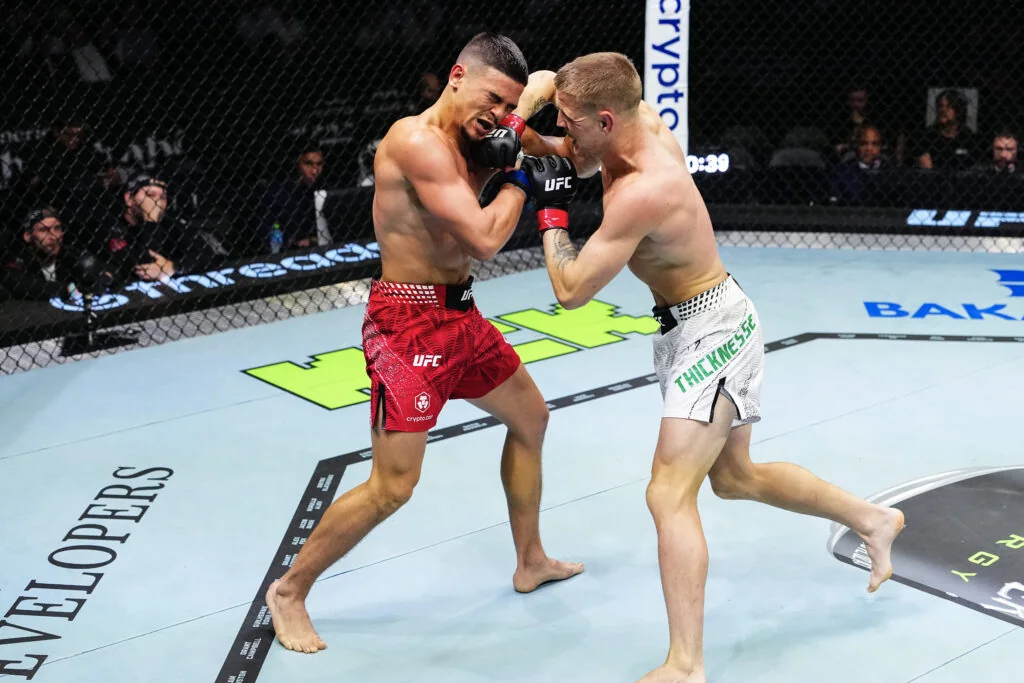
The original cards show three 10–9 scores for Thicknesse in Round 2. The three named Sherdog scorers agreed with that preference. The live account emphasizes close-range elbows and knees alongside combinations and repeated changes between clinching and separation.
That is useful technical context because a clinch is not necessarily an absence of offense. A fighter can connect meaningfully at short range even when the exchanges look less clean or less dramatic than open-space boxing. The question is what he lands or threatens from that position, and what his opponent accomplishes in return.
For someone arguing that Chopurov won the fight, acknowledging Thicknesse's middle round makes the case more specific. A 29–28 for Chopurov need not deny his opponent's success. It can accept Round 2 and argue that the opening and closing rounds belonged to the newcomer. That was Ransom's official route and the route taken by the three Sherdog scorers cited here.
The final round created a different winning route
Cartlidge awarded Round 3 to Thicknesse, completing consecutive winning rounds on his sheet. Lethaby and Ransom gave that round to Chopurov. The account of the action includes wrestling success for Chopurov and a late response from Thicknesse involving striking and a takedown. The round therefore needs an assessment of offense across several phases, rather than a choice based only on who appeared busier in one position.
A strong late exchange can matter greatly if its effect outweighs earlier work. It can also be memorable without being enough to overturn an opponent's stronger overall round. Those are different possibilities that a complete replay should test. The last visible flurry is neither automatically decisive nor automatically irrelevant because it happened near the horn.
The original sheet establishes Cartlidge's preference, but it does not say he ignored the preceding minutes. That would be a claim about his reasoning, which is not written on the card. A fair criticism identifies the relevant offensive comparison and explains why it should lead to Chopurov, rather than assuming a psychological error from the final total alone.
These two rounds also explain why Thicknesse's official win can coexist with a coherent contrary 29–28. The disagreement is not about whether he did anything effective. It is about whether enough of that work occurred within the disputed scoring periods to give him a second round.
Wrestling pressure and clinch offense need the same test
The central technical question is what the attacks achieved. The ABC's July 2025 judging clarification treats effective striking and grappling through their offensive effect. That is a useful educational framework for this discussion; the original Abu Dhabi sheets establish the actual scores without providing a separate written account of each judge's application.
Follow a takedown through the attack it creates
A takedown needs more context than a completed entry. Look at the landing, the attacks that follow, the submission danger and the opponent's response. A brief period on top may produce meaningful offense. A longer hold may produce much less. The clock alone cannot resolve that comparison.
For Chopurov, the replay question is how often wrestling created damaging offense or a serious attacking position before the exchange reset. For Thicknesse, it is what happened after he defended or regained his feet. Merely escaping does not supply an offensive score; it can create the opportunity to deliver the next effective attack.
This keeps the interpretation fair to both styles. It avoids treating every completed takedown as a guaranteed round, while also avoiding the opposite mistake of dismissing a grappling attack whenever the opponent eventually stands. The relevant action includes the threat and effect before that escape, not just the final position when the fighters separate.
Judge the strikes inside the clinch as offense
The official recap specifically identifies Thicknesse's success in close. A short elbow or knee should therefore be evaluated as an offensive action, rather than disappearing from the discussion because the fighters were tied up. At the same time, clinching itself is not a substitute for showing what those attacks achieved.
Watch the contact, the target and the effect on the opponent's next action. Was a strike meaningful, partly blocked or incidental? Did a fighter create another effective attack, or did the position simply consume time? Those questions require the same care that a viewer would apply to an exchange of punches in open space.
Our UFC statistics explainer separates significant strikes, total strikes, takedowns and control time. Those categories can help organize a replay, but adding them together does not create a judging formula. In this bout, the argument must still return to the contested first and third rounds and compare both fighters' effective offense within each one.
Media disagreement and betting odds answer different questions
The contrary assessment was not confined to anonymous comments. The MMA Decisions media list includes 29–28 cards for Chopurov from named scorers associated with MMA Fighting, Wrestling Observer and Sherdog. It also lists a card for Thicknesse. Those entries document identifiable disagreement without turning a selected collection into a census of everyone who watched.
F4W's event report also described Daniel Cormier preferring Chopurov on the broadcast. That is a reported commentary assessment. It deserves clear attribution, and it remains separate from the three officials' cards. Commentary can guide attention toward an exchange, but it is not an additional official vote.
The useful question for any of those scores is the same: which rounds did the observer award, and what effective offense explains the choice? A clear 29–28 case for Chopurov can accept Thicknesse's unanimous middle round while challenging the first or third-round preference that contributed to one of the winning cards.
A betting upset is not proof of a scoring error
Chopurov entered with much stronger betting expectations in the reporting around the bout. Those expectations help explain why the defeat attracted attention. They do not determine who won a particular five-minute round.
A favorite can lose fairly, and an underdog can receive a debatable decision. The surprise attached to the first possibility does not establish the second. A scoring argument becomes stronger when it leaves the pre-fight price behind and identifies the effective work within the disputed round.
The same applies to the fighters' reputations and training partners. Those details make the meeting interesting, but they cannot answer the original-card question. Thicknesse's official victory comes from two complete judges' sheets. The criticism needs to address those sheets and the action behind them, rather than suggesting that the expected winner was entitled to the outcome.
What a fair replay discussion should establish
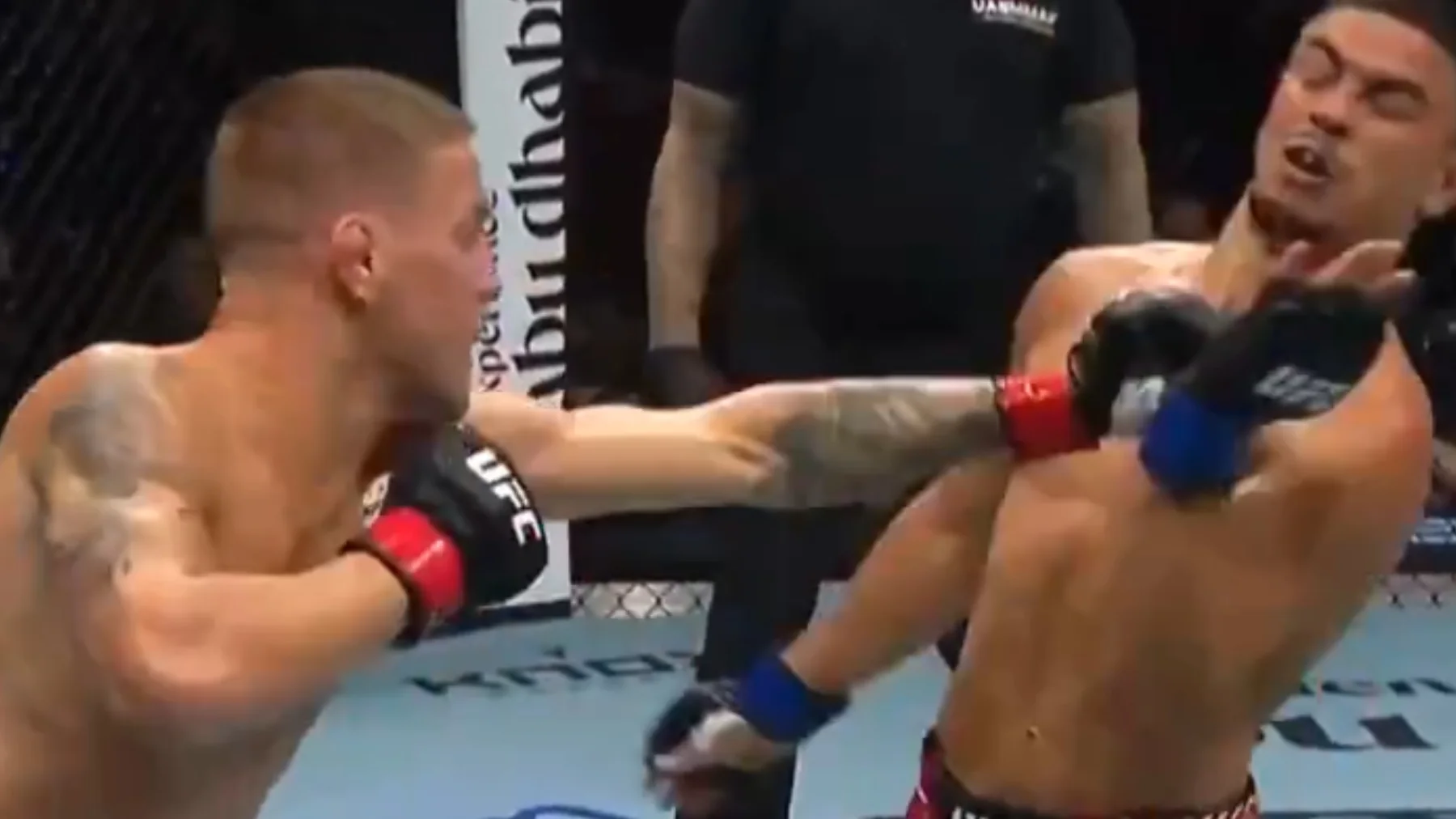
Begin by choosing the round you want to challenge. For Lethaby's winning card, the central departure from his colleagues was Round 1. For Cartlidge's winning card, it was Round 3. The original sheet makes those differences explicit, so a serious discussion can move beyond a general reaction to the announced result.
Watch that whole round and note the strongest effective offense from both fighters. Include striking in close, attacks after takedowns, submission threats and the work immediately after a separation. Then explain the comparison in ordinary language: what mattered, what effect it had and why it outweighed the opponent's best work during those same five minutes.
Keep a separate note of uncertain moments. A camera angle might obscure whether an elbow landed cleanly, or a brief scramble might make an attacking position look more secure than it was. Acknowledging that uncertainty is more useful than filling it with certainty based on the fighter you expected to win. Another angle or a slower review may help, but it still has to remain part of the entire round.
Only after evaluating the three rounds should you add a total. If you prefer Chopurov 29–28, identify whether your view follows Ransom's route. If you prefer Thicknesse, explain whether your second winning round is the first or third. Those are substantively different arguments even though the same final score appears beside the same fighter.
Check the current UFC viewing options for access in your territory. A short official clip can confirm a result or illustrate one exchange, while the complete bout is needed for a full independent scoring assessment. This article's confirmed foundation is the original card and the attributed reporting, rather than a replacement verdict built from selected moments.
Thicknesse remains the recorded split-decision winner in this account as of October 29. The reason the result is disputed is specific: two judges found different second winning rounds for him, while other officials and named media observers preferred Chopurov in those periods. That is a concrete disagreement worth examining on the action, with the arithmetic, expectations and actual scoring evidence kept clear.
Fight talk
Comments