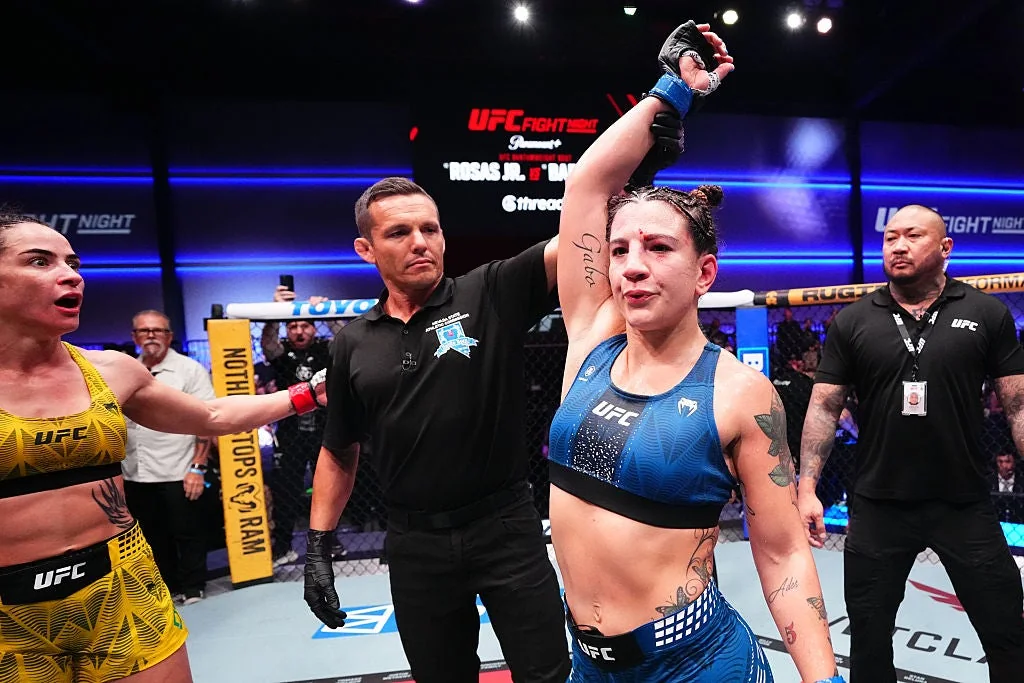
Ailin Perez beat Norma Dumont by unanimous decision at UFC Vegas 121, but the 29–28 scores did not settle the argument among fight fans. The decisive detail is on the UFC's round-by-round card: all three judges gave Perez Rounds 1 and 3 and Dumont Round 2. This review compares that published card with the fight record, UFC Stats and Nevada's scoring criteria. It also separates what Dumont and outside observers argued from what the official record actually establishes.
What do the official Perez vs Dumont scorecards actually show?
Mike Bell, Eric Colon and Sal D'Amato each scored the fight 29–28 for Perez, giving her Rounds 1 and 3 and giving Dumont Round 2. The official UFC scorecards page includes a judge-by-judge graphic for the September 26, 2026 women's bantamweight co-main event at Meta APEX in Las Vegas. Reading the round rows, rather than only the final result line, pinpoints the contested part of the decision.
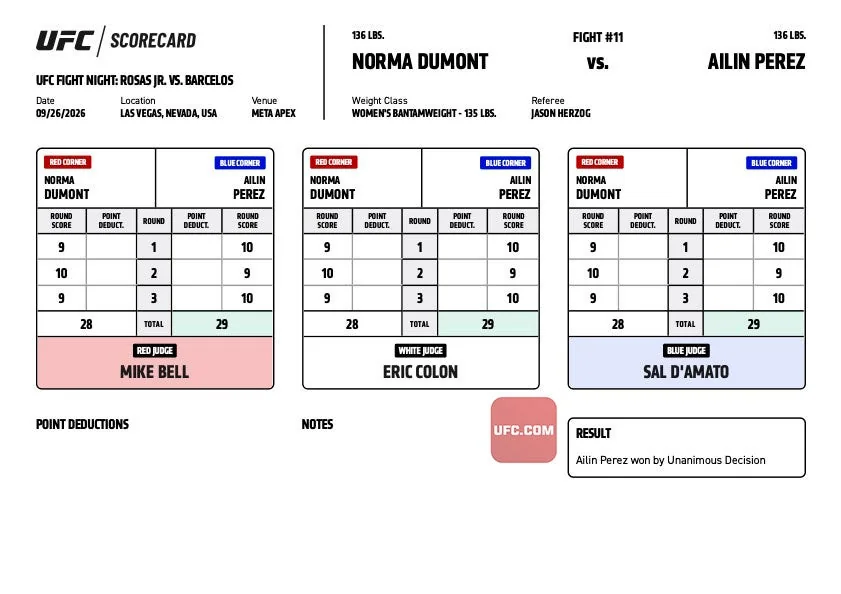
| Judge | Round 1 | Round 2 | Round 3 | Total |
|---|---|---|---|---|
| Mike Bell | 10–9 | 9–10 | 10–9 | 29–28 Perez |
| Eric Colon | 10–9 | 9–10 | 10–9 | 29–28 Perez |
| Sal D'Amato | 10–9 | 9–10 | 10–9 | 29–28 Perez |
There is no split among the appointed judges and no point deduction or 10–8 round in this published card. “Unanimous” describes their votes for the winner; it does not claim that all journalists, fighters or viewers saw the rounds the same way. A Dumont 29–28 reading needs one of Perez's two awarded rounds to change sides. The third round has drawn the sharpest argument because both women had visible late moments, yet the official sheet records the same 10–9 Perez line three times.
The card tells us who the judges picked in each round. It does not publish their reasons for weighting any particular strike, takedown or clinch action. That distinction is essential before using statistics to reverse-engineer a decision. For the rest of the event and the main-event result, see our UFC Vegas 121 full-card recap; here the question is this single three-round bout.
How did the three rounds unfold?
The result makes more sense when the 15 minutes are divided into three separate scoring problems. The official card identifies the winner of each round; UFC Stats records measurable actions; and contemporaneous play-by-play describes what those actions looked like. None of those sources prints a judge's private reasoning. The first two rounds had a clearer alignment between official cards and many live observers. Round 3 is where the competing interpretations become decisive.
Round 1: Perez's takedown changes the opening frame
Dumont took central space early and found low kicks and jabs while Perez moved on the outside. The live Sherdog account describes Perez catching a kick and completing a takedown with about two minutes left. She settled into half guard, landed some short punches and maintained the ground phase to the horn. UFC Stats credits her with one successful takedown in two attempts and 1:51 of control.
The striking count alone seems to point the other way: Dumont landed eight significant strikes to Perez's four in the round. Yet that small raw difference leaves out the quality of Perez's successful grappling and the strikes she delivered after gaining position. It also does not tell us that every one of Dumont's eight landed blows outweighed the ground offense. All three official judges awarded Perez 10–9, as did Sherdog's three live scorers. This is a defensible round to examine rather than an automatic award for whichever fighter spent more time on top.
Round 2: Dumont's best round gets every judge's vote
Dumont answered with her own takedown early in Round 2. Perez returned to her feet, so Dumont did not keep an extended ground advantage, but the Brazilian also landed the more noticeable standing counters described by MMA Fighting and Sherdog. One uppercut through the guard is a more concrete scoring moment than either fighter merely feinting at range. Perez attempted to re-enter clinches and missed two listed takedown attempts in the round.
UFC Stats has Dumont up 15–12 in significant strikes, with one successful takedown in one attempt and 0:40 of control to Perez's 0:21. Those figures do not independently prove every detail of effectiveness, but they fit the broad observation that Dumont produced the more convincing completed offense in this middle frame. Every official judge wrote 10–9 Dumont. The decision was therefore level at one round each before the final five minutes.
Round 3: Perez's fence work meets Dumont's strike edge
Both fighters exchanged low kicks and brief punches in a round with fewer unambiguous turning points. Sherdog's live report lists Dumont jabs, a hook and low kicks; it also records Perez's early overhand, a body kick and late knees after she drove Dumont toward the fence. MMA Fighting similarly describes Perez closing the distance and landing a knee to the body. This is the sequence most readers need to revisit: the same late pressure can appear productive if the knees and short punches had clear effect, or less persuasive if the earlier Dumont strikes were better.
The published numbers sharpen that question without deciding it. Dumont led 23–21 in significant strikes. Perez missed all three listed takedown attempts, yet accumulated 1:29 of control time, much of it connected to fence work. All three judges gave Perez the final 10–9; Sherdog's three live scorers gave it to Dumont. The disagreement is a different reading of one close round, not a dispute over whether the official card was unanimous. A replay can help a viewer assess impact, but neither the score sheet nor the count alone reveals the judges' weighting.
What do the UFC Stats figures show, and what do they leave out?
The UFC Stats bout page gives Dumont a numerical lead in both major strike columns, while it gives Perez much more control time. That tension is part of why viewers questioned the score. It is also a warning against treating a statistics table as an automatic judging calculator: counts identify recorded actions, whereas the judges are asked to assess the effective result of offense in each separate round.
| Metric | Norma Dumont | Ailin Perez |
|---|---|---|
| Significant strikes | 46 of 106 | 37 of 85 |
| Total strikes | 102 of 166 | 47 of 99 |
| Takedowns | 1 of 1 | 1 of 7 |
| Control time | 0:40 | 3:41 |
| Knockdowns | 0 | 0 |
Significant and total strikes count different things
Dumont landed 46 significant strikes to Perez's 37, a nine-strike edge across the full fight. Her total-strike lead was far larger, 102–47. The two UFC Stats columns track different sets of logged contact; a total strike is not a separate point on a judge's card, and a “significant” label does not tell us the exact impact of each shot. A short punch, a harder body knee and a low kick can all affect a round differently despite appearing as simple integers in a post-fight table.
Dumont also led the significant count in each individual round: 8–4 in the first, 15–12 in the second and 23–21 in the third. That is a real reason to scrutinize Perez's awarded rounds. It is not proof that Dumont won all three. The official judges' task was not to sum 46 against 37 at the end; it was to decide each five-minute period on the quality of effective offense. The difference in Round 3 was only two recorded significant strikes, leaving the relative effect of the late clinch work and earlier standing shots central to the debate.
Takedowns and control time need context
Perez completed one of seven takedown attempts in the fight; Dumont completed her only attempt. Perez nonetheless accumulated 3:41 of control to Dumont's 0:40. The apparently odd combination makes sense when the rounds are separated: Perez had 1:51 of control and her successful takedown in Round 1, then 1:29 of control in Round 3 despite going zero for three on takedowns. Fence clinch time can be logged as control without a completed trip to the canvas.
The control clock does not disclose whether a fighter landed damaging strikes, advanced to a dangerous position or mainly kept the opponent pinned. A completed takedown likewise matters for what follows, not as an automatic 10–9 token. Dumont's 0:40 of control in Round 2 did not alone decide the round either; her striking and grappling must be assessed together. Both sides can select a flattering statistic here. Neither selection substitutes for evaluating the effect of their offense.
How do Nevada's MMA judging criteria handle a close round?
This bout took place in Las Vegas, so the relevant starting point is Nevada Administrative Code 467.796, the state's MMA method-of-judging rule. It directs judges to score each round under a 10-point system. A close round goes 10–9; the Perez–Dumont card contains three such rounds on every judge's sheet. The rule does not say that a fighter automatically wins because she landed more counted strikes or held a position longer.
Effective striking and grappling come first
Nevada directs a judge first to ask which fighter had an advantage in effective striking or grappling, or both. Its definitions focus on legal blows and successful grappling that have immediate or cumulative impact with potential to contribute to the end of the contest. A takedown can matter because it creates an advantageous position or produces effective attack. A strike can matter because of its effect, not because the statistics table increments by one. The ABC's July 2025 scoring clarification similarly emphasizes the result of effective actions; it is useful context, while Nevada's regulation is the governing state rule for this event.
That distinction keeps two easy but wrong shortcuts out of the analysis. Dumont's 46–37 significant-strike lead is important evidence of activity, but it does not label the force or consequence of each blow. Perez's successful first-round takedown likewise does not erase every strike Dumont landed before it. A judge who saw Perez's ground offense as the more effective action could choose her in Round 1; one who judged Dumont's striking more consequential could choose Dumont. The rule specifies the criterion, but the published card does not explain each judge's comparative observation.
Position and aggression become relevant only in their proper place
Nevada's order is explicit: effective aggression is considered only if effective striking and grappling are even; cage or ring control comes next only if the prior criteria are still even. Its text also says top or bottom position must be judged by what the fighter accomplishes there, not simply by where she sits. Mere retention of a dominant position is not a primary measure of dominance. That matters in Round 3, when Perez recorded 1:29 of control while completing no takedown. Fence pressure might have supported impactful knees or short punches, but clocked pressure alone would not automatically beat Dumont's stand-up offense.
The same standard protects Dumont from a different oversimplification. Her forward movement and 23–21 Round 3 significant-strike edge are useful details, but advancing or landing two more recorded strikes does not settle their relative effect. A careful viewer should ask which techniques changed the opponent's ability to continue attacking, whether either grappling phase created danger, and whether aggression or cage placement even needed to break a tie. The rule explains the questions judges should answer; it does not let a later reader read their minds.
Why did Dumont and some observers reject the result?
The dispute was immediate and understandable without treating either fighter's view as the official record. Perez and Dumont had a heated buildup, and MMA Fighting reported that security separated them around the final horn. That confrontation preceded the announcement; it does not tell us whether any 10–9 was scored correctly. Once the three 29–28 Perez scores were read, Dumont's disagreement centered on the last round, the same five minutes over which live media scores diverged.

Dumont's post-fight objection is an athlete's account
In an Instagram reaction reported and translated by MMA Mania, Dumont said she considered Round 2 clearly hers and thought Perez had done little in Round 3. She said she did not accept the verdict. These are Dumont's assessments of the exchanges, not a commission finding that the result was wrong. The official card already agrees with her on Round 2, so the meaningful gap between her account and the judges' decision is the final round.
Her frustration also has to be distinguished from the pre-existing hostility between the two women. The separate, visible security response after the horn reflects that rivalry, while the scoring issue concerns effective offense during the round. A post-fight argument, an angry social post and a judge's 10–9 are three different kinds of evidence. Conflating them would make the story louder but less useful for understanding why fans disagreed.
A different third-round read changes a 29–28 card
Sherdog's live report lists Brian Knapp, Tudor Leonte and Dayne Fox each scoring the opener for Perez, the middle round for Dumont and Round 3 for Dumont: 29–28 Dumont on each unofficial card. By contrast, the MMA Mania live writer also had Perez R1 and Dumont R2, then tentatively gave Perez the third for 29–28 Perez. Those examples establish disagreement among observers, not a measured majority of fans or a binding alternative result.
The arithmetic is unusually clean. With no point deduction or 10–8 on the official sheet, Perez and Dumont were tied after two rounds on every judge's card. Give Perez the third, as Mike Bell, Eric Colon and Sal D'Amato did, and she wins 29–28. Give that same 10–9 to Dumont and she wins 29–28 instead. The split in interpretations is therefore specific: how much effective offense each woman achieved in a close final frame. It cannot be settled by saying the appointed judges disagreed with one another; they did not.
Was Perez vs Dumont a robbery, and what follows?
The available record supports calling the decision disputed; it does not prove a clear judging failure. All three appointed judges scored 29–28 Perez. The alternative 29–28 Dumont card is understandable because Round 3 was close, Dumont had a small edge in recorded significant strikes and several independent live scorers favored her. It is equally important that another live writer sided with Perez and that the official judges all saw her late offense as sufficient for 10–9. A “robbery” label expresses a viewer's conviction, not an official category or a conclusion established by the statistics.
The useful rewatch is therefore narrower than a full-fight argument about who was busier. Start with the third round, compare the effect of Dumont's earlier punches and kicks with Perez's late knees and short exchanges, and assess what Perez achieved while holding Dumont at the fence. Nevada's rule asks about effective striking and grappling before any tiebreaker for aggression or cage control. A clock can tell you that Perez controlled 1:29 of the last frame; it cannot tell you whether those seconds produced the more consequential offense. Neither can the 23–21 strike count tell you the force and placement of every contact.
As of September 28, 2026, the published UFC result remains a unanimous Perez win. Dumont's objection and unofficial media cards have not changed that record. There is no verified rematch booking, appeal outcome or title opportunity to attach to this specific result in the sources reviewed here. If the promotion later books either fighter, that future matchup will be a separate fact to report; check our confirmed UFC schedule and fight cards for actual announcements. For now, the precise takeaway is a Perez 29–28×3 decision decided by three identical third-round votes, with a reasonable public debate over how to weigh the offense in those final five minutes.
Fight talk
Comments