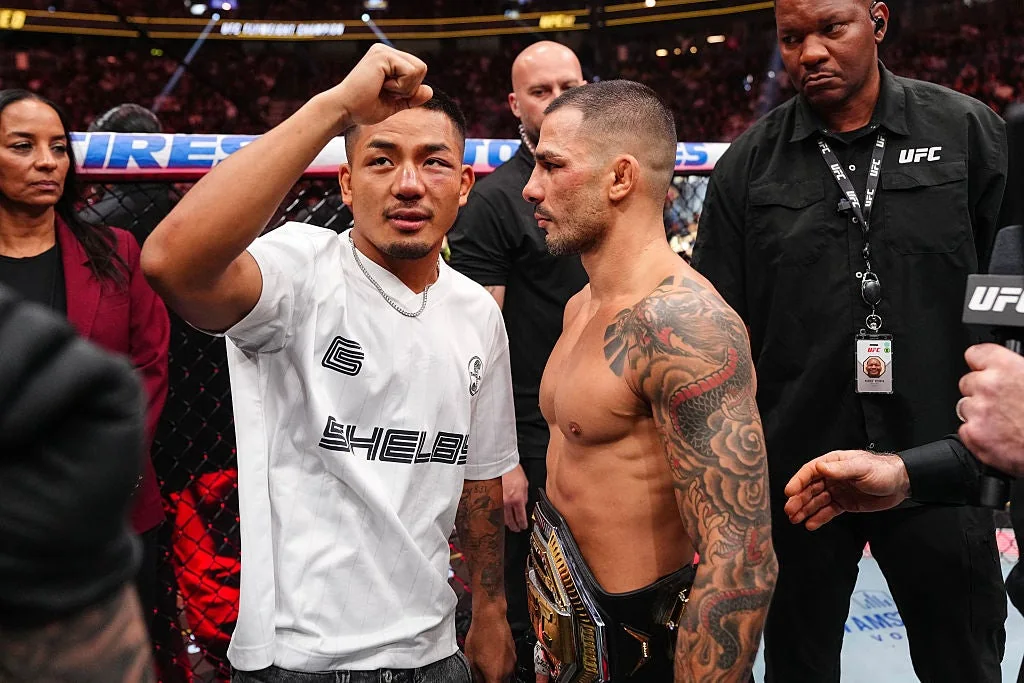
UFC 331 is built around a flyweight rematch that the division genuinely needs. Champion Joshua Van and former champion Alexandre Pantoja shared only 26 seconds in their first meeting before Pantoja suffered an arm injury. Their September return is therefore less a conventional sequel than the first reliable test of which man can impose his complete game. This preview separates confirmed event information from card details that can still move, then breaks down the exchanges that should decide the title.
UFC 331 essentials: what is official
UFC 331 is officially scheduled for Saturday, September 19, 2026, at Crypto.com Arena in Los Angeles. UFC's event page lists a 9 p.m. EDT main-card start on Paramount+ in the United States, with Joshua Van defending the flyweight championship against Alexandre Pantoja. That is the useful headline; local start times, prelim timing and individual bout order should always be checked again during fight week.
| Date | Saturday, September 19, 2026 |
|---|---|
| Venue | Crypto.com Arena, Los Angeles |
| Main event | Joshua Van vs Alexandre Pantoja 2, UFC flyweight title |
| Listed main-card time | 9 p.m. EDT on Paramount+ |
The other major official piece is the five-round lightweight co-main event between Arman Tsarukyan and Mauricio Ruffy. Five scheduled rounds matter because it gives the card a second bout designed for championship-distance pacing, but it should not distract from the update rule every fight fan needs: an announced fight card is a plan, not a guarantee. Injuries, medical issues, weight-cut problems and commission decisions can change opponents or order.
Use the site's live UFC 331 event page for the current lineup, times and results as the event approaches. The broader UFC schedule is the safer place to confirm whether surrounding events or broadcast windows have shifted. This article's job is different: it explains why Van-Pantoja 2 is tactically compelling based on verified records and previous fights.
Why the 26-second first fight settled nothing
Van is the official winner of the first fight, but 26 seconds cannot tell us who owns this matchup over five rounds. At UFC 323 on December 6, 2025, Pantoja suffered an arm injury during an early exchange and could not continue. The official record correctly lists Van winning by first-round TKO due to injury. Respecting that result does not require pretending the bout produced a meaningful sample of either fighter's full game.
UFC Stats logged Pantoja landing six of 11 significant strikes and Van landing two of four. Neither man completed a takedown, attempted a submission or accumulated control time. Those numbers describe the few seconds that happened; they do not establish a repeatable edge. There was no prolonged pocket exchange to test Van's combinations, no fence sequence to test Pantoja's body locks, and no scramble in which either fighter had to make layered defensive decisions.
The honest reading is simple: Van earned the championship under the rules, while the technical question remained open.
That distinction makes the rematch more informative, not less legitimate. Van did not choose the injury and should not have to apologize for accepting the belt. Pantoja, meanwhile, had built a championship résumé around deep five-round fights and layered grappling; losing the title through an accidental physical failure created an obvious competitive case for a second meeting.
The most relevant evidence since then belongs to Van's first defense. He stopped Tatsuro Taira at 1:32 of Round 5 in May 2026, showing that his title reign is no longer defined only by the unusual UFC 323 ending. That victory adds information about his pace, durability and ability to solve a sophisticated grappler over time. It still does not make Taira and Pantoja interchangeable: Pantoja attacks transitions more aggressively, carries a deeper submission résumé and has repeatedly operated in championship rounds.
Fans can review each fighter's evolving record on the Joshua Van profile and Alexandre Pantoja profile. The rematch should be evaluated as a fresh fight with one unusual piece of shared history—not as Round 2 of a tactical battle that never actually developed.
Joshua Van's win condition: volume without reckless entries
Van's clearest route is sustained boxing pressure with disciplined exits. He does not need to prove he can out-grapple Pantoja; he needs to make Pantoja pay for every attempt to cross striking range, then return to a stance that can defend the next shot or clinch. Volume helps only if it is attached to position.
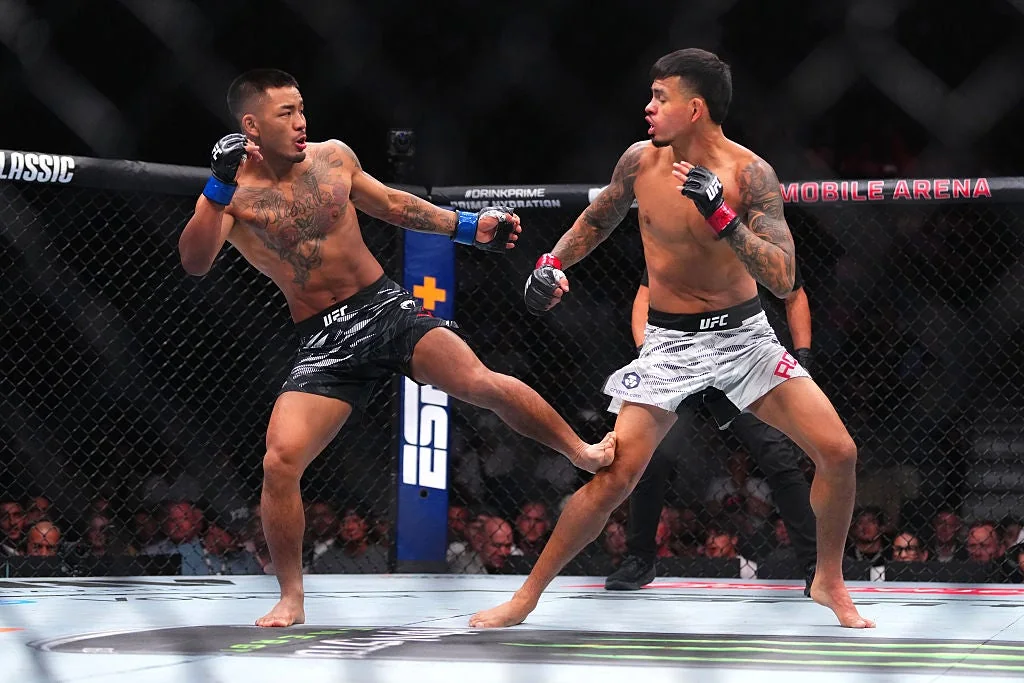
UFC's current profile credits Van with 8.43 significant strikes landed per minute, an exceptional activity rate, but also 5.82 absorbed. That two-way traffic is central to the matchup. Pantoja is hittable, yet he is comfortable converting messy contact into body locks, reactive takedowns and back exposure. A long Van combination that ends square near the fence could become a grappling invitation even when the punches score.
The combination Van should build around
The safest pattern is not a memorized three-punch sequence. It is a layered process: establish the jab, make Pantoja reset with straight shots, touch the body when the guard rises, then exit at an angle rather than drifting straight back. Body work can reduce Pantoja's willingness to surge repeatedly, while a responsible exit keeps Van's hips available. Van should also vary rhythm; constant speed makes his entries easier to time.
His listed 76% takedown defense is encouraging, and the fifth-round stoppage of Tatsuro Taira showed that he can remain dangerous late against a high-level grappling opponent. But percentage alone does not answer the Pantoja problem. Takedown defense includes very different situations. Stuffing a shot in open space is not the same as peeling hands from a rear body lock, clearing a wrist on the fence, or surviving a scramble after posting an arm.
Where Van cannot become impatient
If Pantoja wins an early grappling exchange, Van's job is to defend in layers, not explode at the first opening. Giving up the back while trying to stand would trade a bad position for Pantoja's best position. Likewise, chasing a hurt Pantoja with his feet crossing can erase the advantage. Van's youth, output and recovery give him a strong long-fight platform. The championship version of his game is the one that keeps those tools available for all five rounds.
Alexandre Pantoja's win condition: connect the phases
Pantoja should not chase one perfect takedown; he should force Van to defend several connected problems. His best work begins when a strike turns into chest-to-chest contact, a body lock creates a reaction, and that reaction exposes a leg, hip or back. The first action does not have to score cleanly if it opens the second.
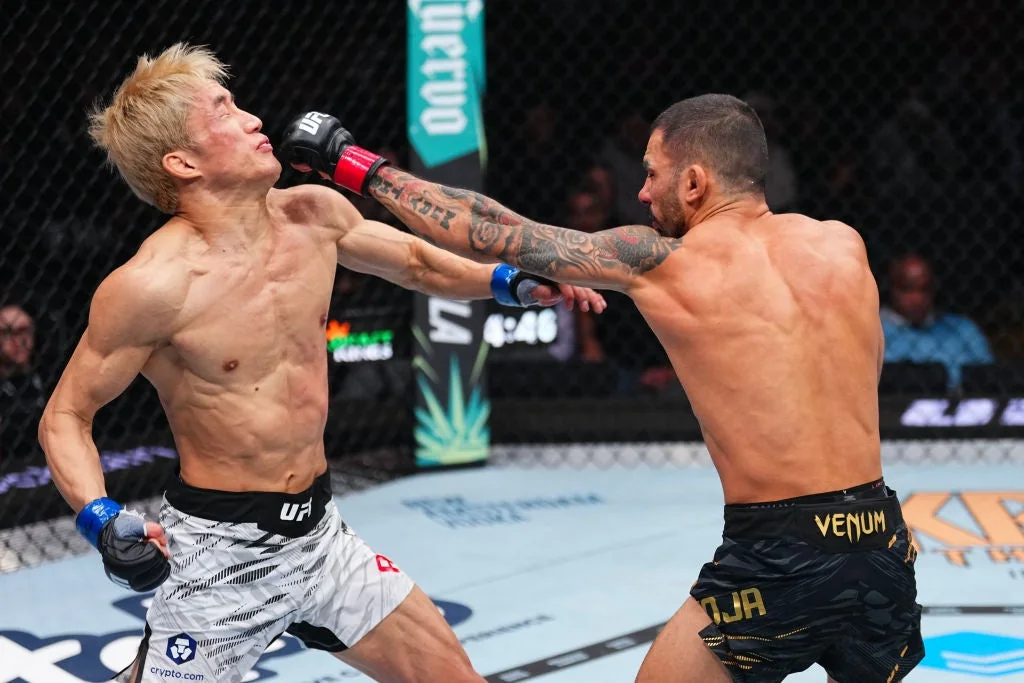
The résumé supports that reading. UFC's profile lists 12 submission wins, while its current rates credit him with 2.79 takedowns and 0.98 submission attempts per 15 minutes. UFC Stats logged nine takedowns against Steve Erceg, eight in the second Brandon Royval fight and six against Brandon Moreno at UFC 290. Those totals are not judging shortcuts—control and takedown counts do not automatically win rounds—but they show how persistently Pantoja can make an opponent work across phases.
Pressure first, back exposure second
Pantoja's highest-value target is often not top position by itself; it is the back during Van's effort to rise. He has repeatedly finished with the rear-naked choke, including against Kai Asakura at UFC 310 and Kai Kara-France at UFC 317. To create that route here, he can punch into the clinch, lock his hands below Van's elbows, and force Van to choose between accepting fence pressure and turning away to escape.
That approach also slows Van even when it produces no immediate finish. Every hand fight, mat return and technical stand-up taxes the legs and interrupts striking rhythm. Pantoja does not need to hold Van flat for minutes if he can make each minute begin with a grappling tax. His championship experience gives him a practiced sense of when to consolidate and when to attack a transition.
The danger in forcing the issue
Pantoja cannot treat durability as a substitute for defense. His 67-inch reach is two inches longer than Van's listed reach, but Van is the faster volume operator and can punish naked level changes with uppercuts or short combinations. Repeated failed shots from too far away would spend energy without creating the chained positions Pantoja needs. The former champion's ideal fight is physical and complicated, but it must be deliberately complicated—not merely chaotic.
Five-round swing factors and key checkpoints
Watch who makes the other man solve the same problem repeatedly. A five-round title fight is not won by collecting isolated highlights. It is won by creating a reliable sequence, noticing the opponent's adjustment and staying one decision ahead. Van and Pantoja have both shown long-fight capacity, but their preferred workloads stress different systems.
- 1. Cage geography. Van wants room for his combinations and angled exits. Pantoja benefits when Van's retreat finishes near the fence, where clinch connections require less open-space penetration.
- 2. Entry quality. Count how often Pantoja touches Van with a strike before grabbing him, not merely how many official takedowns he completes. For Van, notice whether combinations end with balance or leave his hips square.
- 3. Escape cost. A Van stand-up can be a tactical win while still costing meaningful energy. If he must clear hooks, fight wrists and absorb a mat return first, Pantoja may be building value that appears later.
- 4. Effective offense. Judges assess effective striking and grappling first. Raw strike totals, takedown totals or control time are not automatic round winners; impact and actions that move toward a finish carry the real weight.
- 5. The second adjustment. Round 4 may reveal more than Round 1. If Van's jab has solved the initial pressure, can Pantoja switch to clinch entries behind overhands? If Pantoja has timed the exit, can Van shorten combinations and attack the body?
The profile numbers offer useful scale. UFC currently lists Van with 1,230 landed significant strikes, 87% from standing position. Pantoja's listed distribution includes a larger share from clinch and ground positions. These are career aggregates against different opponents, not a forecast, but they reinforce the central contrast: Van accumulates offense primarily through sustained striking; Pantoja can produce meaningful offense in every phase.
Damage also changes tactics. A compromised lead leg can slow Van's exits; body work can reduce Pantoja's burst entries; a cut can alter how freely either man accepts pocket exchanges. Fans should resist scoring a round from one statistic on screen. The Unified Rules prioritize effective striking and grappling, with effective aggression and fighting-area control used only when effectiveness is even. A takedown followed by no offense may matter less than the clean strikes that preceded it.
Finally, listen to the corners without treating instructions as proof that they were executed. The better corner adjustment is the one visible in the next exchange. For a refresher on card structure and five-round exceptions, the site's UFC Fight Night guide supplies the broader event context.
Prediction, confidence and what can still change
The editorial lean is Pantoja, narrowly, because his clinch-to-back pathways create more ways to change the fight. The most plausible winning route is a competitive decision built on high-value grappling sequences, with a submission becoming available if Van rushes an escape. Confidence is moderate-low: the first meeting offers almost no technical evidence, and Van's later title defense demonstrated meaningful five-round growth.
Why Pantoja can win
He can attack during transitions, does not require a clean open-space shot to begin grappling, and has championship-round experience against several styles. His two-inch listed reach advantage may also help him make first contact before closing distance.
Why Van can overturn the pick
His faster combination volume, body work and proven late offense can make Pantoja's repeated entries progressively slower. If Van consistently exits into open space and makes Pantoja restart, the striking gap can become the clearest scoring story.
This is not a claim that grappling time automatically wins rounds. Pantoja must use position to land damaging offense, threaten submissions or force defensive reactions that visibly advance his attack. Van can win rounds even after being taken down if he escapes efficiently and produces the more effective offense around that sequence. The quality of actions matters more than the category label attached to them.
Several developments could change the analysis. A difficult return from Pantoja's arm injury could reduce confidence in posting, framing or hand fighting. A disrupted Van camp could affect the conditioning advantage assumed here. Weigh-in trouble, a late opponent change or a move in bout length would alter the tactical frame entirely. None of those problems is asserted; they are reasons to update a preview rather than treat it as permanent.
The event page still listed Van-Pantoja 2 when checked on August 29. Fight fans should revisit the UFC 331 card and start-time page during fight week, then verify the official weigh-in results. If both arrive healthy, the rematch finally gives Van a chance to validate the championship against the man who lost it without a conventional technical defeat—and gives Pantoja the chance to prove that his connected game remains the division's hardest five-round puzzle.
Fight talk
Comments