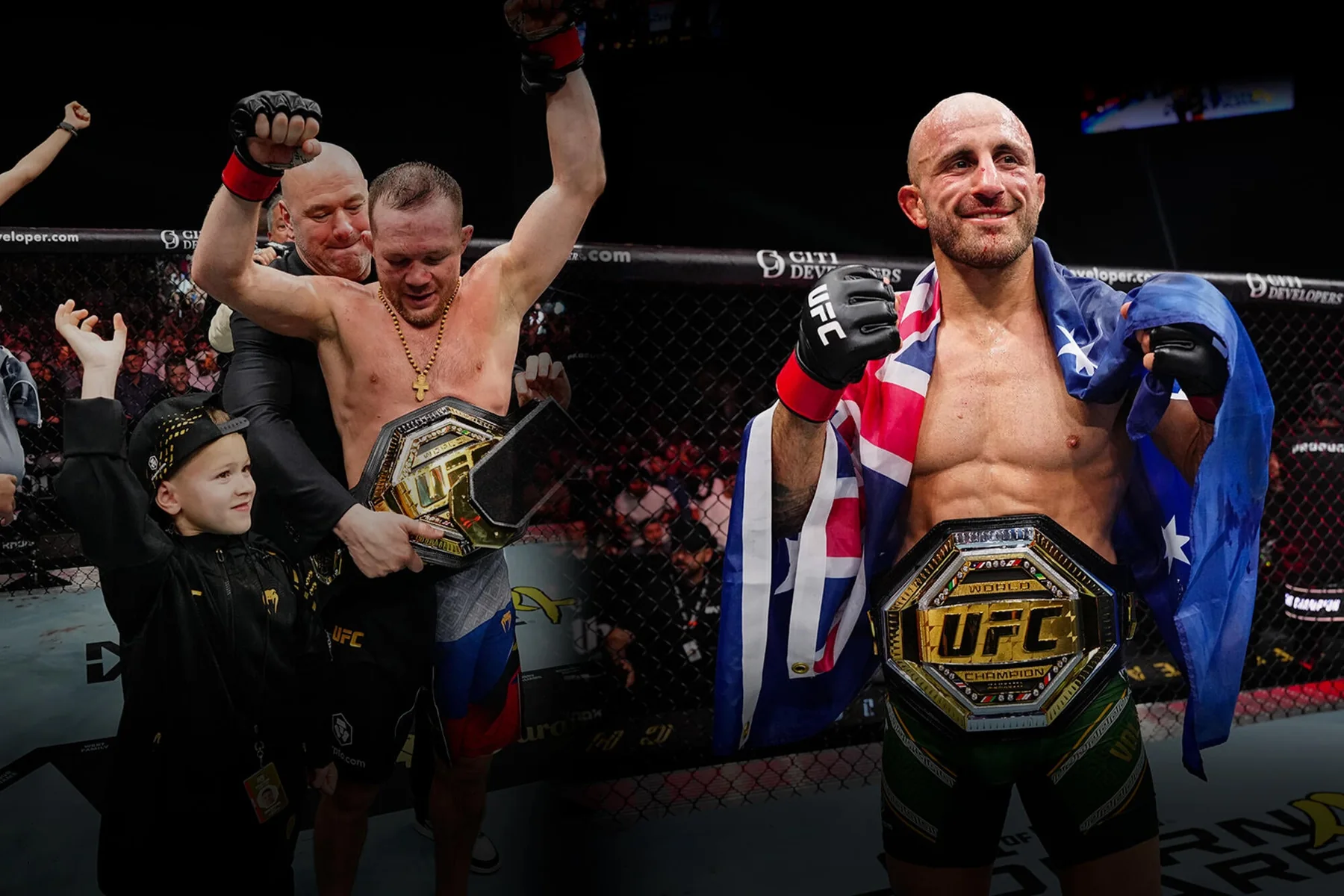
Alexander Volkanovski stopped Movsar Evloev at 4:54 of Round 2, and Petr Yan beat Merab Dvalishvili by unanimous decision to keep both championship belts with their owners at UFC 333. The October 24 card in Abu Dhabi paired an abrupt featherweight finish with a bantamweight fight that changed shape over five rounds. Here are the final results and the sequences that explain them.
UFC 333 results at a glance
UFC 333 took place at Etihad Arena in Abu Dhabi on October 24, 2026. Both champions retained, but their routes were very different: Volkanovski removed the judges from the main event, while Yan needed a late rally and the decision after 25 minutes. Those outcomes are the starting point for understanding the card, rather than treating every headline about a dominant champion as the same kind of performance.
| Winner and opponent | Official outcome |
|---|---|
| Alexander Volkanovski over Movsar Evloev | TKO, Round 2, 4:54 |
| Petr Yan over Merab Dvalishvili | Unanimous decision, 48–47 on all three cards |
| Lone'er Kavanagh over Ramazan Temirov | TKO, Round 1, 4:28 |
| Alexander Volkov over Rizvan Kuniev | Unanimous decision, 29–28, 30–27, 30–27 |
| Aaron Pico over Losene Keita | TKO, Round 1, 1:14 |
These are the main-card methods listed in the official UFC recap. A headline may call any spectacular striking finish a knockout; the result line is more precise. Kavanagh and Pico, like Volkanovski, are officially listed as winning by TKO. That distinction matters if you are comparing results, searching for a replay or discussing whether a referee intervened.
For someone who missed the event, the most useful order is the main event, the full co-main event and then the two first-round striking finishes. Yan's bout particularly benefits from a complete viewing: the action that established Dvalishvili's early pressure makes the champion's later changes more meaningful. Volkov's decision provides another contrast, with work at distance and in close rather than a single decisive highlight.
Our UFC results page helps place these outcomes alongside other cards. The earlier UFC 333 event guide supplies the pre-fight setting; this article follows the completed competition. The winners below are confirmed results, while comments about what could come next are analysis rather than announced matchups.
How Volkanovski finished Evloev in the second round
The decisive change was a clean right hand followed by immediate pursuit. Volkanovski did not give a hurt challenger an easy pause to recover. The official account of the finishing sequence describes Evloev turning away as he backed out, Volkanovski following and the fight ending under ground strikes. That chain is more informative than simply saying the champion's boxing was better.
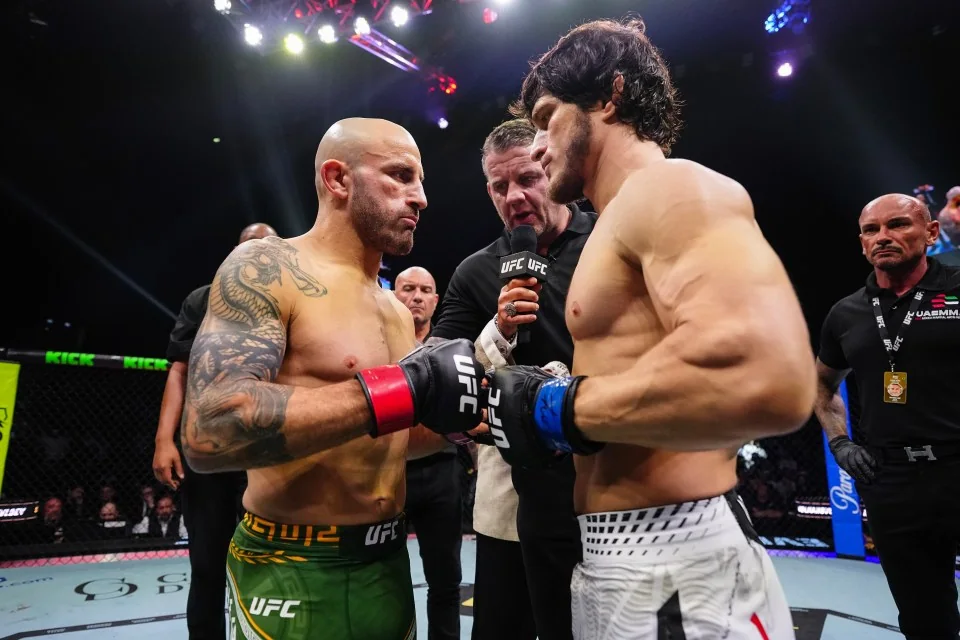
The opening round was a real contest
Evloev's early work deserves to survive the highlight. He was able to make Volkanovski grapple and had success before the decisive exchange. In Uncrowned's live round notes, the opening five minutes included brief takedowns, returns to the feet and strikes on separation. Those are active exchanges, rather than evidence that the challenger was overwhelmed from the opening bell.
For a grappler, the value of a takedown can include the offense that follows it and the effort required to escape. For the defending fighter, getting upright quickly preserves opportunities to strike. Both things can be true in the same exchange. A competitive first round does not make a second-round finish surprising in hindsight; it explains how much the situation changed once clean strikes began interrupting Evloev's responses.
The right hand changed the direction of the fight
Turning away during an exit can leave a fighter with fewer immediate answers. The practical question becomes whether he can regain his stance, defend the next attack and create enough separation to recover. Volkanovski's pursuit denied that comfortable reset. This is a tactical reading of the reported sequence, rather than a claim to know exactly what Evloev was thinking or feeling.
The distinction between landing first and following effectively is central. A clean punch might create a brief advantage that disappears if the attacker pauses or rushes out of position. Here, the advantage continued into the next phase and then the ground exchange. The finish therefore involved recognition and continuation as well as the initial connection. It should not be reduced to an unsupported diagnosis about Evloev's chin or willingness to compete.
Why the finish was recorded as a TKO
The official result is TKO by strikes, with six seconds remaining in Round 2. Sherdog's report identifies referee Marc Goddard's intervention after the follow-up attack. There is no need to describe Evloev as unconscious to explain the result. The intervention ended the contest while Volkanovski was striking.
That also explains why the opening round no longer determined the winner. No decision was required, and an unofficial media score for Round 1 is not the final result. When revisiting the bout, watch how often the fighters can reset early, then compare the exit and pursuit near the finish. The contrast gives a clearer account of the champion's work than watching the last few punches alone.
Yan solved a different problem against Dvalishvili
Yan retained by winning the decision after a fight in which he had to change the terms of engagement. All three judges returned 48–47 for the champion. That is a narrow round-based total, even though his strongest late moments looked emphatic. A rally in a championship fight is worth explaining on its own terms; it is not the same story as controlling every minute.
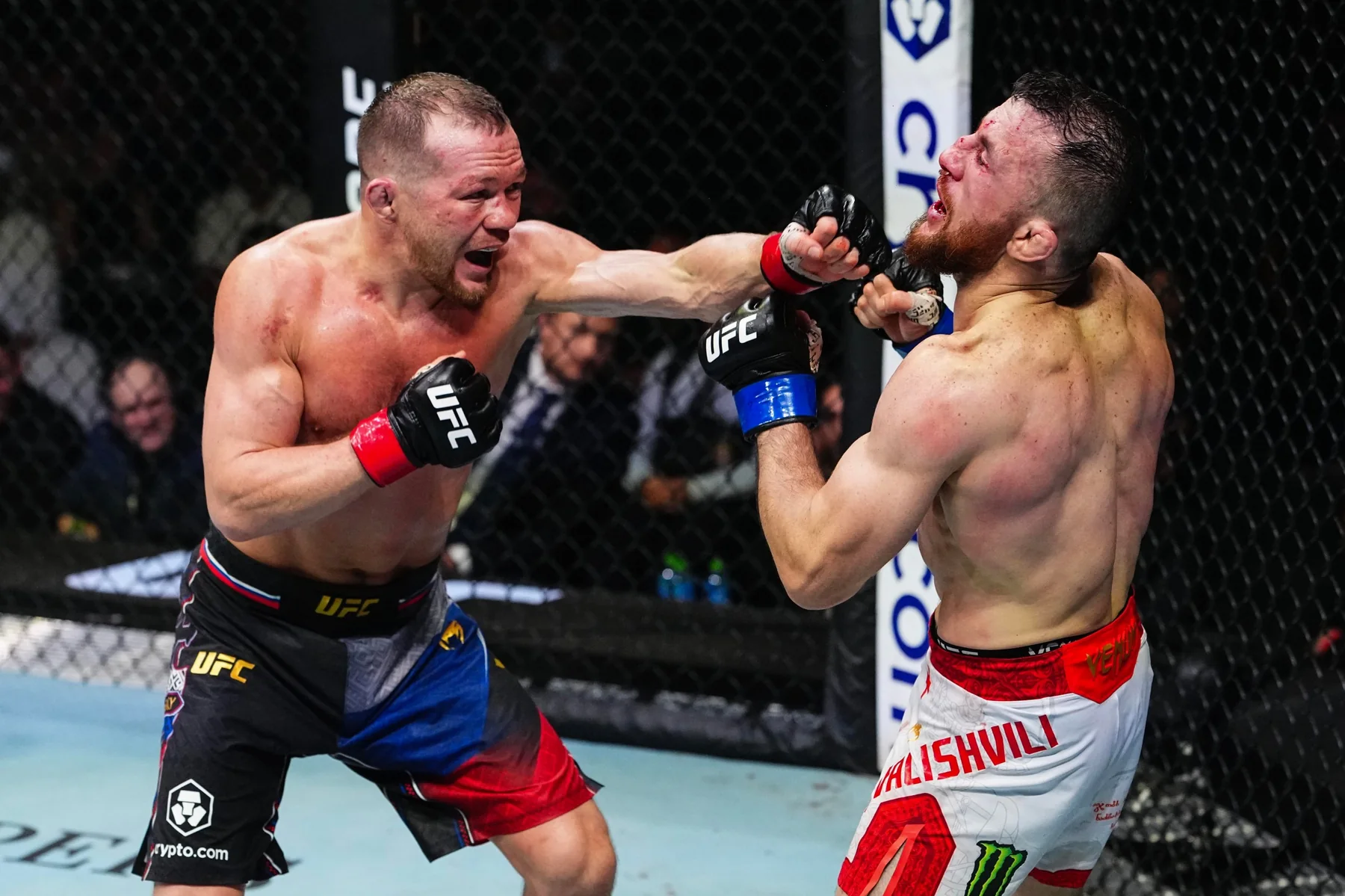
Early pressure limited the champion's offense
Dvalishvili repeatedly made Yan defend the wrestling. The UFC's co-main-event recap emphasizes how the challenger's early attacks occupied Yan's hands and restricted his opportunities to strike. Even when a takedown did not become a long stretch of top control, the next entry could arrive before the champion had established his preferred rhythm.
That is why looking only at the final successful-takedown count would miss part of the tactical picture. An attempt can force a response without automatically earning a judge's favor. The useful distinction is between the defensive work it demands and the effective offense it produces. Dvalishvili was creating repeated problems; Yan needed to defend them in ways that also allowed him to answer.
Body work and defensive resets shifted the fight
By the third round, Yan was finding more meaningful offense, including work to the body. His later success combined cleaner striking with the ability to return to exchanges after defending wrestling. MMA Fighting's report describes Yan picking his moments and repeatedly attacking the body as the contest developed. This was an improvement in what followed the defense, as well as in the defense itself.
The distinction matters for watching the closing rounds. When the champion can reset with enough balance and space to attack, the challenger has to deal with consequences on the way in and out. Dvalishvili continued pressing rather than conceding the contest, but pressure alone did not prevent Yan from landing the more telling late offense.
For a scoring discussion, keep each five-minute round separate. The strongest final exchanges do not rewrite an earlier round, and the final 48–47 totals alone cannot tell you every judge's individual round assignment. Our guide to UFC statistics explains why control time, takedowns and significant strikes answer different questions. The confirmed result here is unanimous retention for Yan; a complete card-by-card audit requires the original score sheets.
Kavanagh, Pico and Volkov gave the main card its depth
The three non-title main-card fights offered distinct reasons to pay attention. Kavanagh and Pico produced quick striking conclusions, while Volkov built a decision across several phases. The official bout recaps make those differences clear: an uppercut, an attack linking wrestling and punching, and a heavyweight performance that extended into close-range grappling.
Kavanagh found the decisive uppercut
Lone'er Kavanagh stopped Ramazan Temirov at 4:28 of the opening round. The early exchanges were competitive before the uppercut created the opening for the finishing punches. The useful technical detail is the transition from trading at range to connecting with a strike through the middle. A finish can arrive late in an otherwise contested round; the official time does not mean the preceding minutes were one-way traffic.
For flyweight followers, this is a performance to evaluate through opponent and sequence rather than duration alone. The clean connection and the follow-up were the immediate reasons it ended. They support interest in Kavanagh's next opponent without automatically establishing a championship booking or proving how he would handle every style near the top of the division.
Pico made the level change matter
Aaron Pico's TKO of Losene Keita came after 74 seconds. His first approach included a takedown, followed by Keita getting back upright. The subsequent right hand and ground follow-up supplied the finish. The wrestling therefore belongs in the explanation even though punches decided the result.
The tactical reading is that attacks at different levels give a defender more than one problem to solve. A fighter preparing to meet another entry also has to recognize the next strike quickly enough to defend it. That does not establish Keita's private expectation on the decisive exchange. It explains why isolating the final right hand can leave out relevant work that preceded it. Pico won a short contest through linked phases, rather than a striking exchange with no setup.
Volkov won through more than reach
Alexander Volkov beat Rizvan Kuniev unanimously, with two 30–27 cards and one 29–28. His length mattered, but the official account also identifies clinch work and a prolonged back-control phase late in the third round. Those details prevent the result from becoming a generic story about a taller heavyweight staying outside.
A fighter who can compete effectively in close makes it harder for an opponent to solve distance simply by getting past the long strikes. Volkov's third consecutive victory strengthened his position in the heavyweight conversation, while the decision still needs to be read as three individually scored rounds. It did not award a future title fight. For the eventual booking and date, follow the UFC schedule rather than treating a contender's post-fight ambition as an announced bout.
The prelim results deserve a closer look
The earlier bouts supplied important finishes and a scoring issue that should be kept separate from judging preferences. The official preliminary results list nine fights before the main card:
- Dominick Reyes beat Azamat Murzakanov by KO, head kick and punches, at 2:40 of Round 1.
- Abdul Rakhman Yakhyaev beat Nikita Krylov by TKO, knee, at 2:38 of Round 1.
- Abus Magomedov beat Cam Rowston by technical submission, guillotine choke, at 1:44 of Round 1.
- Grant Dawson beat Nurullo Aliev unanimously, 29–27 on all three cards.
- Colby Thicknesse beat Asaf Chopurov by split decision, with two 29–28 cards for Thicknesse and one 29–28 for Chopurov.
- Abubakar Vagaev beat Jacob Malkoun unanimously, 29–28 on all three cards.
- Daniel Santos beat Bolaji Oki unanimously, 29–28 on all three cards.
- Kody Steele beat Noah Gugnon by KO, strikes, at 3:54 of Round 1.
- Iasmin Lucindo beat Nicolle Caliari unanimously, 30–27 on all three cards.
Reyes and Yakhyaev delivered first-round finishes
Reyes' finish followed a moment of danger for him. The official recap describes Murzakanov landing a left hand before Reyes found space, reset and connected with the high kick that started the finishing attack. The interesting part is that recovery and reset: the winner of an exchange is not guaranteed to win the next one. Watch the separation before the finish to understand why that kick had room to work.
Yakhyaev's finish took a different route. His grappling attack moved from a choke attempt into a riding position, and the decisive knee arrived as Krylov tried to rise. The sequence links submission threat, positional adjustment and striking. It is a reason to watch the transition rather than just the impact. A written recap does not replace the exact frames needed for any separate argument about a grounded opponent's legal status.
Dawson's scorecards included a foul deduction
Aliev lost a point in the first round for shots to the back of Dawson's head. The final 29–27 totals therefore include a referee's penalty as well as the judges' scoring. A point deduction and a wider winning margin within a round are different mechanisms. Do not take an unusual total and assume it proves a judge awarded a particular 10–8 round.
The broader lesson is to preserve the detail behind a result line. Magomedov's technical submission identifies a different ending from a tap; Thicknesse's split decision identifies disagreement between judges; Lucindo's three 30–27 cards identify unanimous round totals. None of those labels, by itself, supplies a complete account of every exchange. Together, they show why the prelims are useful viewing for fight fans interested in more than the two championship outcomes.
What the card changes in the title picture
The immediate championship picture is simple: Volkanovski remains featherweight champion and Yan remains bantamweight champion. What is less settled is the next appointment for either man. A successful defense confirms the belt holder after this card; it does not establish the challenger, date or weight class of the champion's following fight.
Volkanovski's win removes an undefeated challenger from the immediate title equation and adds another successful defense to his second reign. That is meaningful without declaring that Evloev can never return. A first defeat changes a contender's position, but the response against future opponents will tell us more about his route back than an instant prediction made from one finishing sequence.
There is also a difference between Volkanovski expressing interest in a lightweight opportunity and the UFC announcing one. Reporting on his post-event comments describes conditional interest involving Justin Gaethje and Ilia Topuria. As of October 29, those comments are intentions and possibilities in this account, rather than a confirmed fight with an agreed date. They should not be used to tell featherweight contenders that their division has already been vacated.
At bantamweight, Yan's second victory over Dvalishvili gives him the lead in their completed trilogy. The UFC's post-card analysis discusses Song Yadong and Sean O'Malley in the next-challenger conversation. That is useful context for the debate, while an editorial discussion is still different from a signed and announced title fight.
The same discipline applies further down the card. Volkov strengthened his argument, Kavanagh supplied a memorable finish and the light heavyweight winners made themselves harder to overlook. None receives a future belt merely from winning emphatically. Follow the announced schedule for actual bookings; use the performances to understand why certain matchups will interest fight fans when they become real.
How to revisit UFC 333 without losing the important context
Start with the official UFC 333 results and highlights hub, which separates the main card, prelims and scorecards. Those are different ways into the event. A result page establishes the outcome, a highlight shows selected action and an original scorecard records the judges' round scores. None should be silently substituted for the others.
For the main event, watch the opening exchanges before the finish. Evloev's attempts to create grappling work explain why Volkanovski's ability to keep returning to a striking contest mattered. Then focus on the change after the clean right hand: the exit, the pursuit and the continuation on the ground. That order preserves the difference between a competitive pairing and its decisive final sequence.
For Yan against Dvalishvili, the full rounds are especially useful. Watch an early round and a late one with the same questions: who is producing the effective offense, what does the wrestling achieve after contact, and who can attack after a defensive reset? If you then want to score the bout, replay all five rounds consecutively and record each one before looking at the final totals. A compilation of Yan's best late punches cannot answer what happened across the opening ten minutes.
Access to particular videos or full replays depends on the viewing service and territory. Check the current UFC viewing guide and your local provider rather than assuming a highlight link guarantees a complete replay everywhere. The official pages themselves can display regional availability notices.
Finally, keep the date attached to every conclusion. UFC 333 settled the October 24 results, not every question about the divisions' future. The strongest explanation of the card connects the actual finishes and decisions to the next questions without announcing bouts that have not been confirmed. Volkanovski's pursuit, Yan's adjustment and the variety beneath them are enough to make this a card worth revisiting carefully.
Fight talk
Comments