What were the full UFC Freedom 250 results?
Justin Gaethje stopped Ilia Topuria after four rounds to win the undisputed lightweight championship in the UFC Freedom 250 main event. Ciryl Gane claimed the interim heavyweight title in the co-main event, and every one of the seven contests ended by KO or TKO. The completed card took place Sunday, June 14, 2026, on the White House South Lawn in Washington, D.C.
| Winner | Opponent | Official result | Stakes |
|---|---|---|---|
| Justin Gaethje | Ilia Topuria | TKO, corner stoppage — R4, 5:00 | Won undisputed lightweight title |
| Ciryl Gane | Alex Pereira | TKO, strikes — R2, 1:27 | Won interim heavyweight title |
| Sean O’Malley | Aiemann Zahabi | KO, right hand — R2, 4:02 | Bantamweight bout |
| Josh Hokit | Derrick Lewis | TKO, strikes — R2, 4:09 | Heavyweight bout |
| Mauricio Ruffy | Michael Chandler | TKO, strikes — R1, 4:29 | Lightweight bout |
| Bo Nickal | Kyle Daukaus | TKO, strikes — R1, 4:34 | Middleweight bout |
| Diego Lopes | Steve Garcia | KO, strikes — R2, 2:42 | Featherweight bout |
Three details keep the table accurate. First, UFC’s official scorecard labels O’Malley’s finish a knockout by right hand, even though some compact recaps use TKO. Second, Gaethje’s time of 5:00 in Round 4 means the round was completed and Topuria’s corner declined to send him out for the fifth; it was not a referee stoppage during live fourth-round action. Third, Gane won an interim heavyweight belt, while Gaethje left as the undisputed lightweight champion.
The seven-of-seven finish rate is literal: zero decisions and zero submissions. It does not mean every ending was the same. Two official results were KOs, four were strikes TKOs, and the main event was a corner-stoppage TKO. Those labels preserve who ended the contest and how.
This is also why a final results record differs from the card fans saw before the opening bell. A scheduled matchup only says who was expected to compete; an official result supplies the winner, method and time. Our UFC Fight Night guide explains how cards can change before an event, while the table above records what actually happened at Freedom 250.
The table is arranged main event first for quick lookup on mobile screens and later result checks. In live order, Lopes–Garcia opened the night and Topuria–Gaethje closed it. That display choice changes neither the official sequence nor the recorded result.
How did Justin Gaethje beat Ilia Topuria?
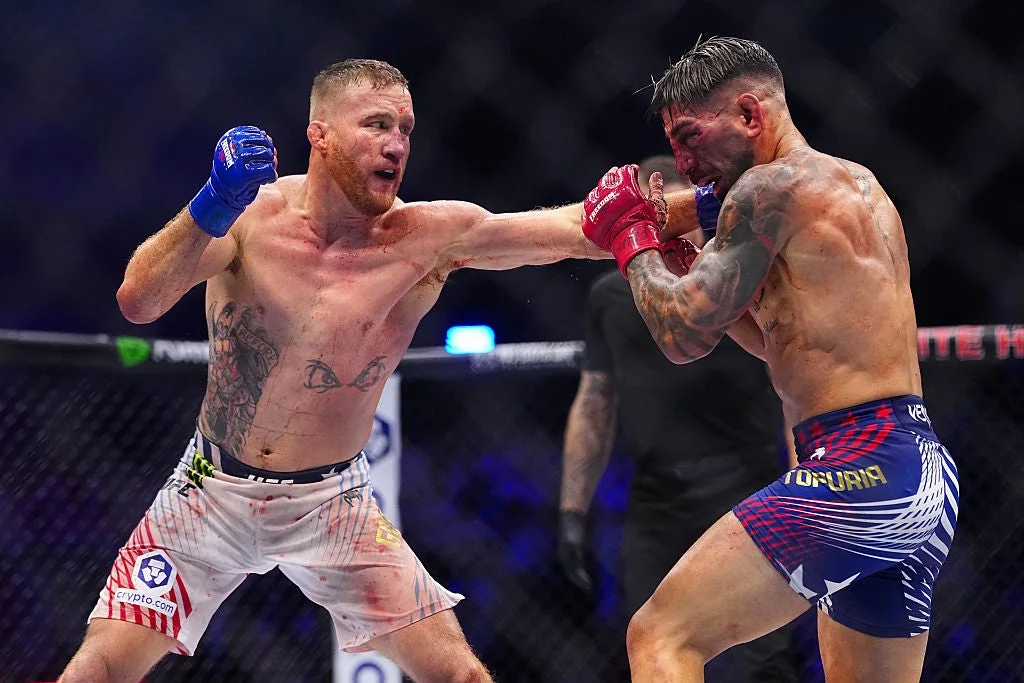
Gaethje survived Topuria’s strongest phase, restored control with straight punches and sustained pressure, and produced enough cumulative damage that Topuria’s corner stopped the fight before Round 5. The official result is a TKO by corner stoppage at 5:00 of Round 4. That wording matters: the fourth round ended normally, and the corner chose not to send Topuria back out.
The outcome did not follow a simple one-way script. Gaethje established his jab and landed the heavier work in the opening round, but Topuria changed the momentum in Round 2. His attack to the body dropped Gaethje, and he followed from top position with ground strikes and submission threats. Gaethje had to defend, recover and resist the temptation to turn the next exchange into an uncontrolled brawl.
His answer arrived through repeatable offense rather than one isolated highlight. In Round 3, the jab and straight right increasingly found Topuria as he advanced. Those cleaner lines damaged Topuria’s face and made each entry more costly. A doctor assessed Topuria between rounds, but the contest continued; the doctor did not record the final stoppage. Gaethje maintained the pressure in Round 4, mixing head attacks with punishing body work instead of giving Topuria the reset he needed.
Topuria still reached the end of that round, but his corner decided he could not safely continue. The result therefore belongs to Gaethje’s accumulated work across the third and fourth, not to a fictional fifth-round exchange or a medical stoppage. It also completed a major career turn: Gaethje became the undisputed UFC lightweight champion and ended Topuria’s previously unbeaten professional run. The best short description is precise rather than dramatic—Gaethje weathered the second-round crisis, imposed the more sustainable attack, and forced the corner’s decision after four rounds.
For replay viewers, the decisive transition begins after Topuria’s second-round success. Watch how Gaethje returns to the straight path down the middle and makes Topuria absorb damage while closing distance. The visible sequence supports the tactical explanation without pretending that an unofficial strike total or speculative injury diagnosis is needed to understand the finish.
What happened when Ciryl Gane fought Alex Pereira?
Ciryl Gane stopped Alex Pereira with strikes 1:27 into Round 2 and won the interim UFC heavyweight championship. UFC’s official result calls the ending a TKO, not a single-shot knockout and not a decision. That distinction fits the sequence: Gane hurt Pereira, continued the attack and prompted the referee to intervene while Pereira was still absorbing offense.
The finishing run developed quickly after the second round began. Associated Press coverage described a right jab that sent Pereira stumbling, followed by a hammer fist and continued pressure. A left to the chin came at the end of the surge before the stoppage. The useful replay cue is therefore the combination of disruption and follow-up, rather than an attempt to reduce the finish to one cinematic blow. Gane created the opening, recognized that Pereira had not recovered and kept working until the referee had seen enough.
The stakes made the result larger than an ordinary heavyweight win. Pereira was making his UFC heavyweight debut after championship runs at middleweight and light heavyweight. Victory would have made him the first athlete to win UFC titles in three weight divisions. Gane prevented that milestone and became an interim heavyweight champion again, adding a belt while stopping one of the promotion’s most accomplished multi-division finishers.
“Interim” remains the essential qualifier. The bout created a champion for the division’s temporary title track; it did not make Gane the undisputed heavyweight champion. Our UFC weight classes guide explains the division limits and title-fight allowance, while this result answers the narrower question: Gane won at heavyweight by second-round TKO, and Pereira’s bid for a third UFC division ended at 1:27.
Which other fighters won at UFC Freedom 250?
Sean O’Malley, Josh Hokit, Mauricio Ruffy, Bo Nickal and Diego Lopes won the five non-title bouts. None needed the judges. Read in live-event order, their finishes show how a seven-fight card reached the main and co-main events without producing a single scorecard.
Diego Lopes def. Steve Garcia
Official result: KO (strikes), Round 2 at 2:42. Garcia’s jab helped keep the opener measured, but Lopes changed the fight with a left hook in the second and finished with follow-up blows. It was the night’s first bout and first knockout.
Bo Nickal def. Kyle Daukaus
Official result: TKO (strikes), Round 1 at 4:34. Nickal established the threat of his wrestling, did damage after getting the fight down and later dropped Daukaus on the feet. The referee stepped in during the follow-up, so the record uses TKO rather than KO.
Mauricio Ruffy def. Michael Chandler
Official result: TKO (strikes), Round 1 at 4:29. Ruffy controlled the striking distance, hurt Chandler with a kick and closed the show with punches near the fence. This was a lightweight bout, despite one live-news summary incorrectly labeling the division.
Josh Hokit def. Derrick Lewis
Official result: TKO (strikes), Round 2 at 4:09. Hokit’s control and ground work made Lewis carry the fight early. When Lewis pressed in the second, Hokit answered with overhand rights and a finishing combination, ending the late-added heavyweight matchup before the horn.
Sean O’Malley def. Aiemann Zahabi
Official result: KO (right hand), Round 2 at 4:02. O’Malley first stunned Zahabi with a left and then landed the right that ended the contest. The win snapped Zahabi’s seven-fight UFC winning streak and delivered the last non-title finish before the two championship bouts.
In casual conversation, all five may be called knockouts. For an accurate record, however, UFC lists two KOs—Lopes and O’Malley—and three strikes TKOs—Nickal, Ruffy and Hokit. Preserving those official labels prevents a quick recap from quietly rewriting how each referee recorded the ending. It also keeps the method count aligned with the completed result table: five non-title stoppages, followed by Gane’s TKO and Gaethje’s corner-stoppage TKO.
Why did the all-stoppage card enter UFC history?
Freedom 250 became the first UFC event at which every bout ended by knockout or technical knockout. The completed card went seven for seven: two official KOs and five TKOs, with no submission, decision, draw, disqualification or no contest. UFC repeated that historical description in both its result coverage and its post-event audience report.
7
bouts completed
7
KO/TKO finishes
0
judges’ decisions
That claim is narrower than it first sounds. It does not mean this was the first UFC card with no decisions: an all-finish event could also include submissions. It does not mean Freedom 250 set the record for the greatest number of stoppages on one show, either. Seven fights made it a compact event compared with many modern cards, so its perfect finish percentage and its raw finish total answer different questions.
The method wording also protects the record from hype. Gaethje’s corner stoppage is officially a TKO, as are the referee interventions for Gane, Hokit, Ruffy and Nickal. Lopes and O’Malley own the two official KOs. “Every fight was a knockout” works as promotional shorthand; “every bout ended by KO or TKO” is the accurate historical formulation.
UFC’s bonus report reflected the concentration of finishes. Gaethje and Gane received the named Performance of the Night awards, while UFC stated that the other winners received $25,000 finish bonuses. Those awards add context, but they do not prove that the event was the “greatest” card—a subjective label. Nor does the perfect rate tell readers whether every matchup was close or competitive; it records how the bouts ended, not their quality. As of August 19, 2026, the defensible legacy is measurable: the first seven-bout UFC event to finish 7-for-7 by KO or TKO.
What made the White House setting unique?
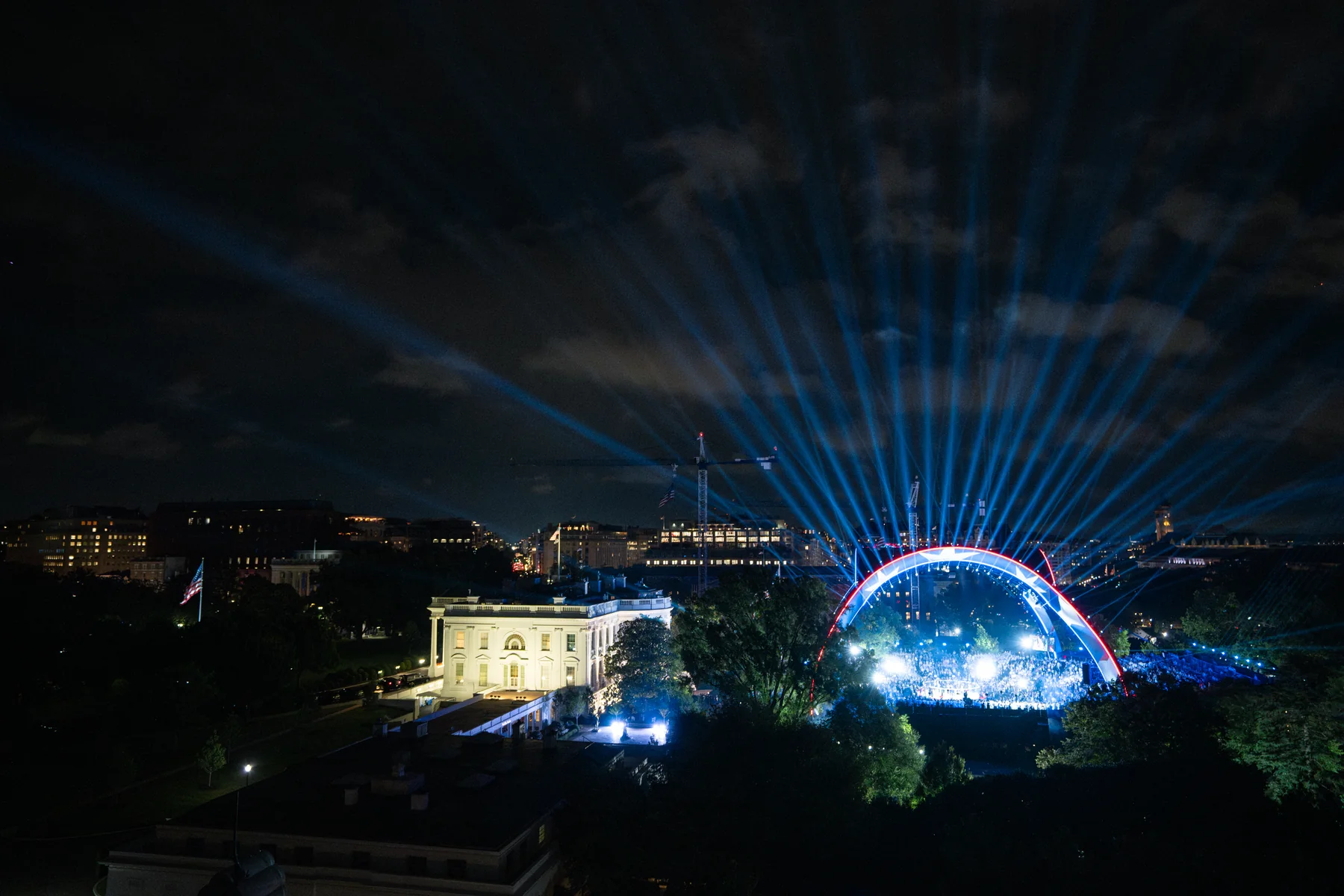
Freedom 250 was the first mixed martial arts event held at the White House, with the Octagon installed on the South Lawn instead of inside a conventional arena. The location changed nearly every part of the presentation around the fights: where athletes prepared, how they walked to the cage, what spectators saw overhead and how the broadcast framed the night.
A working landmark became backstage space
Official photographs place fighters in the Red, Green and Blue rooms and show Ciryl Gane walking through the Cross Hall. The headline fighters’ route incorporated the Oval Office. That does not mean every athlete began there; different matchups used different interior spaces.
The cage sat under the Claw
A large open-air production structure nicknamed the Claw held the lighting and screens above the Octagon. With the White House directly behind it, even standard wide shots looked unlike a UFC arena broadcast. Associated Press reported more than 4,000 spectators in the South Lawn audience.
Walkouts became part of the location
The route from formal White House corridors into an outdoor fight cage made movement between backstage and competition visible storytelling. For the main event, fireworks accompanied the introductions, extending the walkout beyond the familiar tunnel, curtain and arena aisle.
Ceremony joined fight production
The Marine Band played entrance music, while the Navy Blue Angels and Air Force Thunderbirds conducted a flyover. Those elements connected the card to America’s 250th-anniversary celebrations and President Donald Trump’s 80th birthday without changing the official fight rules or results.
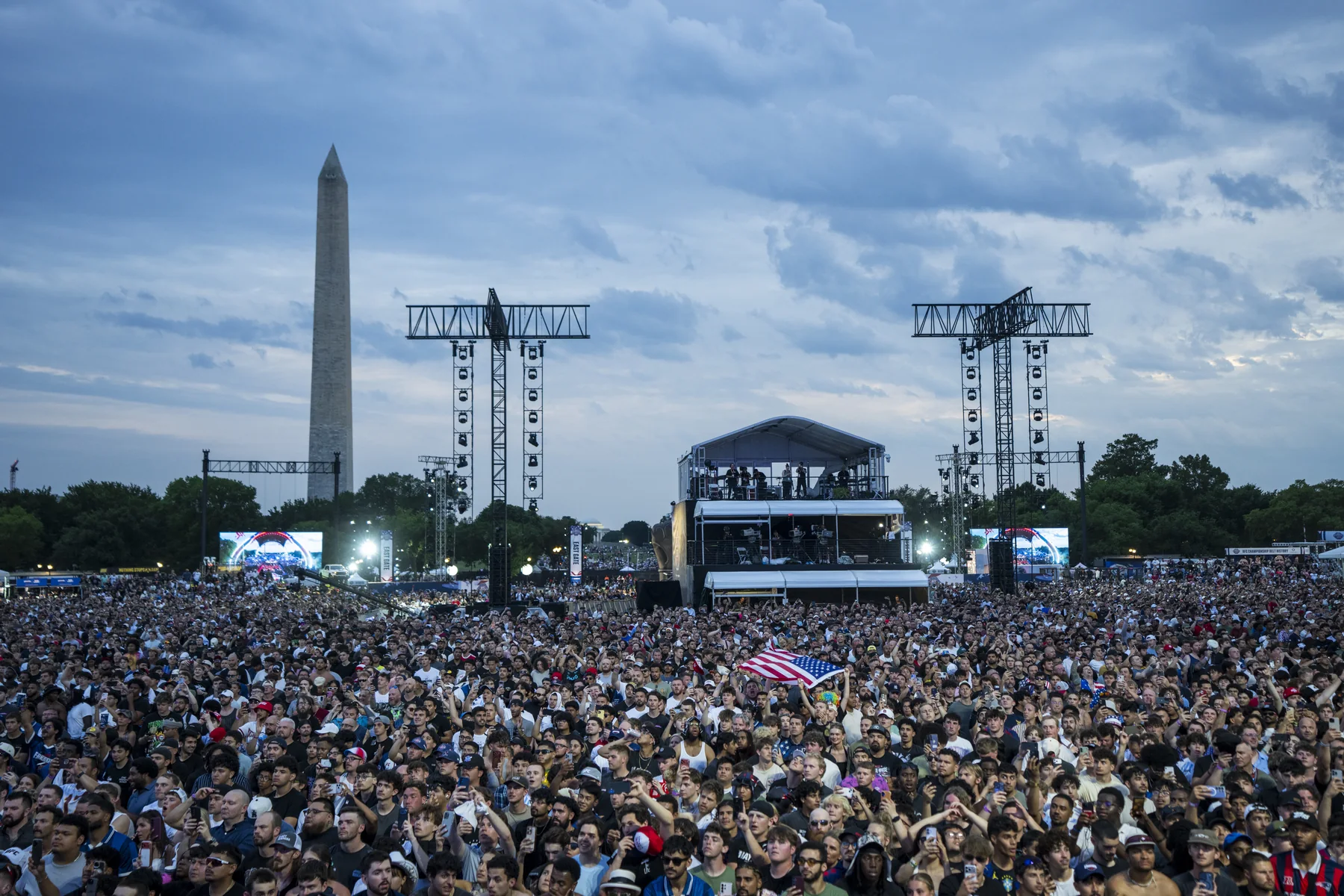
One geographic distinction is essential. The actual contests and the 4,000-plus audience described by AP were on the secured South Lawn. The public-facing Fan Fest and large-screen watch party were on the Ellipse, the open area between the White House and Washington Monument. Both belonged to the same weekend, but they were not interchangeable venues or interchangeable tickets. When a photograph shows distant screens or the Washington Monument viewpoint, it may depict the public viewing footprint rather than a seat beside the Octagon.
Were Fan Fest tickets also White House fight tickets?
No. The free UFC Freedom 250 Fan Fest ticket covered the Ellipse event and its large-screen watch party; it did not admit the holder to the fight audience on the White House South Lawn. The confusing shorthand “White House ticket” circulated around both, but the official product name, location and entitlement were different.
Ellipse Fan Fest / watch party
- Free ticketed public experience on the Ellipse
- Fan activities, weigh-in and entertainment across two days
- Sunday fights shown live on large screens
- Up to two tickets could be requested through a random drawing
South Lawn fight audience
- Separate secured audience beside the actual Octagon
- Limited invitation/VIP distribution, not the Fan Fest request pool
- Associated Press reported more than 4,000 attendees after the event
- An Ellipse confirmation did not grant access to this area
UFC’s request rules added several safeguards. A submission was not a guaranteed ticket; eligible requests were selected randomly. Issued passes were mobile-only, non-transferable and prohibited from resale, and selected registrants could be screened. The temporary $1 card authorization mentioned in the FAQ verified identity—it was not a ticket charge. Those details made a third-party “transfer” especially risky even before fight night.
Pre-event reports also used changing capacity projections for the Ellipse. Those planning estimates should not be treated as final attendance, and a larger public allocation never changed what the ticket delivered: admission to the viewing area, not a South Lawn seat.
Completed-event warning
Freedom 250 ended on June 14, 2026. As of August 19, no ticket can provide future entry to this event. An offer for a current “live” ticket is expired, misleading or fraudulent, and an archived resale listing does not establish that the pass was transferable or valid.
The practical test is simple: read the venue line. “The Ellipse” meant the Fan Fest and remote viewing experience; “South Lawn” meant the actual fight site. Being steps from the White House and watching the same live feed was still not the same as holding a seat beside the cage.
What is UFC Freedom 250's legacy after the final bell?
Freedom 250 left three durable records: a consequential championship reset, the UFC’s first all-KO/TKO card and the first MMA event held at the White House. Audience reports then added unusual scale, but those figures only stay meaningful when reach, average viewers and geography remain attached to them.
Competition
Justin Gaethje became undisputed lightweight champion and ended Ilia Topuria’s unbeaten professional run. Ciryl Gane won interim heavyweight gold and stopped Alex Pereira’s attempt to become a UFC champion in a third weight division.
Card record
All seven bouts ended by official KO or TKO. That 7-for-7 finish rate remains a specific company first as of August 19, 2026, without needing the subjective claim that every fight was an all-time classic.
Place
The South Lawn, White House rooms and Ellipse experience created a one-night event footprint no normal arena could copy. UFC called it the first MMA event at the White House; that narrow first is the defensible historical label.
Paramount reported that the stream reached 17 million viewers in the United States and Latin America, while the live average-minute audience across the seven bouts was 8.2 million—7.0 million in the U.S. and 1.2 million in Latin America. “Reached” counts people who watched at some point; it is not an average concurrent audience. Paramount called the show its biggest exclusive live event at the time and reported more than 130,000 Fan Fest attendees across two Ellipse days, a separate measure from South Lawn attendance.
UFC later estimated 34 million global viewers after adding other international markets. That estimate expands the geography of the earlier report; it should not be added to the 17 million regional reach figure or presented as though every market used one measurement system. The careful conclusion is still substantial: Freedom 250 paired verified sporting firsts with a large streaming audience, while leaving political judgment and “greatest ever” rankings to the reader. Future cards may surpass a platform record, but they cannot become the first UFC card staged here or erase who won on June 14.
Fight talk
Comments