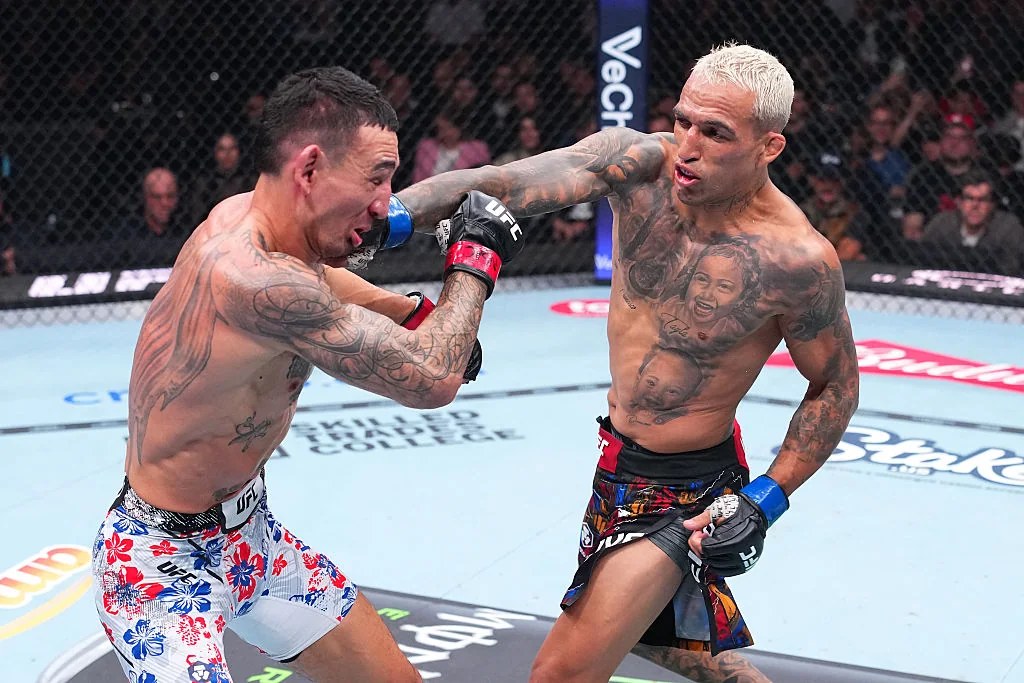
Charles Oliveira’s UFC record is 25 wins, 11 losses and one no contest as of October 19, 2026. His complete professional MMA record is 37 wins, 11 losses and one no contest. Those are different totals: the larger number includes fights before he joined the UFC. His latest completed bout was the March 7, 2026 unanimous-decision win over Max Holloway for the BMF title.
Charles Oliveira’s record: UFC bouts versus his full MMA career
The quickest way to understand Oliveira’s record is to state the competition being counted. A fighter profile can display a complete professional record while sitting on the UFC website. That does not make every win on that profile a UFC win. UFC is the promotion; MMA is the sport in which the broader career took place.
| Scope through October 19, 2026 | Wins | Losses | No contests | Total appearances |
|---|---|---|---|---|
| UFC bouts | 25 | 11 | 1 | 37 |
| All professional MMA bouts | 37 | 11 | 1 | 49 |
The total appearances are simple additions of the completed results, including the no contest. There are no draws in either line. The difference between the two win totals is twelve victories before his UFC debut. This distinction also prevents his overall submission total from being mistaken for his promotion-only submission record.
Why the no contest stays separate
The no contest comes from Oliveira’s June 26, 2011 bout with Nik Lentz. UFC’s official history records an illegal knee and a no-contest result. It belongs in his number of appearances but should not be converted into a win, a loss or a draw. His later victories over Lentz are different fights and do not replace that entry.
Use the same care with dates. A booked bout can appear prominently on a Charles Oliveira fighter page before it takes place. It changes the upcoming schedule, not the completed record. When comparing a historical article with the current totals, identify the last fight each source includes rather than assuming every different number is a contradiction.
The early UFC years: eight losses before his title run
Oliveira’s UFC debut was a 41-second armbar win over Darren Elkins on August 1, 2010. It advertised exceptional submission ability immediately. It did not mean that the young fighter’s broader MMA game was already equipped to beat every experienced lightweight or featherweight he would face.
By the end of 2017, his UFC record stood at 10-8 with one no contest. Those eight defeats came against the following opponents. The methods matter: a decision, an injury stoppage and a submission are different competitive outcomes, even though each adds one loss.
| Opponent | Date | Official method |
|---|---|---|
| Jim Miller | December 11, 2010 | Submission, kneebar |
| Donald Cerrone | August 14, 2011 | TKO, strikes |
| Cub Swanson | September 22, 2012 | KO |
| Frankie Edgar | July 6, 2013 | Unanimous decision |
| Max Holloway | August 23, 2015 | TKO, injury |
| Anthony Pettis | August 27, 2016 | Submission, guillotine |
| Ricardo Lamas | November 5, 2016 | Submission, guillotine |
| Paul Felder | December 2, 2017 | TKO, strikes |
That list includes established contenders and champions, and it crosses different stages of Oliveira’s development. It is more informative than describing him as a fighter who simply failed whenever opposition improved. He was gaining experience against opponents with mature striking, wrestling and submission games while moving between featherweight and lightweight.
The 2015 Holloway result deserves particular care. It was an injury TKO in the first round. It remains an official loss, but it did not provide the same sustained tactical evidence as their five-round rematch in 2026. Do not erase the first result, and do not use its short duration to invent how a healthy fight would have developed.
Felder’s victory at UFC 218 became the last defeat before Oliveira’s championship-building streak. Looking backward from a title win can make that turning point seem inevitable. It was not. A 10-8 UFC record still contained exceptional talent, but becoming a champion required a sequence of better performances against increasingly demanding opposition. The losses explain the distance he traveled; they should not be edited out of the career story.
The winning streak that changed his lightweight career
Oliveira reached his first UFC title opportunity on an eight-fight winning streak. The run began against Clay Guida in June 2018 and continued through Christos Giagos, Jim Miller, David Teymur, Nik Lentz, Jared Gordon, Kevin Lee and Tony Ferguson. It was a sustained sequence, not one dramatic victory that suddenly placed him in a championship fight.
The methods show a wider game than the label “submission specialist” can suggest. His wins over Guida, Giagos, Miller and Teymur included different routes to a tap. He then stopped Lentz and Gordon with strikes. The threat of his grappling remained central, but opponents were also being punished before the fight became a prolonged ground exchange.
Lee and Ferguson provided especially useful checkpoints in 2020. Oliveira submitted Lee with a guillotine 28 seconds into the third round on March 14. Nine months later, he beat Ferguson by a three-round unanimous decision at UFC 256. One fight ended through a decisive submission opportunity; the other required him to sustain a successful performance to the final horn.
That contrast matters when assessing a contender. A fighter who can threaten a finish and also win a complete fight has more than one way to turn skill into a result. The Ferguson decision did not make the previous submissions less impressive. It added evidence that Oliveira could remain effective when an opponent survived the immediate danger.
Keep the streak’s different milestones straight. The eight victories earned the Chandler title opportunity. Beating Chandler made it nine. The Poirier defense made it ten, and the Gaethje victory made it eleven before Islam Makhachev ended the run in October 2022. Those numbers describe consecutive wins across the climb and championship period. They do not describe eleven title defenses.
The editorial lesson is about accumulation rather than destiny. Oliveira did not need to become a different person on the night he won the belt; he needed the parts of his game to produce reliable results against a rising standard of opposition. The streak is the bridge between the gifted but inconsistent early fighter and the champion he became.
The lightweight championship run, fight by fight
Oliveira won the undisputed UFC lightweight title once and made one successful defense. The Gaethje victory is an essential part of his championship-era run, but its unusual eligibility rules mean it cannot be added as another successful defense. Follow the three fights in order.
UFC 262: surviving Chandler to win the vacant belt
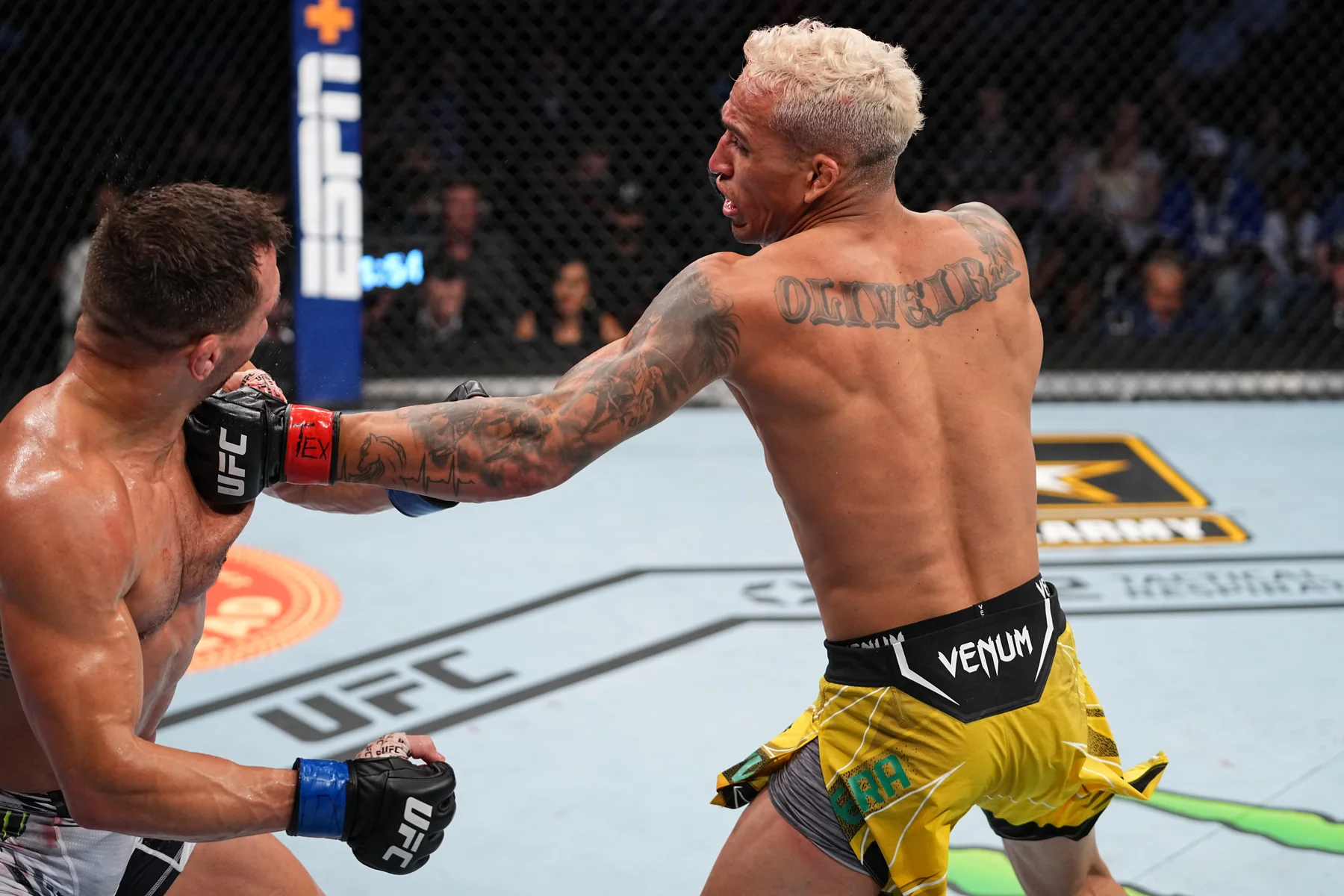
On May 15, 2021, Oliveira stopped Michael Chandler 19 seconds into Round 2 at Toyota Center in Houston. The lightweight title was vacant following Khabib Nurmagomedov’s retirement. Oliveira’s victory made him champion after more than a decade of UFC competition.
The turning point was striking, despite his submission reputation. Chandler had hurt him during a volatile first round. Early in the second, Oliveira landed the left hook that dropped Chandler, then pursued the follow-up until the referee intervened. Surviving the first-round danger mattered, but the title-winning action was the immediate offensive response after the interval. His route to the belt therefore cannot be described accurately as simply another submission.
UFC 269: the successful defense against Poirier
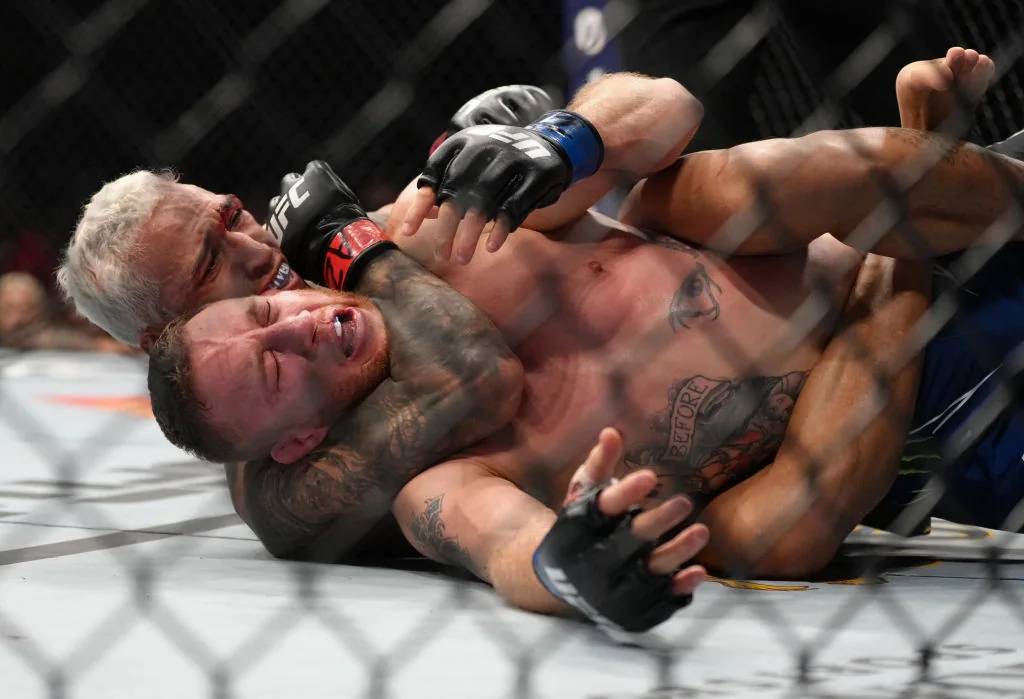
On December 11, 2021, Oliveira submitted Dustin Poirier with a rear-naked choke at 1:02 of Round 3. This was the successful defense of the lightweight championship he had won against Chandler.
Again, the early difficulty did not settle the fight. Poirier had productive striking exchanges, while Oliveira increasingly brought the contest into grappling phases. The decisive third-round back take gave the champion the position from which to finish. For a record article, the important connection is between the method and its consequence: the submission was a win, a finish and a retained championship, all in the same bout.
UFC 274: beating Gaethje without retaining the title
On May 7, 2022, Oliveira submitted Justin Gaethje with a rear-naked choke at 3:22 of Round 1. Both men had dangerous moments before Oliveira secured the finish. The sporting result was another major victory over a leading lightweight.
The championship consequence was different. Oliveira weighed 155.5 pounds for a bout with a 155-pound title limit. UFC’s official title update said he would vacate the belt when the main event began and that only Gaethje could win it. Because Oliveira won, the title remained vacant.
Beating Gaethje did not restore Oliveira’s eligibility or count as retaining the belt. The fight belongs among his wins and among his defining performances. The official title-defense total remains one. Keeping those statements separate preserves both the achievement inside the cage and the actual championship history.
Makhachev, Tsarukyan and Topuria: three different setbacks
Three later defeats brought Oliveira’s loss total from eight to eleven. Islam Makhachev submitted him at UFC 280 on October 22, 2022. Arman Tsarukyan beat him by split decision at UFC 300 on April 13, 2024. Ilia Topuria knocked him out at UFC 317 on June 28, 2025. They were different tests with different consequences.
Makhachev ended the eleven-fight winning streak and won the vacant lightweight championship. The second-round arm-triangle followed a knockdown and a transition into a finishing position. That sequence illustrates why Oliveira’s own submission record is not a guarantee of safety against another elite grappler. Being dangerous from many positions is different from being unable to lose position or be finished.
The Tsarukyan bout was a three-round contender fight, not an undisputed title defense. Oliveira threatened submissions, including an early guillotine and a late D’Arce, but Tsarukyan survived and won the decision. The official UFC 300 scorecards record a split verdict, with two judges at 29-28 for Tsarukyan and the other at 29-28 for Oliveira.
A split decision should not be rewritten as a dominant stoppage. Equally, a dangerous submission attempt does not become a completed submission because it looked close. The result requires assessing three rounds of work, with one judge disagreeing about the winner. That is a different story from the clear second-round finish against Makhachev.
Topuria’s victory was another vacant-title contest and ended much faster: a first-round knockout at 2:27. The official recap describes Topuria succeeding in their grappling exchange before finishing on the feet. This was a loss to a sharp, powerful opponent in immediate exchanges, rather than a decision that turned on one scoring round. It did not mean Oliveira had lost a lightweight belt he was holding; he had entered trying to win the vacant championship.
The intervening results also belong in the timeline. Oliveira stopped Beneil Dariush after the Makhachev loss, beat Chandler over five rounds after the Tsarukyan loss and submitted Mateusz Gamrot after the Topuria defeat. A list of losses alone hides those responses. A complete assessment recognizes both the problems exposed by elite opponents and the evidence that Oliveira continued to win consequential fights afterward.
What Oliveira’s submission and finish records actually count
UFC’s career record book, checked October 19, 2026, lists Oliveira first with 17 submission wins and 21 finishes. Its stated statistical scope runs from UFC 28 onward, which includes his entire UFC career. These are promotion records, distinct from his complete professional MMA totals.
The arithmetic is useful. His 25 UFC wins consist of 17 submissions, four KO/TKO victories and four decisions. Adding the submissions and striking stoppages gives 21 finishes. Dividing those finishes by his 25 wins produces an 84 percent finish share among his wins. It is not the percentage of all 37 UFC appearances, and it is not a prediction of his chance to finish the next opponent.
The overall career profile lists 22 submission wins. That number includes pre-UFC competition and should not replace the UFC-only total of 17. Likewise, an older article showing 16 UFC submissions can be correct for its publication date while no longer being the current figure.
The technical story behind different kinds of wins
Oliveira’s submissions are not all repetitions of one position. The calf slicer against Eric Wisely, the anaconda against Hatsu Hioki and the rear-naked choke against Mateusz Gamrot illustrate different routes to a finish. His range makes a scramble dangerous because defending one threat can expose another; it does not mean that every submission attempt must succeed.
The four striking stoppages also belong in the explanation of his success. The Chandler title win came from punches, and his later decisions required productive work across complete rounds. A submission threat can shape how an opponent defends without becoming the official method of victory. That is why the method label and the wider tactical contribution should be discussed together.
For fight-by-fight interpretation, distinguish an actual submission win from a recorded submission attempt, and distinguish useful offensive grappling from possession of position alone. Our guide to UFC statistics explains those categories. Oliveira’s record is remarkable because of the completed results; the underlying actions explain how those results were created.
The BMF win over Holloway and what comes next
Oliveira’s latest completed fight added a different kind of championship achievement. He beat Max Holloway by unanimous decision at UFC 326 on March 7, 2026, with all three judges scoring the five-round bout 50-45. He won the BMF title at T-Mobile Arena in Las Vegas.
The career significance lies partly in the method. The UFC’s leading submission winner did not need another submission to produce a clear result. He repeatedly used grappling to interrupt Holloway’s offense, advanced his positions and combined that work with strikes. Holloway’s ability to avoid the finish did not turn the rounds into a close decision.
The win also gave their rivalry a complete competitive rematch after the brief injury ending in 2015. It did not erase the earlier official loss. Both results stay on the record, while the 2026 fight provides a much longer sample of how their games matched at lightweight. Our UFC 326 results and Oliveira–Holloway analysis covers that performance in detail.
The BMF belt should be identified separately from the undisputed lightweight championship. Oliveira’s achievement does not change the number of successful defenses in his 2021–22 lightweight reign. The distinction matters whenever a career summary counts championships, title defenses or fights with a belt at stake.
What is announced for UFC 335
As of October 19, UFC has announced Oliveira against Diego Lopes for December 12, 2026, at T-Mobile Arena. The announced stakes are Oliveira’s BMF title, and UFC describes it as Lopes’ promotional lightweight debut. That is a confirmed future matchup at this snapshot, subject to the usual possibility of card changes.
It has no result yet. Do not add a win, a loss, a defense or a finish before the fight takes place. Use the upcoming UFC events listing and official announcements for changes, then update the career totals from the completed outcome.
Until then, the record remains 25-11 with one no contest in UFC competition and 37-11 with one no contest overall. Those totals capture an unusually long career: early setbacks, an eleven-fight winning streak, an undisputed championship and later success against elite opponents. The numbers are the starting point; the different ways those fights were won and lost explain their value.
Fight talk
Comments