
Petr Yan won the UFC 333 trilogy fight because every judge awarded Merab Dvalishvili the first two rounds and Yan the final three. The identical 48–47 totals came from identical round assignments. The real discussion is how the effective offense changed, and why a relentless pace did not settle the whole fight in the challenger's favor.
The official cards agree on every round
Yan retained the bantamweight title by unanimous decision at Etihad Arena in Abu Dhabi on October 24, 2026. The UFC's original scorecard identifies David Lethaby, Darryl Ransom and Vito Paolillo as the three judges. Each recorded exactly the same scores in all five rounds, with no point deduction shown.
What each judge actually recorded
| Round | Lethaby: Yan–Dvalishvili | Ransom: Yan–Dvalishvili | Paolillo: Yan–Dvalishvili |
|---|---|---|---|
| 1 | 9–10 | 9–10 | 9–10 |
| 2 | 9–10 | 9–10 | 9–10 |
| 3 | 10–9 | 10–9 | 10–9 |
| 4 | 10–9 | 10–9 | 10–9 |
| 5 | 10–9 | 10–9 | 10–9 |
| Total | 48–47 | 48–47 | 48–47 |
The MMA Decisions transcription matches those original entries. Yan's first ten minutes produced 18 points on each card; his final three rounds added 30. Dvalishvili's corresponding figures were 20 and 27. There was no official 10–8 round and no penalty changing that arithmetic.
Why three 48–47 totals are not the whole story
A unanimous decision means all three judges selected the same overall winner. It does not inherently mean they agreed on every round. Three judges could reach 48–47 while choosing different three-round combinations. Here, the original sheets resolve that possibility: the agreement extended to the entire round-by-round pattern.
The sheets still do not contain written explanations of individual exchanges. They tell us which fighter each judge preferred in each round, rather than how strongly that judge felt about a body kick or a scramble. The technical account below explains a plausible, evidence-based route to those scores, not private reasoning attributed to the officials.
Keep the event number attached when searching. This is UFC 333 in October 2026, the third meeting, rather than UFC 323 in December 2025. Mixing the cards from those two title fights creates a false disagreement before the analysis even starts. Our UFC results page is a useful way to check the correct event and opponent pairing first.
Why Dvalishvili won the opening two rounds
The judges did recognize Dvalishvili's early work: every one of them gave him both opening rounds. Any explanation beginning with the claim that the panel ignored his wrestling throughout the fight is already at odds with the original cards. The more useful question is what made that early pressure productive, and why its value did not automatically carry forward into later rounds.
The UFC's post-event analysis describes a challenger who kept making the champion respond while offering strikes and repeated entries. Yan was spending considerable time dealing with those attacks, which limited what he could deliver in return. That is a different picture from a fighter merely walking forward without connecting or creating offensive opportunities.
There were brief takedowns rather than an uninterrupted spell of control. The relevant sequence includes how Dvalishvili reached the legs, what happened after contact and how quickly Yan could begin attacking again. A defender can stand up successfully and still finish the exchange having offered little offense. Escaping danger preserves his chance to compete; it does not erase the opponent's productive work during that round.
Dvalishvili's striking also belongs in the explanation. MMA Fighting's account records an opening leg kick and right hand before the repeated wrestling exchanges. It is therefore misleading to describe the early rounds as a simple contest between all wrestling on one side and all striking on the other. The challenger was mixing threats, and the champion had not yet found enough freedom to answer consistently.
When watching those ten minutes, ask what Yan could do immediately after stopping a shot or returning to his feet. If the next problem arrived before he could build offense, Dvalishvili was still shaping the exchange. Then compare the later rounds, when the balance of productive attacks changed. The UFC statistics guide helps separate attempts, completed takedowns and control time; none is a substitute for watching the offense produced within one five-minute period.
How Yan turned the third, fourth and fifth rounds
Yan's winning run began in Round 3, not merely in the final exchange of the fight. The original sheets give him all three closing rounds. That matters because a general impression that he finished strongly is less precise than identifying the point where his offense began winning individual scoring periods.
Round 3 changed the offensive balance
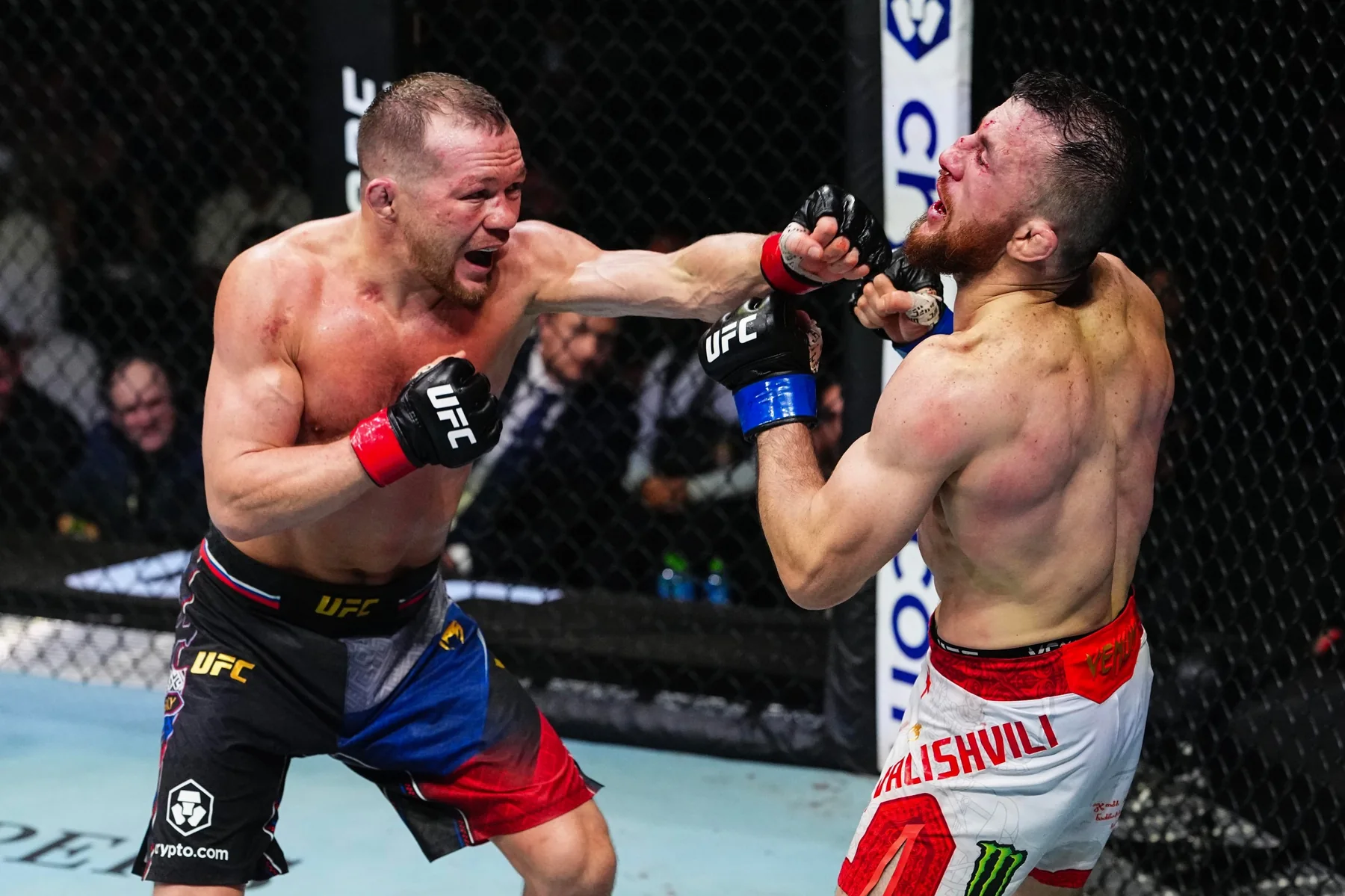
The official recap identifies the third round as the stage when Yan began finding rhythm and hurting Dvalishvili to the body. The champion was no longer simply completing a defensive task and waiting for the next entry. He was finding ways to make the challenger pay during the striking exchanges surrounding those attempts.
The technical significance is the connection between defense and the next attack. A sprawl, frame or quick return can leave a fighter able to strike, or it can leave him occupied and unable to respond. Yan's later work was valuable because more offense emerged from the situations he had previously been surviving. That makes the change more specific than a claim that he suddenly wanted the fight more.
Body shots are also easy to undervalue if attention stays on head movement and facial marks. Their significance depends on their effect within the round, rather than the fact that they look different from a head punch. In this case, the contemporaneous accounts consistently identify the body attack as part of the shift. That does not authorize a medical diagnosis or prove that every later failed shot had the same cause.
The last two rounds rewarded the cleaner follow-up work
Round 4 extended the change in productive striking. The useful comparison is between the offense each man actually delivered during that round, rather than between Yan's fourth round and Dvalishvili's first. Earlier work established the challenge; it did not bank points that could be spent in another five-minute period.
Round 5 still required Yan to compete with a challenger who kept trying to press. The finish to the contest was not a stoppage or a surrender. Yan continued to find punches and body attacks while dealing with the entries, and all three judges preferred his work. The post-fight report describes his closing combination and body kick as part of that final offensive push.
It is tempting to retell this as a deliberate decision to give away two rounds and then take three. The cards do not prove that plan. They show the actual distribution of round wins; the accounts show a champion solving problems as the fight progressed. A tactical adjustment is an adequate explanation without inventing certainty about a strategy that would leave almost no scoring margin for error.
Nor does the late rally make the opening rounds irrelevant. Yan needed each of his three later rounds because the challenger's two early wins remained on the sheet. That is why a strong ending and a close final total can coexist. The victory was built from a sequence of round wins, not a bonus awarded for finishing the night with the most memorable combinations.
The judging concepts that matter in this fight
The ABC's July 2025 judging clarification offers a useful framework for understanding the debate: evaluate offensive effectiveness within each round. It is an educational reference here, rather than evidence that every provision was separately verified as adopted for this Abu Dhabi event. The event's original cards remain the evidence of what its judges actually scored.
Defensive wrestling creates opportunities rather than points
Under that framework, stopping an attack does not earn a separate defensive score. Yan's ability to deny or escape wrestling mattered because it kept him available to create offense. The punches and kicks after a reset could then supply positive scoring evidence.
For this fight, follow an entry through its entire sequence. Did Dvalishvili complete something productive before Yan escaped? Did Yan merely return to safety, or did he strike effectively afterward? Those questions distinguish tactical success from scoring evidence. Calling every denied shot a point for Yan would be just as misleading as awarding Dvalishvili a point for every attempt.
Activity and control still need effective offense
Striking and grappling both count through what they achieve. A long list of attempts does not establish their effect, and a positional advantage needs to be assessed with the attacks produced from it. The ABC's officials handbook provides further context for evaluating effective techniques rather than assigning a fixed value to a position.
That comparison cuts both ways in Yan–Dvalishvili. A viewer favoring the champion should still account for the challenger's effective early offense. A viewer favoring the challenger should still examine the later body work and clean connections. Neither fighter gets to make his preferred category the only category the viewer considers.
A 10–9 round can be clear without being a 10–8
The judges made every round 10–9. In the 2025 clarification, a wider 10–8 margin requires meaningful damaging offense; positional superiority without damage is insufficient. The difference between winning a round and winning it by that wider margin is therefore a separate judgment.
For example, confidently preferring Yan's work in a late round does not obligate a viewer to call it 10–8. Dvalishvili remained offensively involved, and the official sheets contain no such wider score. Equally, a competitive appearance does not prove the round should be even. Decide who had the stronger effective offense, then consider the degree of advantage.
This avoids two common shortcuts: turning every close fight into a draw and turning every clear round into a blowout. It also keeps the explanation tied to these five rounds, rather than pretending a single control-time total can solve all MMA decisions.
Why some viewers still disagreed

The disagreement was real, but its scope needs careful wording. Athlon's reaction report identified Jessica Penne as a fighter who preferred Dvalishvili. It also described posts from Muhammad Mokaev and Derek Brunson inviting discussion. Asking an audience about a decision is different from explicitly declaring that the wrong fighter won.
That distinction is useful whenever a headline collects reactions. A handful of posts can establish that particular people expressed particular views. It cannot establish what all fighters believed, how most viewers scored the bout, or that there was an organized problem with the officials. The evidence of a close debate should not be inflated into a claim of universal outrage.
Different viewing habits can produce different impressions of this fight. Someone tracking every entry may be especially aware of how much Yan had to defend. Someone focusing on the cleanest connections may remember the champion's late offense more strongly. Those are explanations of what viewers might notice, not proof that one group watched dishonestly. The next step is to test the impression against a complete round, including the other fighter's productive moments.
Dvalishvili's response also needs to stay in its proper role. In his October 26 statement, he thanked his teams and supporters and expressed motivation to return. His post-fight assessment, reported separately, credited Yan. That is relevant to the tone of the aftermath; it does not turn a fighter into a fourth judge or replace independent evaluation of the rounds.
The opposite is true as well: a disappointed fighter objecting would not by itself invalidate a decision. Whether the loser accepts or contests the outcome, the scoring discussion still needs an identifiable round and the effective actions within it. Personality and sportsmanship cannot supply missing scoring evidence.
Our Perez–Dumont scorecard analysis covers a different disputed decision. The transferable habit is to separate the official sheet, a viewer's score and a wider allegation about officiating. For Yan–Dvalishvili 3, the original sheets are unusually consistent. A contrary score can still be discussed seriously, provided its author explains which round changes and why.
How to score the replay without following the crowd
Watch all five rounds in order and write a short reason for each score before looking again at the official sheet. This is a practical viewing method, not a replacement for officials' training. Its purpose is to make your conclusion specific enough to discuss: a round, an advantage and the actions that created it.
In Round 1, record Dvalishvili's successful offense alongside the entries Yan resisted. In Round 2, ask whether the challenger's attacks kept producing the stronger work or merely looked busy. Those questions prevent a viewer from dismissing early wrestling just because it did not create a submission or a prolonged top position.
In Round 3, note the body attacks and the change in what happened after Yan defended. Separate an observed reaction from a guess about a hidden injury. In Round 4, compare both fighters' effective work within that round, without giving Yan credit for having looked better in the previous one. In Round 5, keep watching through the final exchanges and give Dvalishvili's remaining offense the same attention as the champion's closing combinations.
For every difficult round, identify the best argument for the fighter you did not select. If that argument contains only attempts or a position, ask what those actions produced. If it contains effective strikes or grappling, explain why you considered the other fighter's work more consequential. This is more useful than announcing that a round was obvious and leaving the actual comparison unstated.
Then total the five scores. The original UFC 333 sheets provide a clear comparison: Dvalishvili in the first two, Yan in the final three, every round 10–9. If your card differs, it should now be possible to say exactly where. Do not let the final total persuade you to change a round after the fact just to match a preferred winner.
Use the current viewing guide to check access in your territory. A highlight package and an overall statistics graphic can help you find moments to revisit, but neither contains the complete five-round comparison. Yan's retention is the official outcome. Understanding it comes from following the shift in effective offense, while keeping the opening pressure, the late rally and the scoring of each round distinct.
Fight talk
Comments