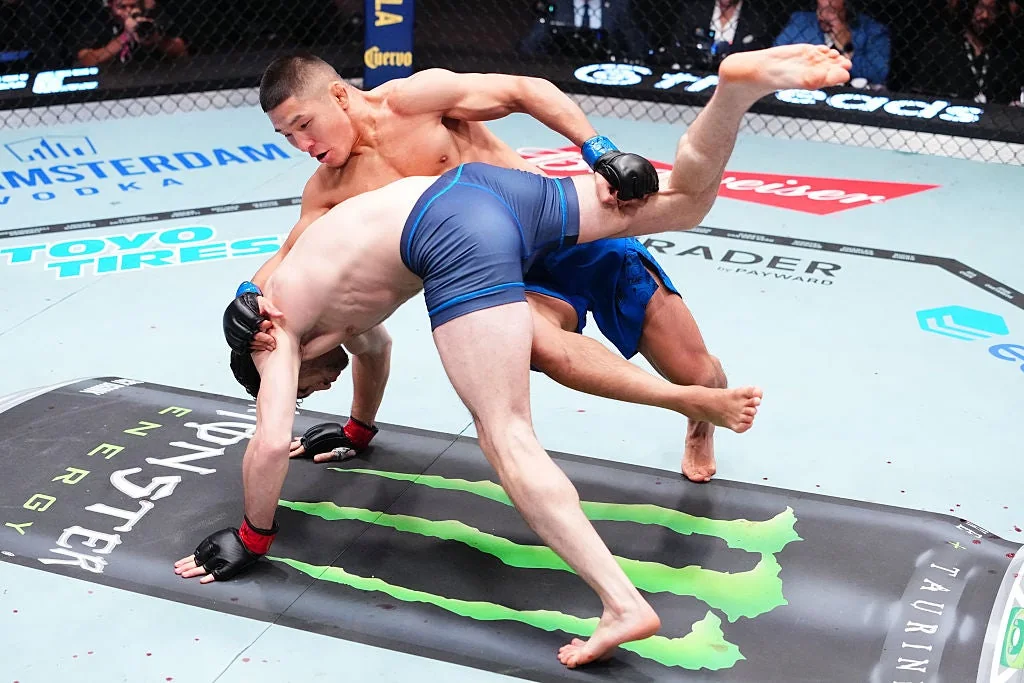
Ilimbek Akylbek won The Ultimate Fighter 34 men's bantamweight final when Mahammadeli Osmanli was disqualified for a knee to the head of a grounded opponent at UFC Vegas 121. The official result came at 2:19 of Round 1, but the short result line leaves several questions: what position was Akylbek in, why did the stoppage produce a DQ, and what can viewers actually infer from the disputed aftermath? This account starts with UFC's event record and applies the rules of the event's Nevada jurisdiction.
What was the official TUF 34 bantamweight final result?
Ilimbek Akylbek defeated Mahammadeli Osmanli by disqualification for an illegal knee at 2:19 of Round 1. That is the fight-specific result published by UFC in its post-event report for the September 26 card. The bantamweight tournament final was part of the Rosas Jr. vs Barcelos main card at Meta APEX in Las Vegas. A DQ is a recorded victory for Akylbek and a recorded loss for Osmanli; it is not a judges' decision, a knockout awarded to the fighter who threw the knee, or a no contest.
| Winner | Opponent | Method | Round and time |
|---|---|---|---|
| Ilimbek Akylbek | Mahammadeli Osmanli | Disqualification, illegal knee | Round 1, 2:19 |
The names are easy to lose across reports. UFC's result heading writes Mahammadeli; the body of that same article writes Mahammadali, and an official athlete page uses Mehemmedeli. They refer to the same Azerbaijani finalist. The winner appears as Ilimbek Akylbek on UFC's result and athlete page; some coverage appends Uulu, and some uses Akylbeck. This article follows the UFC result heading's display names so a spelling difference does not become a false dispute about who fought.
The official report says Akylbek could not continue after the illegal blow, which explains why the live contest ended instead of resuming after a warning. The distinction between an illegal technique and the referee's choice of final result needs the actual Nevada foul rules, discussed below. For the rest of the card, including the other TUF final and the Rosas Jr. main event, see our UFC Vegas 121 full-card results.
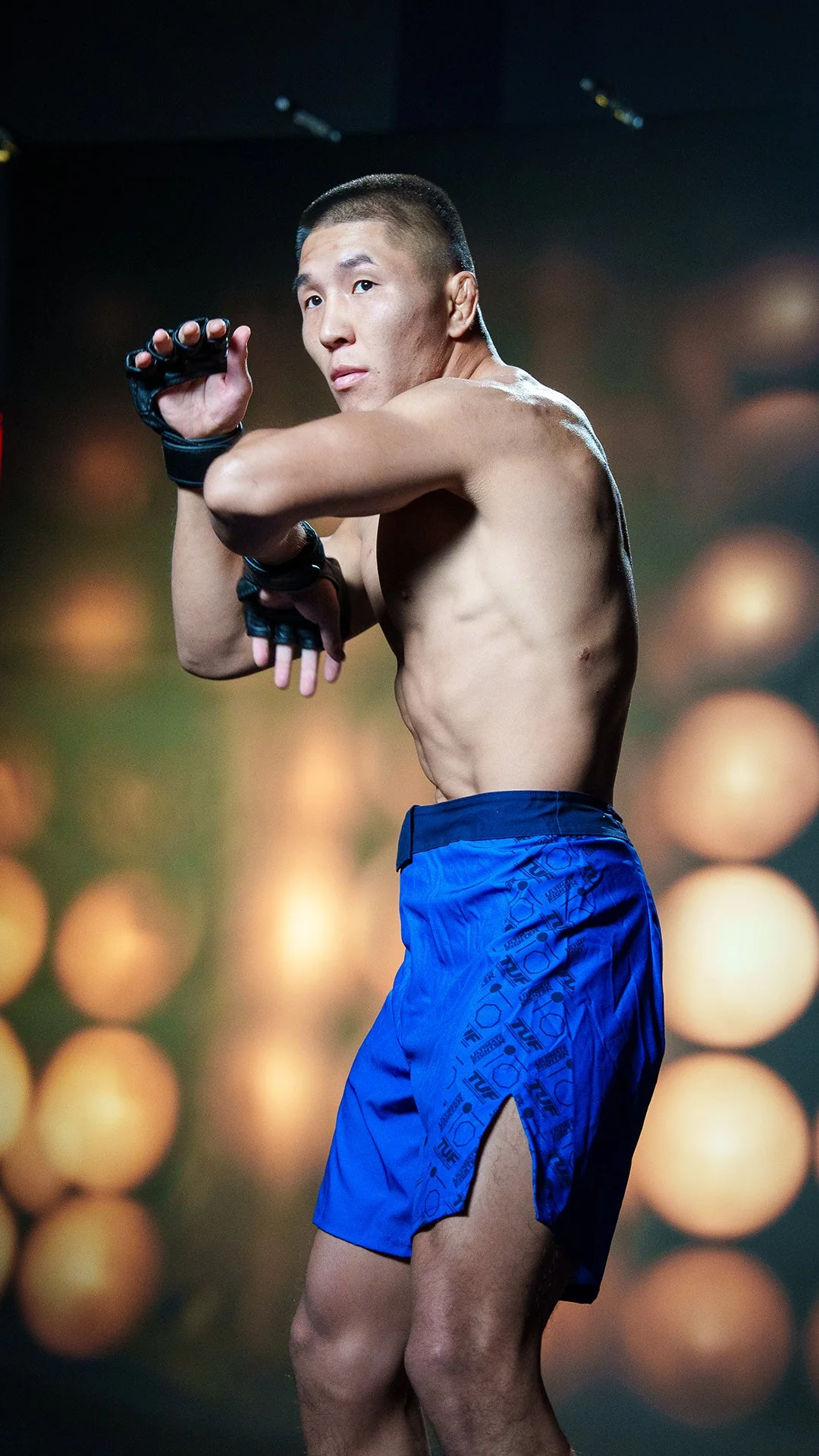
What happened in the first 2:19 before the disqualification?
The fight was short, but it was not a single uninterrupted knee-strike sequence. The finalists exchanged at range, Akylbek completed a takedown, and both returned to standing before the foul. UFC's post-event account places Akylbek on both knees when Osmanli drove a knee into his head. The key distinction for fans reviewing the clip is the position at contact, rather than who had won the earlier exchange or how aggressive Osmanli's forward move looked.
A short grappling exchange left Akylbek on both knees
Sherdog's live report describes Osmanli opening with a body front kick and missing a high kick as Akylbek moved in behind punches. They traded brief combinations. Akylbek then finished a single-leg takedown and landed some modest ground offense before Osmanli elevated him and escaped. This confirms there was a real grappling phase before the finish; it does not tell us what a judge would have scored had five minutes elapsed. The eventual result was a foul stoppage, so a hypothetical early score is beside the point.
The accounts differ on the precise cause of Akylbek's final fall. UFC says that moments after they worked back up from the grappling exchange, Akylbek slipped and fell to his knees. Sherdog reports a left hand from Osmanli that staggered an off-balance Akylbek and sent him down. Those descriptions do not establish a single agreed cause of the fall, and this article cannot settle the mechanics by inventing another camera angle. They do agree on the fact that matters for the next technique: Akylbek was already down when the head knee arrived.
Osmanli's knee ended the live action
UFC reports Osmanli charging forward and connecting with a full-force knee to Akylbek's head while Akylbek was on both knees. MMA Junkie's fight report identifies it as a left knee. Whether Osmanli meant to commit a foul is a separate question from what technique landed. The broadcast and reporting support the visible sequence; they do not expose his private intention at the moment he threw it.
The referee halted live action. UFC says Akylbek was down and dazed for several moments and ultimately could not continue. MMA Fighting identifies the referee as Kerry Hatley, while MMA Junkie says the officials looked at replays and Akylbek's response before the fight was waved off. The official outcome came at 2:19, not after a completed round or a scorecard tally. It is fair to describe a forceful illegal knee and a subsequent DQ; it is not fair to convert a reporter's description of apparent unconsciousness into a documented medical diagnosis or to claim knowledge of every conversation between the referee and ringside personnel.
Why was the knee illegal under Nevada's grounded-opponent rule?
Nevada bans a knee to the head of a grounded opponent, and a fighter with a knee on the canvas is grounded under its written definition. The event took place at Meta APEX in Las Vegas, so the relevant text is Nevada Administrative Code 467.7962. Its list of mixed martial arts fouls includes “kneeing the head of a grounded opponent” in subsection 15. The target matters: the rule identifies a knee to the head, not a general prohibition on every knee delivered while one fighter is down. UFC's account identifies head contact here.
The same Nevada section gives a precise grounded test for head kicks, head knees and stomps. A fighter is grounded if a hand, palm or fist is bearing weight on the floor, or if a body part other than a hand or the sole of a foot is touching it. A knee is a body part outside the hand-and-foot exception. UFC says Akylbek fell to both knees before Osmanli made contact, so the condition is met without asking whether he also posted a hand. Even one knee down would satisfy this branch of the definition. A preceding punch, a stumble or a deliberate level change could affect how someone got there, but would not make a head knee legal after the knee reached the mat.
There is a reason some discussions of grounded opponents sound different. The Association of Boxing Commissions' August 2025 Unified Rules PDF also lists a head knee to a grounded opponent as a foul, but its definition excludes hands and feet as the contact that establishes grounding. Nevada's published local language still includes a weight-bearing hand. That difference could matter in another hand-only position; it does not matter to this specific incident because a knee touching the canvas qualifies under either description. The safest explanation of a Las Vegas result starts with the Nevada regulation, then uses ABC material as context.
This establishes that the technique was prohibited. It does not, by itself, specify the final bout result. A referee still has to deal with the fighter's ability to continue and the governing foul-outcome rule. That is why “the knee was illegal” answers one question, while “why did Akylbek win by disqualification?” requires a separate one.
Why a DQ instead of a no contest or point deduction?
The recorded result is a DQ because the bout ended after a prohibited head knee and UFC says Akylbek could not continue. But an illegal strike alone does not tell us which result rule will apply. Nevada first assigns the referee authority to enforce the foul and assess the stopped fight; its regulations then distinguish an intentional foul that ends the bout from an accidental one. The official UFC article gives the method and the physical sequence, not a transcript of Kerry Hatley's private deliberation. That limits what any later analysis can honestly say about intent.
Nevada's intentional-foul branch permits an immediate DQ
Nevada NAC 467.698(1) says that if an injury caused by an intentional foul means a contest cannot continue, the fighter who committed it loses by disqualification. The broader referee rule, NAC 467.682, allows a referee to disqualify a fighter for a foul, and NAC 467.695 also recognizes that authority. These provisions explain how a foul-ending DQ is legally available. They do not let us read Osmanli's mind. The public outcome is consistent with the DQ pathway; the reviewed UFC report does not publish an official written finding about his subjective purpose in launching the knee.
A points-only response belongs to a fight that can safely resume. Nevada's same intentional-foul section requires a two-point deduction when the injury does not end the contest. Its MMA point-deduction rule also lets a referee penalize other fouls according to severity and effect. Here UFC says Akylbek was unable to continue, so there was no remaining round in which a deduction could operate. “Just take a point” does not solve a bout that officials have stopped; it assumes the very continuation that the official account says was unavailable.
The accidental-foul path for an early MMA stoppage
NAC 467.7966 is Nevada's specific accidental-foul rule for mixed martial arts. If the referee determines that an accidental foul injured a fighter so that a three-round contest cannot continue during its first two rounds, the regulation calls for a “no decision.” Fans often discuss that kind of early outcome as a no contest; Nevada also lists no contest among authorized MMA results. The precise statutory wording here matters more than the shorthand. This fight was stopped in Round 1, but time alone does not select this branch: the accidental-foul determination must come first.
A different Nevada accidental-foul provision, NAC 467.702, has round thresholds for other combat sports and explicitly says it does not apply to MMA. Using that section to argue what should have happened in the TUF final would put the wrong rule on a Las Vegas cage fight. Neither is there a scorecard route after only 2:19 of a three-round bout under the MMA provision; its technical-decision branch comes after the second round is completed. The contrast explains why a first-round injury can be associated with a no-decision question without changing this bout's published DQ.
What the referee and ringside physician can decide
Nevada NAC 467.713 gives the referee the injury-stoppage decision and permits consultation with a ringside physician. NAC 467.682 permits review of available replay and consultation with commission officials. MMA Junkie reported replay and response checks in this bout; the reviewed sources do not identify a particular physician's assessment, so none should be invented. The regulation also does not promise every fouled fighter an automatic five-minute break. For an accidental foul, a restart within a recuperative period of at most five minutes is conditional on the fighter's chance of winning not being seriously jeopardized and on the foul not involving concussive head impact.
That procedure protects the fighter and the result's integrity. A viewer can question the decision and inspect the published rules, but a clip cannot show every observation made during a stoppage. The durable reference point remains the official Akylbek DQ result. Our Fight Night guide to following official results explains why the final method, round and time matter more than a live impression or an early social-media label.
What do claims that Akylbek exaggerated the injury establish?
They establish a post-fight dispute, not a finding that Akylbek simulated an injury. The decisive knee was illegal because of his position at contact; the DQ was the official ending after he could not continue. Questions about a later movement or expression belong to a different inquiry. Neither a slow-motion clip nor an angry rival's interpretation can by itself supply the referee's full safety assessment or a medical diagnosis.
Osmanli's allegation is a fighter's account
After losing the tournament final, Osmanli argued on Instagram Live that Akylbek had grasped his leg following the knee and had exaggerated his reaction after the referee intervened. Both MMA Mania and Sherdog reported the accusation. It is understandable that a finalist facing a sudden DQ would contest what he perceived in a frantic moment. That does not make the perception an official conclusion about Akylbek's condition. The reviewed UFC result still says the fighter from Kyrgyzstan could not continue.
Reporters also describe the visible sequence differently from a simple frozen image. MMA Mania notes that Akylbek adjusted a grip on Osmanli's leg after contact, then rolled onto his back after Hatley stopped the action and appeared affected as the aftermath continued. Selectively showing the grip without the rest of the sequence can give a distorted impression; treating the later posture as a confirmed diagnosis would be an equal overreach. The two observations are details for review, not a reliable test of sincerity.
The clip cannot determine medical capacity
A brief movement after a head strike shows that the athlete moved. It does not tell a spectator whether he could defend intelligently through more fighting, how he felt, or whether continuation was safe. Nevada NAC 467.713 puts the injury-stoppage call with the referee, who may consult a ringside physician. We have no public physician report or full officiating record in the sources reviewed here, and no basis to declare that Akylbek either suffered a specific diagnosis or fabricated one.
Nevada's foul list even includes faking an injury under its timidity provision. That matters only as a rule that could be applied when supported by an official finding; it is not evidence that it was applied to Akylbek. The published ruling penalized Osmanli's grounded head knee, not Akylbek's response. Fans can disagree about what the clip suggests, but the result cannot be reversed by a social-media interpretation of one movement. A formal change would require a documented official process, and none is verified here as of September 28.
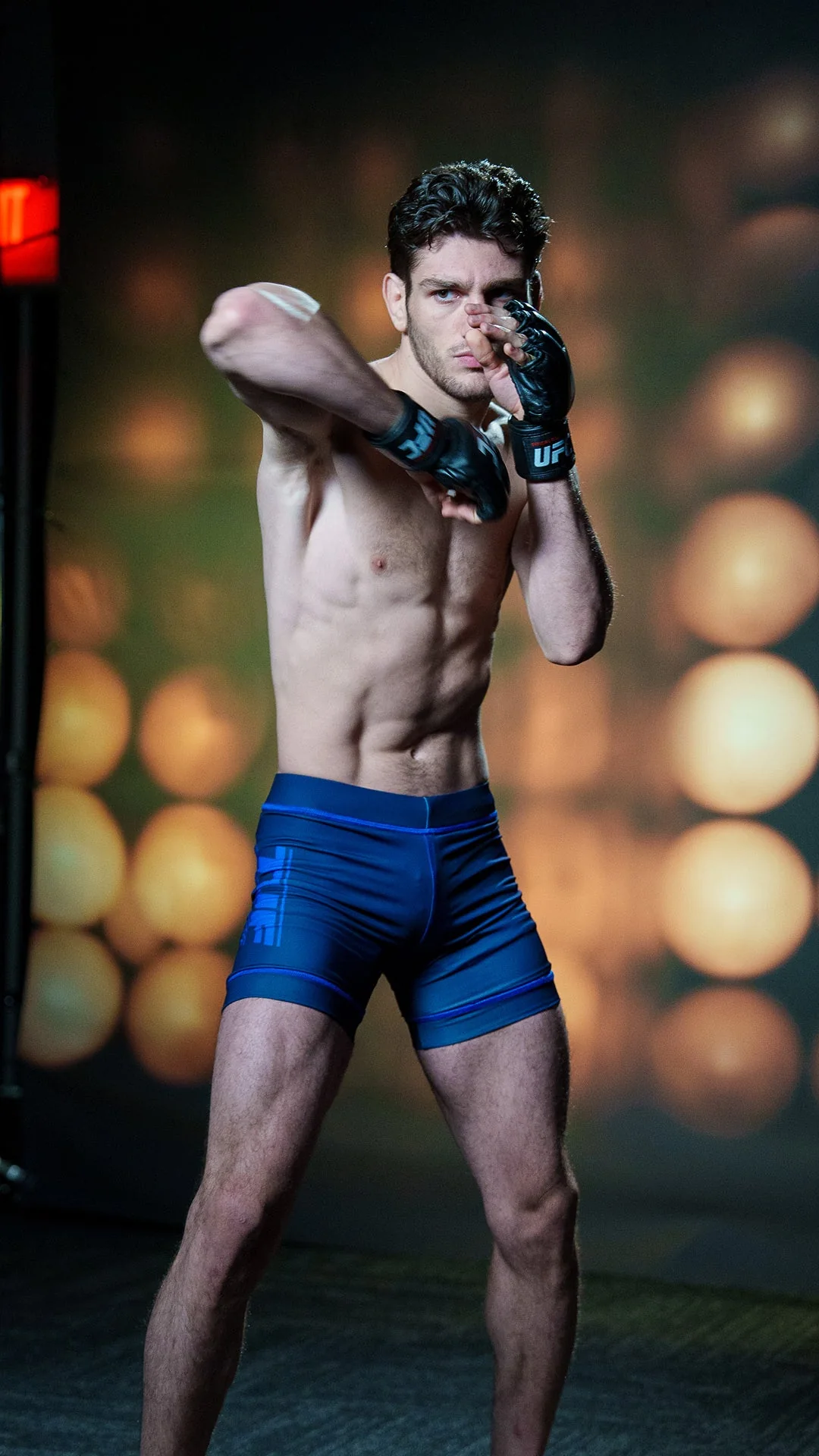
What does the DQ mean for both fighters and a possible rematch?
Akylbek is the official TUF 34 men's bantamweight winner; no rematch had been announced by the UFC as of September 28, 2026. The disqualification records a win for Ilimbek Akylbek and a loss for Mahammadeli Osmanli. It does not produce the kind of extended, completed fight that could settle every sporting argument about their relative skills. Those two statements can coexist. Calling the finish unsatisfying is an opinion about the competition; changing the recorded result would require an official action that has not been reported.
The result carries two unusual tournament milestones. UFC's event report identifies Akylbek as the first fighter from Kyrgyzstan to win The Ultimate Fighter and the first TUF winner crowned through a disqualification. Those are UFC's historical claims, rather than a claim that we independently audited every past season. MMA Fighting reported that Akylbek received the winner's plaque after the stoppage. The plaque and the DQ method describe the same official tournament outcome, however abruptly the final ended.
The finalists arrived by different paths. In UFC's pre-event account, both represented Team Bisping. Osmanli finished his quarterfinal and semifinal opponents, while Akylbek won two decisions to reach the final. That contrast helps explain why viewers wanted more than 2:19 between them, but it cannot tell us who would have won a legal, uninterrupted continuation. Neither fighter gets an imagined victory for work that the stopped fight never contained.
A second meeting is a plausible topic for fans and even for the writer of UFC's result recap, who suggested the pair could run it back. A suggestion is not a fight announcement. Through September 28, the reviewed UFC material provides no signed matchup, date, venue or booking notice for Akylbek versus Osmanli again. If the promotion later schedules one, it would be a separate bout with its own result; it would not automatically erase Akylbek's TUF 34 title. Until then, the useful answer is specific: Akylbek won the tournament by Round 1 DQ at 2:19, and a rematch remains unconfirmed.
Fight talk
Comments