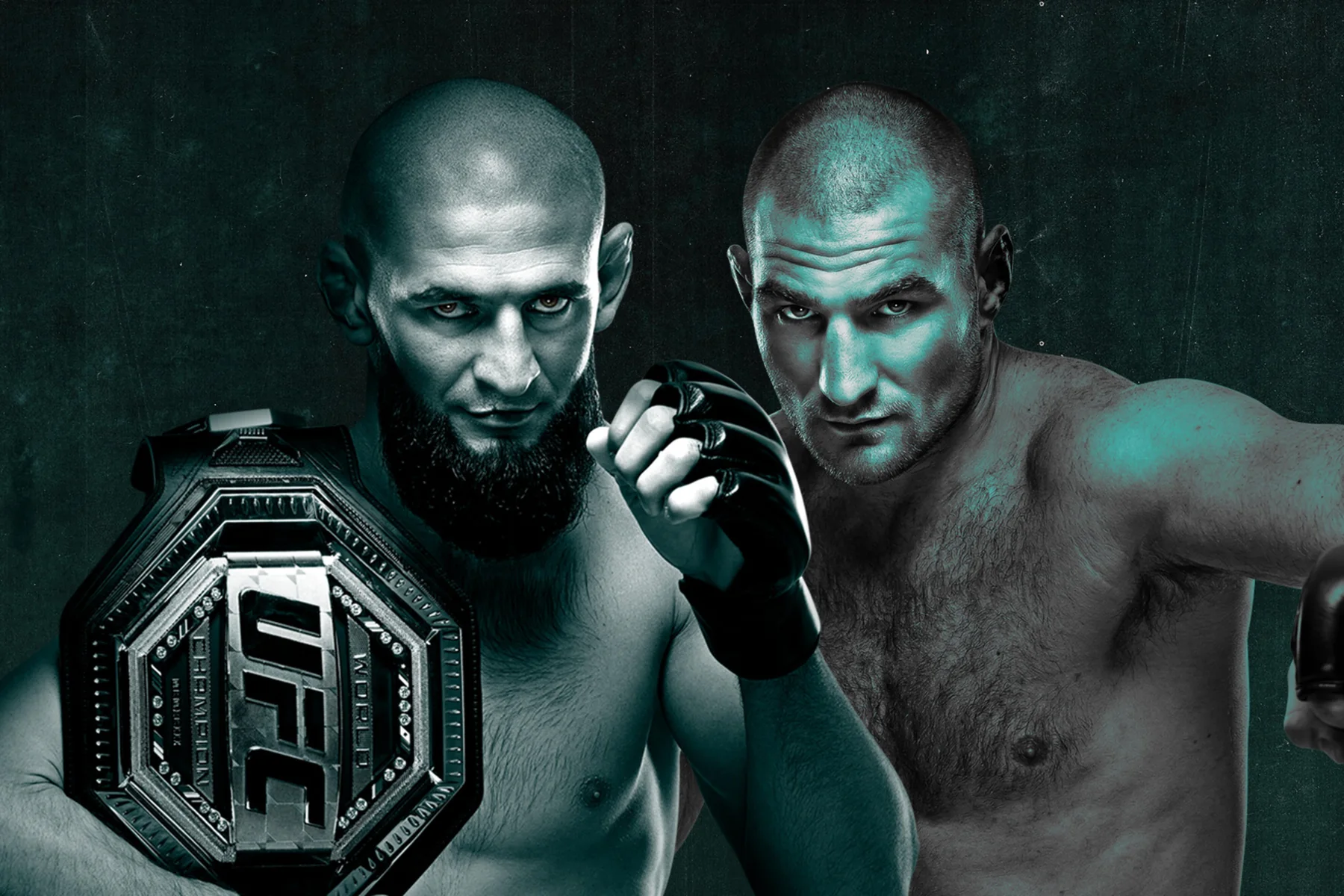
UFC 328 produced two title-fight answers in very different ways. Sean Strickland took the middleweight championship from Khamzat Chimaev by a 48-47, 48-47, 47-48 split decision. Joshua Van retained the flyweight title by stopping Tatsuro Taira 1:32 into round five. This results guide records the complete card and explains the competitive details that a winner list cannot.
UFC 328 results at a glance
UFC 328 took place May 9, 2026 at Prudential Center in Newark, New Jersey. In the main event, Sean Strickland defeated Khamzat Chimaev by split decision after five rounds. Two judges scored it 48-47 for Strickland and one scored it 48-47 for Chimaev. The narrow cards matter: this was not a result that can be explained by saying one fighter controlled the entire contest.
The co-main event ended before the judges were needed. Joshua Van stopped Tatsuro Taira with strikes at 1:32 of round five in their flyweight championship bout. A late finish in a competitive five-round fight is more than a line on a record; it shows the champion could keep producing decisive offense after both athletes had revealed and adjusted to each other's best looks.
Main event: Strickland def. Chimaev, split decision, five rounds.
Co-main: Van def. Taira, TKO (strikes), round 5, 1:32.
Location: Prudential Center, Newark.
The official scorecards are the starting point for interpreting the main event, while the official event page controls methods and times. Statistics can help identify where offense occurred, but totals accumulated across five rounds do not tell a judge how to score any single round. The analysis below keeps effective striking and grappling ahead of reputation, crowd response or raw activity.
For a fast list of recent cards, use the site's UFC results page. Stay here for the round-level questions, title consequences and full UFC 328 record.
How Sean Strickland beat Khamzat Chimaev
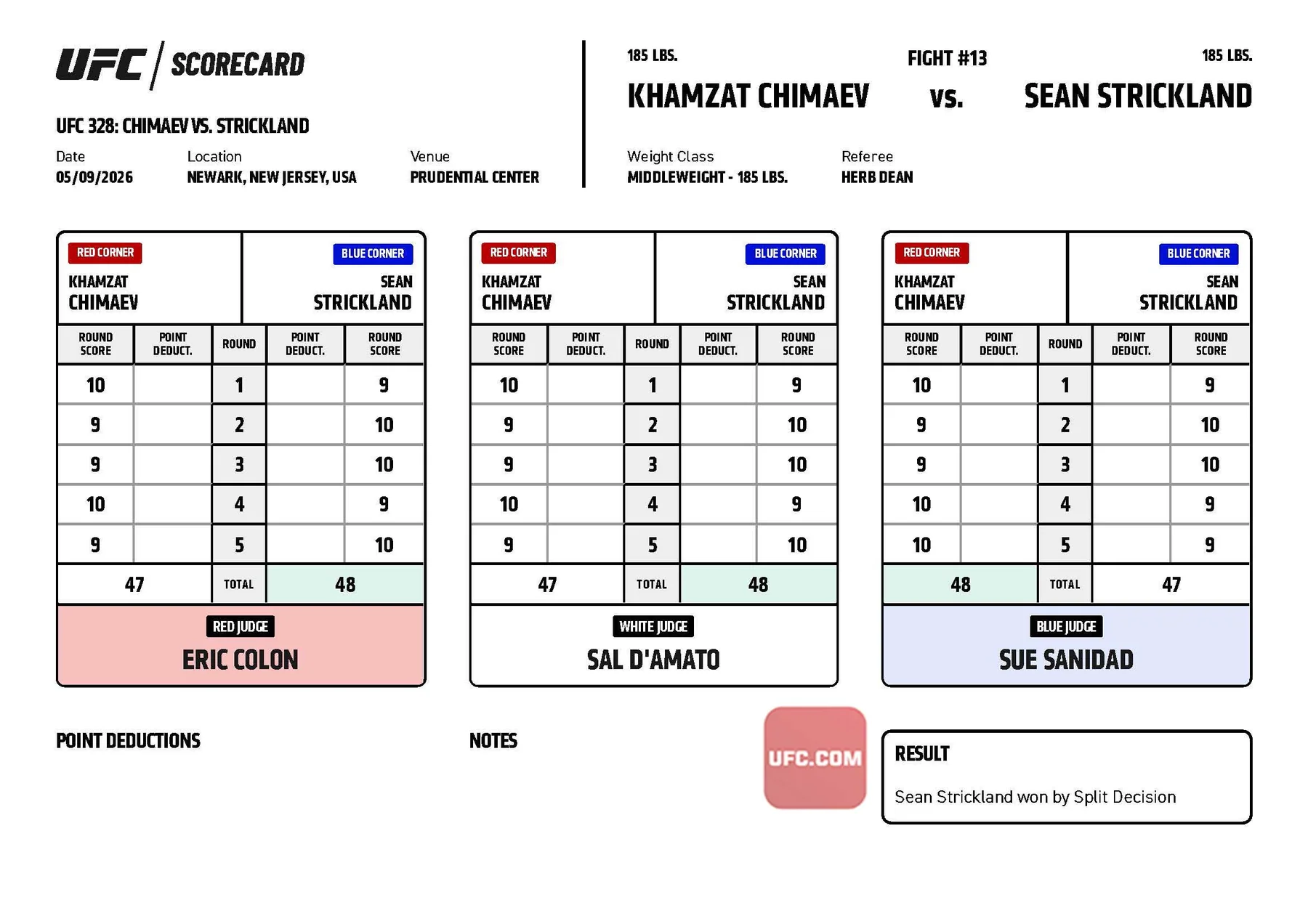
The official cards make the argument much narrower than the phrase “split decision” suggests. Eric Colon and Sal D'Amato scored the fight 48-47 for Sean Strickland. Sue Sanidad scored it 48-47 for Khamzat Chimaev. All three judges agreed on rounds one through four: Chimaev won the first and fourth; Strickland won the second and third. Round five was the only round that split the panel.
Reading the 48-47 split scorecards round by round
The shared scoring tells us neither corner faced a mysterious card. Chimaev established the early lead in round one. Strickland answered in rounds two and three, turning the middle of the fight into his strongest stretch. Chimaev restored parity in the fourth. That created a clean final-round equation: win the fifth, win the championship.
Colon and D'Amato gave that last round to Strickland; Sanidad gave it to Chimaev. A responsible analysis therefore focuses on the quality of offense in round five rather than adding five-round totals. One fighter could lead an aggregate category because of a dominant earlier round and still lose three separate 10-9 rounds.
Why effective offense mattered more than raw activity
MMA judging starts with effective striking and grappling: actions that contribute toward ending the fight or produce meaningful immediate impact. Forward movement, attempted takedowns and time near the fence can describe initiative, but they do not automatically override the cleaner, more damaging work. That distinction is especially important in a Chimaev fight, where the threat of wrestling can look dominant even when an opponent exits and answers.
Strickland's upright pressure and straight punching work when they interrupt an opponent's entries and make exchanges repeat on his terms. Chimaev's best sequences force layered defense—shot, clinch, return, strike—rather than a single action. The fifth-round disagreement shows how close their effective work appeared to different cageside judges. It does not erase the striking or grappling context, but it limits any claim of certainty.
The fairest conclusion is that Strickland earned two unanimous rounds, Chimaev earned two unanimous rounds, and Strickland persuaded two judges in the decisive fifth. Fans can disagree with that final assessment. Calling all five rounds one-sided is inconsistent with the official scorecards.
What the middleweight title change means
Strickland's second championship reign
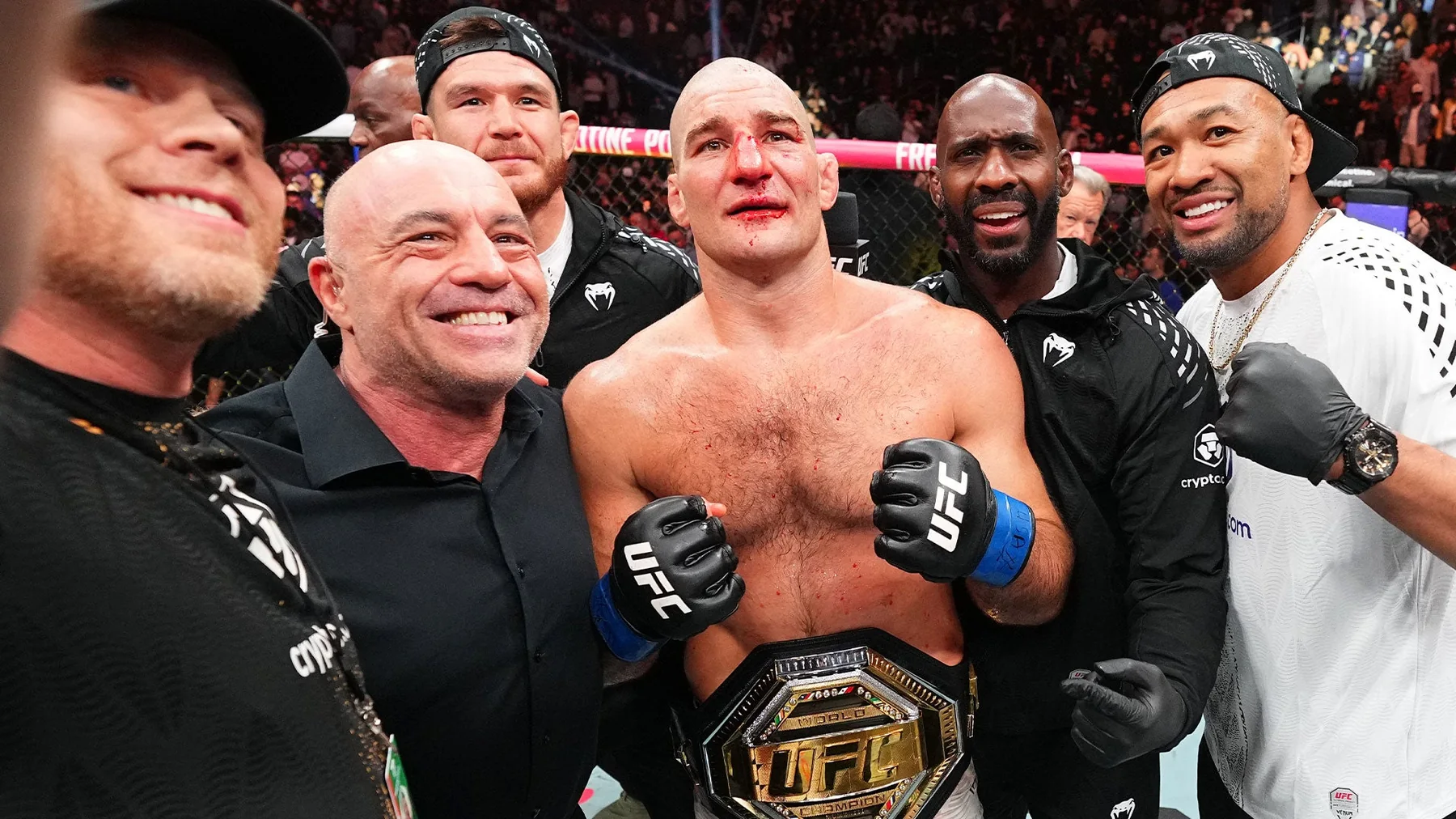
UFC 328 put Sean Strickland back on top of the middleweight division. His first championship win came through an disciplined upset of Israel Adesanya; this one required taking a tied fight into the fifth round against a very different threat. That range matters. Beating an elite kickboxer by controlling distance and beating Chimaev while managing wrestling transitions are separate tests of championship adaptability.
A second reign also changes how future challengers prepare. Strickland's stance can look simple, but his lead hand, checking actions and defensive awareness disrupt the first layer of an opponent's offense. Contenders need a plan for sustained scoring that does not depend on Strickland backing away. The current middleweight rankings guide supplies the broader contender picture, but only an official UFC announcement establishes the next defense.
Chimaev's first professional defeat and route back
The split decision gave Chimaev his first professional loss. It should prompt technical questions rather than a collapse narrative. He won two rounds on every card and one judge believed he won the fifth. The evidence says he remained championship-competitive through 25 minutes; it also says he did not secure enough clear offense in the final round to persuade two judges.
His route back depends on recovery, divisional scheduling and the UFC's matchmaking. A rematch argument can point to the narrow cards. A fresh-contender argument can point to a division that needs movement. Either way, improvement has a concrete target: make late-round entries lead to damage or threatening control, and create cleaner moments that cannot be mistaken for pressure alone.
For Strickland, the belt creates a new queue. For Chimaev, the loss converts aura into film. Both consequences make the eventual next bookings more revealing than a quick demand for an automatic rematch.
Joshua Van stopped Tatsuro Taira in the fifth round
The late finish after a competitive title fight
Joshua Van defeated Tatsuro Taira by TKO at 1:32 of round five. The timing is central to the story. Both flyweights had already completed 21 minutes of a championship contest when Van's strikes forced the stoppage. Whatever the live scorecards might have held, the finish removed interpretation and gave the champion a decisive defense.
Taira's grappling presents layered problems because an opponent must manage entries, back exposure and transitions without abandoning offense. Van's route required staying composed enough to defend those phases and still carry dangerous combinations into the championship rounds. The finish should not be used to pretend every earlier minute belonged to Van. Its value is that he found his most conclusive work when fatigue normally reduces precision.
What Van's defense changes at flyweight
A successful defense against a high-level young challenger gives Van more than another win. It supplies five-round evidence and makes future opponents account for late offense as well as his speed. Fighters who hope to bank early grappling rounds cannot assume the champion's danger fades after 15 minutes.
For Taira, the result identifies a difficult but specific development point: how to preserve defensive responsibility when a long grappling fight returns to open exchanges. A fifth-round stoppage is costly, yet reaching that stage of a title bout also provides better information than a quick defeat.
The site's flyweight rankings analysis can frame the contenders around Van. The next defense remains unconfirmed until the UFC announces it; UFC 328 only establishes that Van left Newark with the belt and a late stoppage over Taira.
UFC 328 main-card results
| Winner | Opponent | Result |
|---|---|---|
| Sean Strickland | Khamzat Chimaev | Split decision, 5 rounds |
| Joshua Van | Tatsuro Taira | TKO, R5 1:32 |
| Alexander Volkov | Waldo Cortes Acosta | Unanimous decision |
| Sean Brady | Joaquin Buckley | Unanimous decision |
| King Green | Jeremy Stephens | Submission, R1 4:20 |
Alexander Volkov beat Waldo Cortes Acosta by unanimous decision. The official cards were 30-27, 29-28 and 29-28. For Volkov, a decision win at heavyweight reinforces the value of managing distance and winning repeated exchanges without needing a single finishing shot. Cortes Acosta completed all three rounds but did not take enough of them to split the panel.
Sean Brady's unanimous decision over Joaquin Buckley was wider: 30-25, 30-25 and 30-27. Two judges found multiple rounds with a substantial scoring gap. That does not mean control time alone decided them; dominant scores must still rest on effective striking or grappling. The result strengthens Brady's welterweight position because Buckley's explosiveness makes clean control difficult.
King Green submitted Jeremy Stephens with a rear-naked choke at 4:20 of round one. The method is notable for a veteran most readily associated with boxing rhythm and defense. A late first-round submission can arise from strikes forcing a defensive reaction, a scramble or back exposure; the official result confirms the choke, while replay supplies the exact sequence.
Together, the main card offered a split championship decision, a fifth-round title stoppage, two meaningful decisions and a first-round submission. That variety is why a full results record should preserve method and time rather than reduce UFC 328 to its headline controversy.
UFC 328 prelim results and performances to revisit
Submission-heavy middle portion of the card
- Ateba Gautier def. Ozzy Diaz by KO, round 2, 1:10.
- Yaroslav Amosov def. Joel Alvarez by arm-triangle choke, round 2, 1:13.
- Grant Dawson def. Mateusz Rebecki by rear-naked choke, round 3, 4:42.
- Jim Miller def. Jared Gordon by guillotine choke, round 1, 3:29.
- Roman Kopylov def. Marco Tulio by unanimous decision.
- Pat Sabatini def. William Gomis by unanimous decision.
- Baisangur Susurkaev def. Djorden Santos by rear-naked choke, round 3, 4:12.
- Jose Ochoa def. Clayton Carpenter by unanimous decision.
The cluster of submissions gave the undercard a clear identity. Amosov finished Alvarez with an arm-triangle, Dawson and Susurkaev used rear-naked chokes, and Miller caught Gordon with a guillotine. These labels identify the final technique, but they do not show how each position developed. Fans revisiting the card should watch the transition before the finish: whether pressure forced a shot, a scramble exposed the back, or a front headlock punished posture.
Prospects and veterans whose next booking changed
Gautier's second-round knockout adds evidence of finishing power while showing that opponents can make him work beyond an opening burst. Dawson's late third-round submission is valuable for a different reason: he maintained grappling effectiveness near the end of a full three-round fight. Miller's first-round guillotine added another quick technical finish to one of the UFC's longest résumés.
The decisions deserve accurate detail too. Kopylov beat Tulio 29-28 on all three cards. Sabatini beat Gomis 30-27, 30-27 and 29-28. Ochoa swept Carpenter 30-27 from every judge. Those scores supply a stronger description than simply saying “decision”: Ochoa left no round-level disagreement, while Sabatini lost one round on one card.
None of those results announces the next opponent. They change matchmaking leverage and the quality of each fighter's latest evidence; the UFC still determines when and against whom that evidence is tested.
What comes next after UFC 328
Strickland's next defense should balance merit, timing and freshness. A top contender with a strong recent win offers divisional movement; Chimaev offers an immediate rematch case because one round separated them. Neither route is official until it appears on a UFC event page. The champion's health and the schedule of other contenders may matter as much as a ranking number.
Van's fifth-round finish gives the flyweight champion a persuasive defense and more negotiating weight around his next date. Taira remains relevant because he reached the fifth round against the champion, but the division can reasonably require another elite win before a second title opportunity. Rankings organize the field; they do not operate as an automatic tournament bracket.
Volkov and Brady strengthened cases near the top of their divisions through clear decisions. Green, Amosov, Dawson, Miller and Susurkaev created finish-driven momentum, although career stage and opponent availability will lead to different next steps. A veteran's valuable matchup is not always the same as a prospect's developmental test.
The lasting UFC 328 question is whether the new champions can repeat their solutions against different styles. Strickland must defend against opponents who may strike without Chimaev's wrestling approach. Van must manage challengers who respond differently to his late pace. Those tests will reveal more than speculative matchmaking immediately after Newark.
UFC 328 results FAQ
Who won the UFC 328 main event?
Sean Strickland defeated Khamzat Chimaev by split decision to win the middleweight title. The scores were 48-47, 48-47 and 47-48. Strickland won rounds two and three on every card and took round five from two judges.
Was Strickland vs Chimaev controversial?
It was close enough for reasonable disagreement, particularly in round five. It was not five rounds of conflicting judging: all three officials agreed that Chimaev won rounds one and four and Strickland won rounds two and three. The debate is the final round. Rewatch that round under effective striking and grappling criteria before relying on aggregate totals.
Where can fans watch UFC 328 highlights or a replay?
Use UFC's official event page, verified UFC video channels and UFC Fight Pass or the authorized rights holder in your country. Replay libraries vary by region and can change after the event. Avoid unofficial uploads that may be incomplete, misleadingly titled or removed.
Fight talk
Comments