UFC Pound-for-Pound Rankings 2026: The Current Top 15
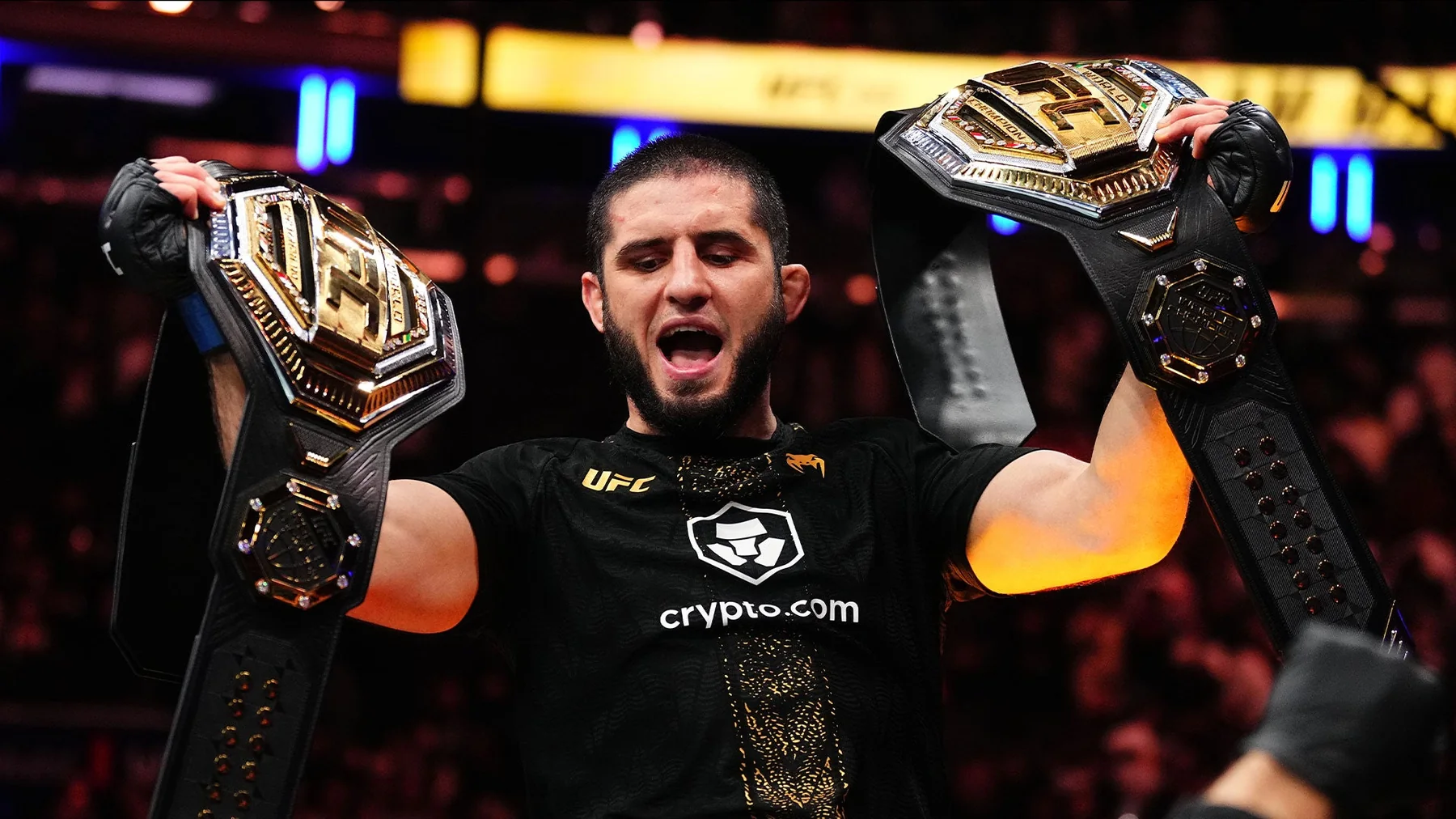
Islam Makhachev is the official men's pound-for-pound No. 1 on the UFC board dated August 25, 2026. Alexander Volkanovski and Petr Yan complete the Top 3. This is a current-performance ranking across weight classes, not a prediction that fighters of radically different sizes should face one another.
| Rank | Fighter | Division status on this snapshot |
|---|---|---|
| 1 | Islam Makhachev | Welterweight champion |
| 2 | Alexander Volkanovski | Featherweight champion |
| 3 | Petr Yan | Bantamweight champion |
| 4 | Justin Gaethje | Lightweight champion |
| 5 | Ilia Topuria | Former lightweight champion |
| 6 | Tom Aspinall | Heavyweight champion |
| 7 | Sean Strickland | Middleweight champion |
| 8 | Merab Dvalishvili | Former bantamweight champion |
| 9 | Alex Pereira | Former light heavyweight champion |
| 10 | Ciryl Gane | Interim heavyweight champion |
| 11 | Joshua Van | Flyweight champion |
| 12 | Khamzat Chimaev | Former middleweight champion |
| 13 | Alexandre Pantoja | Former flyweight champion |
| 14 | Arman Tsarukyan | Lightweight contender |
| 15 | Charles Oliveira | Former lightweight champion |
“Pound-for-pound” removes the advantage of natural body size and asks which fighter's results, skills and form travel best across divisions. It is therefore not a claim that Volkanovski could physically beat Aspinall. This August 25 list is the traditional media-panel P4P vote. UFC.com's separate All Meta Rankings view currently publishes divisional lists but no Meta P4P table, so weight-class sensitivity or any other model input cannot be used to explain these numbers. Our guide to how UFC rankings work explains the two products.
The status column is context, not a second ranking. Under UFC's published panel rules, champions can receive P4P votes; a contender can also appear above a champion from another class when the panel's aggregate ballots place them there. This article will compare quality and timing of results as editorial analysis, not reverse-engineer undisclosed voter reasoning or award automatic points for holding a belt. Recheck the same media-panel view after events because the dated order can change.
Why Islam Makhachev Is Still the Pound-for-Pound No. 1
The strongest editorial case for Makhachev at No. 1 is that his best skills translated to a higher division and his newest result reinforced that case. The panel publishes the aggregate rank, not a formula or a reason from every voter. Makhachev did not carry the 155-pound title into an abstract debate; he moved to welterweight, took the belt from Jack Della Maddalena, then defended it against the official No. 1 contender Ian Machado Garry.
Portability
Moving up meant facing longer, naturally larger welterweights. Makhachev still found takedown entries, maintained connections through scrambles and managed championship distance. Winning the belt in his 170-pound debut and then defending it is stronger P4P evidence than merely speculating that a style would travel.
Range of winning methods
His official profile lists 13 submission wins, but the current case is broader than grappling finishes. Against Garry, he had to negotiate long-range striking, failed entries and late-round decisions. A P4P leader should be able to change the route when the first route is difficult.
Current elite evidence
UFC 330 extended his Octagon streak to 17. More importantly for this article's analysis, it came against a ranked title challenger after championship wins over Oliveira, Volkanovski, Poirier and Della Maddalena. That weighs opponent, method and timing instead of treating the streak number as a panel formula.
The Garry defense also shows why credible P4P analysis should not read like a highlight reel. Official scores were 49-46, 49-46 and 48-47. UFC's recap says Garry landed the better strikes during portions of the fourth round, even as Makhachev returned to repeated takedowns. In the fifth, the champion put Garry on the canvas, took the back and held the position to the horn. That is a picture of adjustment under resistance, not effortless dominance.
After the win, Makhachev became only the fifth UFC two-division champion to defend titles successfully in both weight classes. That historical distinction supports the current ranking, but the latest five rounds matter more for this list: they show that his control, decision-making and endurance remain effective against today's contenders. Our UFC 330 result analysis breaks down the championship fight in greater detail. For the August 25 snapshot, no other candidate combines a fresher title defense, a longer active UFC streak and verified success across two divisions.
Ranks 2–6: Champions with Different Claims to the Top
Volkanovski owns the deepest current championship body of work in this tier, while Gaethje owns its most important fresh head-to-head result. Yan has restored himself by avenging a decisive loss, Topuria remains highly rated despite his first defeat, and Aspinall's finishing efficiency is balanced against a latest fight that produced no winner.
No. 2 Alexander Volkanovski
Volkanovski retained the featherweight title over Diego Lopes by unanimous decision at UFC 325, their second five-round meeting in ten months. His profile credits him with five defenses during his first reign. That volume of championship-round evidence—pace changes, pocket defense, takedown timing and corner-to-corner adjustment—gives him a broader current case than a single spectacular finish. His listed October 24 bout with Movsar Evloev can either strengthen that stability or redraw the top of the board.
No. 3 Petr Yan
Yan's strongest argument is correction. Merab Dvalishvili overwhelmed him over five rounds in 2023; Yan then rebuilt and won their December 2025 rematch by unanimous decision to reclaim the bantamweight belt. Avenging a stylistically difficult loss is powerful P4P evidence because it demonstrates adaptation rather than simple matchup comfort. A future third meeting listed by UFC means the claim is still testable, not permanently settled.
Nos. 4–5 Justin Gaethje and Ilia Topuria
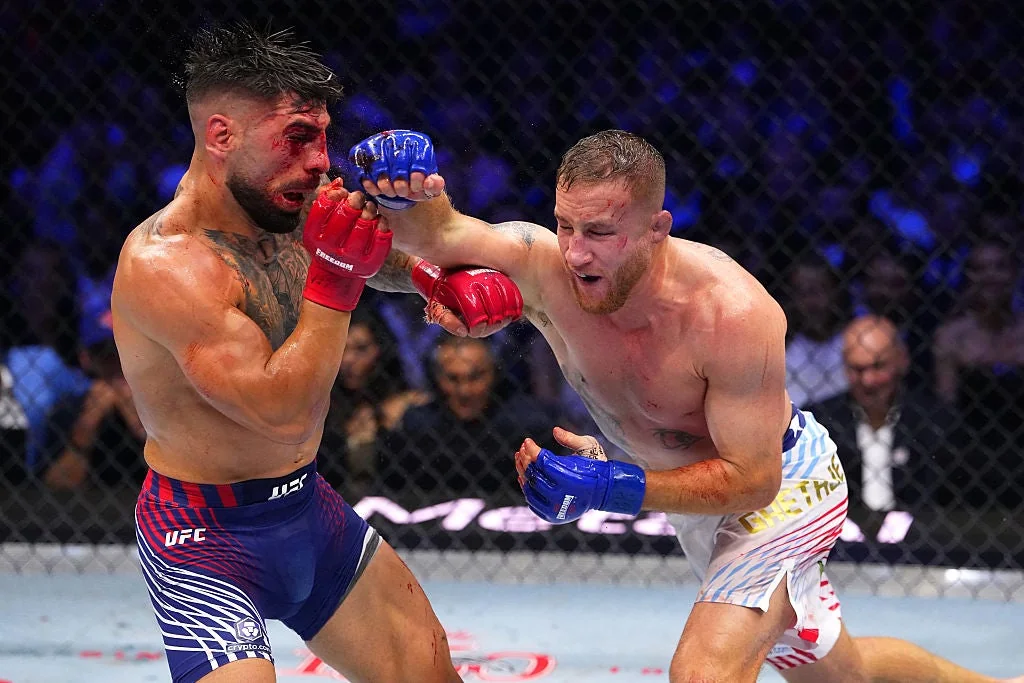
Gaethje's June 14 win carries exceptional recency and opponent value in this article's analysis. Topuria hurt him to the body and threatened submissions in Round 2, but Gaethje recovered, increased the damage and forced Topuria's corner to stop the contest after Round 4. It was Topuria's first professional defeat and delivered Gaethje the undisputed lightweight title. The media panel placed Topuria directly behind him. A reasonable editorial explanation is that Topuria's earlier knockouts of Volkanovski and Charles Oliveira still demonstrate transferable speed, accuracy and finishing pressure across two divisions; that is not a disclosed voter formula.
No. 6 Tom Aspinall
Aspinall's profile lists 14 first-round finishes and no decision wins, an extraordinary efficiency case for a heavyweight. The limitation is freshness: his October 2025 bout with Ciryl Gane ended in a first-round no contest after an accidental eye poke, so it provided no competitive resolution. His official placement is No. 6; editorially, another completed result would give analysts and media voters more current evidence than that unresolved bout.
Our editorial reading treats these positions as different balances of résumé depth and recent evidence. Volkanovski and Yan have answered championship questions over long fights; Gaethje just changed the lightweight hierarchy; Topuria has to show how he responds to defeat; Aspinall needs a conclusive return. Check the official UFC schedule before treating any listed next bout as fixed, because a ranking is a snapshot and a fight card can change.
Ranks 7–10: Elite Results, Different Kinds of Dominance
In this article's editorial assessment, Sean Strickland has the strongest fresh title result in this group, while Ciryl Gane has the clearest argument that the official order lags behind one direct result. Dvalishvili's historically productive 2025 and Pereira's championship success in two divisions remain relevant résumé facts. The debatable question—not a disclosed panel formula—is how quickly a new loss should outweigh that accumulated work.
| Rank | Fighter | Strongest current evidence | Live question |
|---|---|---|---|
| 7 | Sean Strickland | Split-decision title win over Chimaev | Can the defensive adjustments repeat? |
| 8 | Merab Dvalishvili | Three defenses in 2025 before losing to Yan | Can his pace win the tactical rematch? |
| 9 | Alex Pereira | Championship success at middleweight and light heavyweight | How heavily should the Gane stoppage count? |
| 10 | Ciryl Gane | Stopped Pereira at 1:27 of Round 2 | Will a resolved Aspinall fight follow? |
Strickland's title win was adjustment under pressure
Chimaev controlled the first round of UFC 328 with wrestling, but Strickland stuffed two early attempts in the second and created an unexpected spell of top control. Rounds 3 and 4 stayed standing: Chimaev landed the heavier individual shots while Strickland supplied more volume. In Round 5, Strickland escaped an early takedown and returned to work. The 48-47, 48-47, 47-48 cards confirm a narrow result, yet solving new phases across five rounds is legitimate P4P evidence.
Dvalishvili's loss does not erase an exceptional run
Dvalishvili defended the bantamweight belt three times in 2025 before Yan beat him over five rounds in December and ended his 14-fight streak. His pace, repeat takedown attempts and ability to force opponents to work remain elite traits. The panel placed him No. 8. Editorially, that spot can be defended through sustained production, while Yan's newer tactical answer should matter more than Merab's former status. Their listed third fight will provide cleaner comparative evidence.
Pereira above Gane is the tier's pressure point
Gane stopped Pereira at 1:27 of Round 2 at UFC Freedom 250 and won the interim heavyweight belt. On direct, recent evidence, Gane has the better result, yet the media-panel aggregate still places Pereira No. 9 and Gane No. 10. One possible editorial defense of Pereira is his title success at middleweight and light heavyweight during an attempt to win gold in a third class; UFC does not publish enough ballot detail to prove that is why voters chose the order. Fans are justified in challenging it: head-to-head recency favors Gane, while résumé breadth and prior opponent quality favor Pereira. The next panel update will show the new order, not a model's hidden processing.
Ranks 11–15: How Thin the Margins Become
In this article's editorial assessment, Joshua Van has the strongest fresh win in the bottom five, but the cutoff remains volatile because every fighter carries both elite evidence and an unresolved question. Van and Alexandre Pantoja have an injury-shaped first result to clarify. Khamzat Chimaev must respond to his first loss. Arman Tsarukyan and Charles Oliveira remain separated by a narrow head-to-head decision and different kinds of recent form.
No. 11 Joshua Van
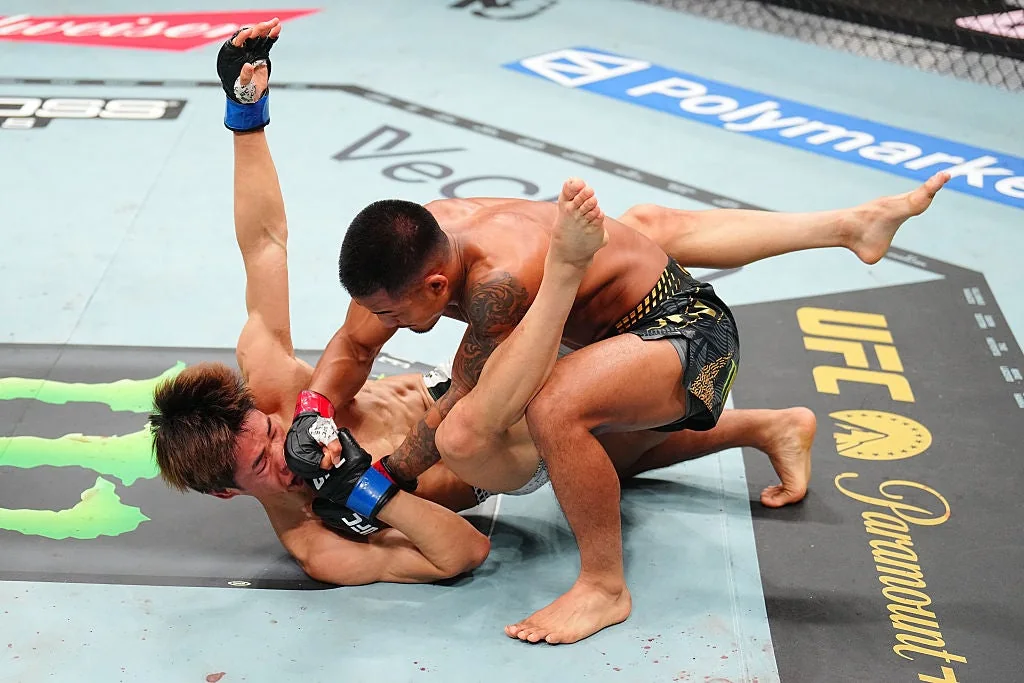
Van won the flyweight belt from Pantoja at UFC 323 in 26 seconds, but that official TKO followed an elbow injury when Pantoja braced a fall. It should not be rewritten as 26 seconds of complete technical separation. Van's next result answers a bigger P4P question: he worked into Round 5 against Tatsuro Taira and finished the challenger at 1:32, proving his offense can survive pace changes and championship duration.
No. 12 Khamzat Chimaev
Chimaev's first professional defeat was a 48-47, 48-47, 47-48 split decision, not a one-sided collapse. He controlled Strickland with wrestling in Round 1 and landed the heavier single strikes in portions of the stand-up fight. Yet P4P status is current: the later failed takedowns, escapes conceded and volume differential give future opponents a tested route. He retains elite value while needing a new win.
No. 13 Alexandre Pantoja
Pantoja entered the Van fight after four title defenses, so his position reflects far more than the injured elbow that ended his reign. The clean analytical question is whether he can reproduce his pressure grappling and durable pocket work against the faster champion when the bout develops normally. A scheduled rematch offers resolution; until then, Van's successful defense deserves the higher spot.
Nos. 14–15 Arman Tsarukyan and Charles Oliveira
Tsarukyan owns the direct win, a split decision over Oliveira at UFC 300, and followed it by submitting Dan Hooker with an arm-triangle at 3:34 of Round 2. His profile lists five straight wins. Oliveira answers with historic depth—UFC records for 17 submissions and 21 finishes—and current form: a submission of Mateusz Gamrot followed by a five-round unanimous decision over Max Holloway in March. Tsarukyan's head-to-head result justifies the order; Oliveira's activity keeps the gap thin.
This boundary is not a lifetime-achievement queue. Van can strengthen his case by resolving Pantoja without an injury caveat. Chimaev can rebuild by showing that the Strickland adjustments were specific to one night. Pantoja can improve his case in the rematch. Tsarukyan's listed fight with Mauricio Ruffy can add current evidence, while Oliveira must keep beating current contenders rather than rely on records. Because the panel positions are tightly packed, one elite result could influence several future ballots—but UFC publishes no formula guaranteeing the size of a move.
How Fans Should Use—and Challenge—the P4P List
Use the official P4P board as a dated media-panel benchmark—not as an answer that ends analysis. UFC publishes the aggregate order and panel eligibility rules, but not one uniform formula or the reasoning behind every ballot. The separate mathematical Meta rankings currently cover divisions and do not publish a P4P list. Questions about opponent, method, date and cross-weight translation below are therefore a transparent way to analyze the panel result, not inputs attributed to a nonexistent P4P model.
- 1. Check the date before the number. UFC says the rankings are recalculated after official events and updated by the following Monday. A major Saturday result can therefore be newer than the visible board for a short window. This article's order is explicitly the August 25 snapshot.
- 2. Compare opponent quality, not just streak length. Beating a Top-5 contender carries more value than beating an unranked opponent. A 10-fight streak can be less informative than three championship wins if the opposition, stakes and performance levels are different.
- 3. Examine method and phase. A finish matters, but context matters too. Van's 26-second win over Pantoja involved an elbow injury; his fifth-round finish of Taira supplies cleaner evidence of sustained championship quality. Strickland's narrow decision over Chimaev shows specific defensive adaptations that a win/loss label cannot describe.
- 4. Test weight-class translation. Natural size is removed conceptually, not physically. Ask whether pace, accuracy, grappling control and decision-making have worked against elite opposition with different dimensions. Makhachev's actual move from lightweight to welterweight offers more evidence than a hypothetical claim that a fighter “could” move up.
- 5. Make a specific challenge. “Gane should be above Pereira because he stopped him in Round 2 two months ago” is an evidence-based disagreement. “My favorite is better” is not. A useful challenge names the result, date and opponent, then explains why the published panel order gives too much or too little practical weight to older résumé value.
Current P4P is not a GOAT ranking
For this article's current-ranking analysis, older results and long inactivity receive less emphasis; that is an editorial standard, not a published rule governing every media ballot. A greatest-of-all-time discussion asks a different question: it evaluates full-career longevity, title-fight totals, records, era depth and how a résumé holds up after the career ends. Charles Oliveira's historic finish records strengthen his legacy, but they do not automatically place him over a fighter with a fresher elite win today. Makhachev's current No. 1 position strengthens his all-time case, but it does not settle every comparison with retired greats.
For that separate career question, see our analysis of the greatest UFC fighters of all time. For this list, our narrower editorial standard is current opponent quality, current method, current form and credible cross-weight translation. That approach lets fans report the official media-panel board accurately, question it intelligently and update their own view when the next fight supplies better evidence.
Fight talk
Comments