
What are the UFC weight class limits?
The UFC currently has 11 sex-specific competitive divisions across nine named weight classes, from women's strawweight at 115 pounds to men's heavyweight at 265 pounds. The two counts are different because flyweight and bantamweight each have men's and women's divisions. The table below is the practical scale reference as of August 19, 2026.
| UFC division | Title maximum | Approx. kg | Usual non-title maximum |
|---|---|---|---|
| Women's strawweight | 115 lb | 52.2 kg | 116 lb |
| Men's flyweight | 125 lb | 56.7 kg | 126 lb |
| Women's flyweight | 125 lb | 56.7 kg | 126 lb |
| Men's bantamweight | 135 lb | 61.2 kg | 136 lb |
| Women's bantamweight | 135 lb | 61.2 kg | 136 lb |
| Men's featherweight | 145 lb | 65.8 kg | 146 lb |
| Men's lightweight | 155 lb | 70.3 kg | 156 lb |
| Men's welterweight | 170 lb | 77.1 kg | 171 lb |
| Men's middleweight | 185 lb | 83.9 kg | 186 lb |
| Men's light heavyweight | 205 lb | 93.0 kg | 206 lb |
| Men's heavyweight | 265 lb | 120.2 kg | 266 lb |
Read “title maximum” literally. A fighter in a 155-pound lightweight championship bout must be 155 or below; the familiar one-pound allowance normally applies only to a non-title contest and can depend on the bout agreement and regulator. That is why a weigh-in result of 156 can be compliant for one lightweight fight but overweight for another. The next section explains that distinction rather than treating the extra pound as an unconditional UFC-wide entitlement.
These figures are weigh-in ceilings, not target everyday weights and not guaranteed cage-night weights. Athletes commonly rehydrate after making the official scale, so a broadcast graphic showing “155 lb” identifies the division more reliably than the fighter's mass when the Octagon door closes. The kilogram values are rounded conversions of the pound limits, while official U.S. event results are normally reported in pounds. Where men and women share a label, they share the same scale ceiling; they remain separate competitive divisions with separate rosters, rankings and championships. Sex-specific rows therefore describe who competes together, not a different mathematical conversion.
UFC divisions are not the entire MMA rulebook.
Athletic commissions may recognize atomweight, super heavyweight or intermediate classes that the UFC does not currently promote. Conversely, UFC's absence of a current women's featherweight ranking is a dated roster fact, not proof that the promotion could never use that class again. Always separate a regulator's permitted class list from the divisions visible on UFC's current roster and rankings.
Why is there a one-pound allowance in non-title fights?
The extra pound is a commonly permitted tolerance in a non-title bout agreement; it does not raise the division's official championship limit. UFC cards therefore often accept 156 pounds for a non-title lightweight contest, while a fighter competing for the 155-pound title must weigh 155 or less.
Non-title lightweight
Usual maximum: 156 lb. A reading of 155.5 or 156 can be compliant when the contract and supervising commission allow the standard one-pound tolerance.
Lightweight title fight
Maximum: 155 lb. A reading of 155.5 is over the championship ceiling even though the same number would fit an ordinary non-title lightweight bout.
The decimal is not what decides the result. Ask three questions in order: Is a UFC championship at stake? What maximum appears in the bout agreement? What has the athletic commission approved? Nevada's official event FAQ, for example, permits one pound over the listed contractual weight but identifies two exceptions: a championship requirement and a contract marked MAX. A regulator in another jurisdiction remains the authority for the event it supervises.
This distinction also explains why a card can list two fighters under the same 155-pound division when one weighs 155 and the other 156. They have not entered a 156-pound division. They have made a lightweight non-title contract with limited tolerance around the divisional ceiling. At heavyweight, the same familiar practice produces a usual non-title maximum of 266 rather than creating a separate class above 265.
Do not turn the allowance into a guarantee or a target. A promoter can put a stricter maximum in the agreement, and title eligibility always demands the exact championship number. The safest way to read a weigh-in is to compare the result with that bout's announced status and official ruling, not with a generic chart alone.
How do official UFC weigh-ins work?
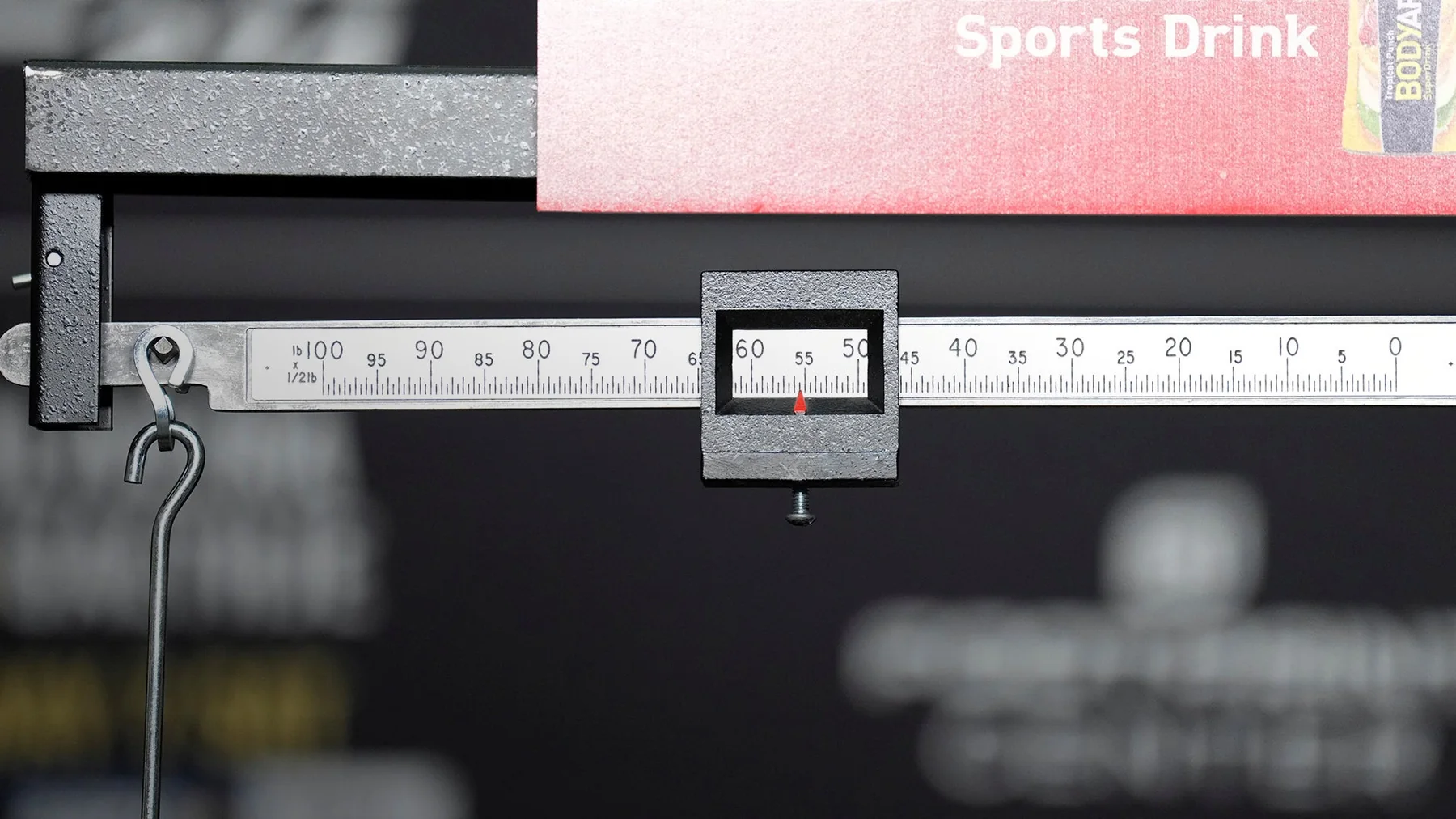
The official weigh-in is the regulated session that creates the weight of record; the later stage pose and faceoff are ceremonial. UFC commonly holds the official session the day before the fight, but the host athletic commission controls the scale procedure, timing and response to a miss in its jurisdiction.
- 1. Licensing and identity are checked. Requirements vary, but a commission may verify the athlete's license, government photo identification and required medical paperwork before allowing competition.
- 2. The athlete uses the official scale. In Nevada, the commission's inspector must approve an appropriately calibrated scale, and commission and promoter representatives are present for the regulated weighing.
- 3. The result is recorded against the contract. Officials compare the number with the title or non-title maximum. UFC's official results page then gives fans the weight beside each scheduled bout.
- 4. Any miss receives an event-specific ruling. The commission may permit another attempt when its rules allow, but an extra hour is not automatic. The bout, medical clearance and contract remain subject to official review.
A common UFC window is around 9–11 a.m. local time, yet that is a planning pattern rather than a universal statute. International events and different U.S. commissions can use other arrangements. Check the current event's official notice instead of assuming that last week's clock or retry rule carries over. Our UFC Fight Night guide places the weigh-in within the rest of event week and card preparation.
The ceremonial show serves a different purpose: introductions, a dramatic scale pose, final faceoffs and fan media. The announced number normally comes from the earlier official process; the stage appearance does not grant a fresh contractual attempt. If a clip seems inconsistent, trust the commission/UFC official result and any written miss notation rather than estimating weight from a decorative scale or an announcer's timing.
What happens when a UFC fighter misses weight?
A UFC weight miss does not trigger one automatic outcome. The fight may continue under revised terms, title eligibility may change, part of the heavier athlete's purse may go to the opponent, or the bout may be canceled. The opponent and promotion can negotiate, but the athletic commission must approve a contest it regulates.
- 1. Confirm the final official number. A first reading is not always the final ruling if that jurisdiction allows another attempt. Wait for the completed official result.
- 2. Check medical and commission clearance. A regulator can reject a matchup on safety grounds even when both athletes say they want to proceed.
- 3. Ask whether the opponent accepts revised terms. If the opponent agrees and the commission approves, the contest can continue at an agreed catchweight rather than its original maximum.
- 4. Read the purse and title ruling. The notice should identify any forfeiture and recipient, plus who remains eligible to win a belt.
- 5. Reconfirm the card. A bout is not safely assumed on until UFC and the regulator leave it scheduled after the negotiations and medical review.
Percentages vary. At UFC 328 in May 2026, UFC's official page recorded Jeremy Stephens at 160 pounds for a lightweight bout and said he forfeited 30% of his purse to his opponent. Nevada's written rule provides a 25% forfeiture unless its representative sets a lesser approved amount. Those examples prove why “fighters always lose 20%” or any other fixed number is unreliable.
Championship stakes add a separate layer. Charles Oliveira's 155.5-pound reading before UFC 274 exceeded the exact lightweight title limit. The event proceeded, but the belt situation changed: Oliveira could not retain or win the championship, while Justin Gaethje remained eligible. That dated case illustrates a possibility, not a shortcut for every title miss. The controlling answer is the official event ruling, including whether the champion or challenger missed.
For fans, the key is sequence. Do not stop at the scale number. Look for the final weight, commission approval, opponent agreement, purse notation, championship language and an updated card. Until all six are clear, a social post saying “fight still on” is incomplete.

What is a catchweight bout?
A catchweight bout uses a specifically agreed scale maximum outside the standard limit for that one contest. It can be planned before fight week or negotiated after someone misses the original weight, but it does not create a new UFC division, ranking or championship.
Standard division bout
A non-title welterweight normally uses the 170-pound division and its usual one-pound tolerance, subject to the contract and commission.
Planned catchweight
Both sides contract for a number such as 163 pounds in advance, and the regulator reviews whether the matchup remains fair, safe and competitive.
Post-miss catchweight
The parties revise the original terms after a miss. The official record can still note the miss and any purse consequence even if the bout proceeds.
Agreement between fighters is only part of the process. The athletic commission supervising the event can review the actual difference between them, medical information and its maximum-spread rules, then approve or reject the contest. The Association of Boxing Commissions' committee report uses 163 pounds as an example but expressly leaves approval to commission discretion. Nevada likewise places MMA under commission authority and makes its standard class schedule subject to approved exceptions.
The label also does not answer whether the arrangement was routine or caused by a miss. Read the event note. “Contracted catchweight” signals a planned maximum; “fighter missed weight, bout proceeds at catchweight” signals a revision. In the second case, calling the fight catchweight does not erase the original failure or guarantee that the opponent received a particular percentage.
Finally, do not automatically add one pound to a catchweight. The written maximum controls. If the agreement says 163, fans should wait for the official ruling before assuming 164 is acceptable.
Which UFC divisions are active for women?
As of August 19, 2026, UFC's current structure has three active women's divisions: strawweight, flyweight and bantamweight. Those are the women's categories shown in the promotion's current division previews and rankings structure. The date matters because UFC can change its roster and championship framework.
| Current women's division | Maximum | What the number means |
|---|---|---|
| Strawweight | 115 lb | Exact title-fight ceiling; up to 116 in an approved non-title bout. |
| Flyweight | 125 lb | Exact title-fight ceiling; up to 126 in an approved non-title bout. |
| Bantamweight | 135 lb | Exact title-fight ceiling; up to 136 in an approved non-title bout. |
Women's featherweight needs a historical qualifier. UFC officially introduced a 145-pound women's championship division in 2016, and its records preserve that title lineage. However, the current UFC rankings and athlete-division navigation do not present women's featherweight as an active ranked championship category at this cutoff. That is more precise than saying the class never existed or can never return. A future 145-pound bout, or even a revived division, would require a new current-status check.
This current-versus-historical distinction prevents two common errors. An archived championship page is evidence that the title existed, not proof that it remains open today. Conversely, the absence of a current rankings table describes the promotion's present structure; it is not a rule banning every woman from competing at that weight under separately approved terms.
“Active division” also does not mean every eligible athlete is ranked. A fighter may compete at 115, 125 or 135 without appearing in the top 15, while a rankings table can change after an event. Eligibility identifies where an athlete can compete; a rank describes that athlete's current place among eligible contenders. For a weigh-in, use the contracted division and title status to choose the limit; do not use a ranking number, an old featherweight graphic or a one-off catchweight label as a substitute.
How should fans read a UFC weigh-in result?
Read an official UFC weigh-in result as a status update, not just a pair of numbers. The bout label determines the applicable ceiling, while the latest note tells you whether a miss changed the money, championship eligibility or the card itself.
- 1. Identify the contracted category. Confirm whether the listing says title bout, interim title bout, ordinary divisional bout or catchweight. Do not infer the category from a fighter's usual division.
- 2. Apply the right ceiling. A UFC title bout requires the exact division maximum. A standard non-title divisional bout generally allows one extra pound. A named catchweight uses its written number.
- 3. Compare both recorded weights. Check each athlete separately. One legal number does not cure the opponent's miss, and being lighter than the maximum is not an error.
- 4. Read every symbol and update. An asterisk can carry the decisive ruling: above-limit amount, purse forfeiture, revised catchweight, title eligibility or additional-time status.
- 5. Recheck whether the bout remains scheduled. “Proceeds as scheduled” is stronger than an early scale clip. A separate medical or regulatory issue can still cancel a bout after a fighter records a legal weight.
- 6. Separate fight-week status from the final record. After the event, use the official result and commission record to confirm that the contest occurred, who won and how. A weigh-in page is not a result.
UFC 324 supplies a useful worked example. Its official listing labeled the main event an interim lightweight title bout, so 155—not 156—was the relevant maximum; the posted weights were 155 and 154. Elsewhere on the card, a 138.5-pound bantamweight reading required the footnote explaining a miss, a 25% forfeiture and that the bout would proceed. Another fight was canceled for a medical issue despite its weight listing. Three different conclusions came from reading the labels and updates, not the numbers alone.
Save this rule:
Title = exact limit. Standard non-title = usual one-pound allowance. Catchweight = written agreement. In every case, the latest official footnote and card status control what fans should report.
For live updates, start with UFC's official weigh-in page and the host commission's ruling. Refresh after the window closes and note the update time before sharing a screenshot. After fight night, move to the official result or scorecard record; our UFC 330 results recap shows the different questions a postfight record answers. This source order prevents an early social post from becoming a false final verdict.
Fight talk
Comments